PUNCH
by James Graham; based on the book Right From Wrong by Jacob Dunne
directed by Adam Penford
The Young Vic, London – until 26 April 2025
running time: 2 hours, 25 minutes including interval
https://www.youngvic.org/whats-on/punch
Something authentically remarkable happens in the second half of this new James Graham play, probably his most emotionally charged to date. Punch is a distillation of Right From Wrong, Jacob Dunne’s autobiographical account of a criminal youth stemmed by a manslaughter conviction and culminating in an astonishing rehabilitation. There’s a heartstopping moment in act two where we watch David Shields’s guilt-ridden, awkward, barely articulate Jacob tentatively but definitively blossom into somebody with a positive future under the steady, forgiving gaze of the parents of the young man whose life he accidentally ended with a fatally aimed sole punch to the head. The detailed subtlety of Shields’s work against the stoic warmth of Julie Hesmondhalgh and Tony Hirst as the pair of humans who are entitled to vengeful fury but instead choose an entirely different path quietly takes the breath away and elevates Graham’s writing and Adam Penford’s staging, already both quite wonderful, into the stratosphere.
No contemporary playwright can beat Graham when it comes to state-of-the-nation narratives onstage and if Punch doesn’t feel as epic as say Dear England or This House, it provides, with humour and sparky theatricality, a clear roadmap of the social deprivations and conditions that drive a restless working class youngster into petty crime and gang membership. At least, that’s the first half which plays out like a Nottingham-accented stage version of Shameless as Dunne, in a group therapy session, relives his early life in the hardscrabble Meadows Estate, with his scally mates, his well meaning but alcohol abusing single mum and his sullen younger brother.
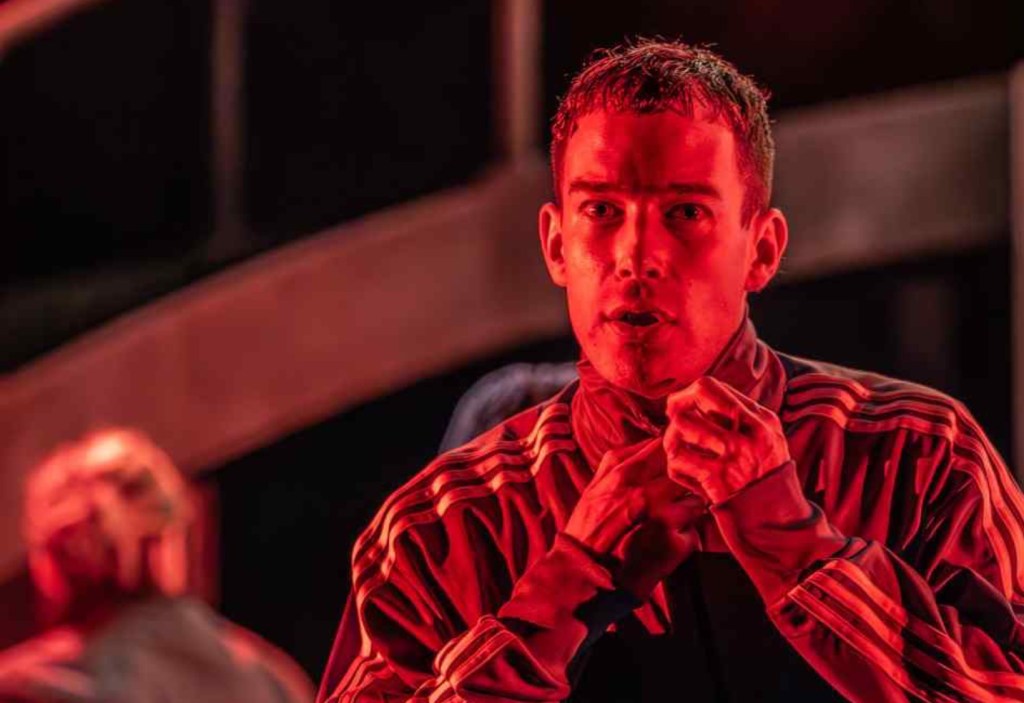
Jagged and episodic, it has the ring of savage truth, undoubtedly because it’s culled from Dunne’s actual lived experience. It’s tremendously watchable, staged with genuine panache by Penford and his movement associates Leanne Pinder and Lynne Page, underpinned by Alexandra Faye Braithwaite’s electronica score. In a towering performance, Shields impressively manages the transitions between cocky, wired youth through withdrawn disaffection to maturity and gravitas, his physicality and voice unerringly conveying which stage of life the man we are looking at is in.
It’s the second act though where the play moves into a more fascinating zone as the consequences of Jacob’s actions are subverted by the sheer kindness and almost superhuman grace of Joan and David, the parents of Michael Hodgkinson, whose life support machine was turned off nine days after the fateful punch outside a Nottingham night club. This production is dedicated to Michael’s memory which is a fitting tribute to the young paramedic if no substitute for him living out his full lifespan.
This second half is extremely moving, all the more so for the lack of histrionics. Graham is too good a writer to make Joan and David into beatific saints, investing them with a questioning humanity that sears as much as it heals. Note the way David states he won’t shake Jacob’s right hand as that is the one he hit Michael with, and you’ll have a hard time getting over the look on Joan’s face as she listens to saved mobile messages from her deceased son. It’s hard to think of another actor as adept as Hesmondhalgh at conveying an innate goodness that never cloys, tempered with direct, warm humour, and Hirst complements her as a man bewildered both by his own feelings and the warm glow of forgiveness emanating from his beloved wife.
For all the truth and brilliance of the performances, if this weren’t a true story, one might have trouble buying that these people could find such kindness in their hearts, but it’s couched here with such sensitivity and intelligence that instead of incredulity you just find yourself sitting there strangely elated and with tears pouring down your cheeks. Graham’s dialogue is gritty, accessible – sentences get jumbled up or go unfinished as characters try to articulate a myriad of conflicting thoughts- and feels entirely credible.
The acting throughout is magnificent, rooted in truth rather than theatrical grandstanding, each of the performers apart from Shields playing multiple roles. Emma Pallant is so touching as Jacob’s troubled mother and then is a spiky joy as his nice but tough social worker (“you’re on the housing list, but it’s a very long list and there’s no housing”) who bemoans that the local councils seem to favour potholes over people when it comes to fixing what’s broken. There’s equally memorable work from Alec Boaden and Shalisha James-Davis as a bunch of contrasting figures in our anti-hero’s troubled life.
Anna Fleischle’s unit set of a metallic bridge atop a forbidding looking tunnel evoking the walkways and no-go zones of soulless urban estate planning is almost aggressively ugly, which feels about right. By contrast, Robbie Butler’s stunning lighting runs the full gamut from stark to fantastical, conjuring up detention centres, intimidating corridors, dancefloors, churches and dark nights of the soul with technical virtuosity.
Punch is a play about healing, and forgiveness. It’s refreshingly non-preachy and well alive to the flaws in a social system that can so easily write people off, while also acknowledging that there are solutions, some of which are not readily obvious. It also pulls no punches (pun intended) in depicting the dangers of wreckless violence. Ultimately though, it presents the finest of humanity, celebrating how kindness and compassion can genuinely turn around an existence that seemed to have gone to the bad. Provocative, life-enhancing theatre.
 ajhlovestheatre
Leave a comment