ALTERATIONS
by Michael Abbensetts, additional material by Trish Cooke
directed by Lynette Linton
National Theatre/Lyttelton, London – until 5 April 2025
running time: 1 hour 50 minutes, no interval
https://www.nationaltheatre.org.uk/productions/alterations/
The space where a play takes place is important. The late Sheridan Morley, theatre critic of Punch and International Herald Tribune, once opined that the Piccadilly (currently home to Moulin Rouge) was such an unsympathetic venue that any show not solid enough to be successfully performed on a busy railway station platform, should never play there. The National’s Lyttelton Theatre isn’t as tricky as that, but it’s the least forgiving of the three South Bank houses, lacking the intimacy of the Dorfman and the imposing uniqueness of the Olivier. I was reminded of Morley’s words watching this sparky, rediscovered 1978 comedy drama by British Guyanese author Michael Abbensetts in the NT’s proscenium house and thinking how much better it would play round the corner in the Dorfman.
The Lyttelton doesn’t quite swallow Alterations whole, but the sheer size of it means it’s harder work to connect with Abbensett’s vibrant characters and Lynette Linton’s staging than it should be. While the play isn’t truly an overlooked classic, it has a lot to commend it, particularly a free-wheeling humour that surprises and delights, and a thoughtful undertow of seriousness.
It’s certainly not that Linton, one of the most consistently brilliant directors of her generation, can’t master the space, as her uniformly acclaimed 2022 revival of Blues For An Alabama Sky on this very stage proved, but Alterations is a very different kind of play. Although its themes are epic (the experience of Guyanese immigrants coming to late twentieth century UK and their efforts to assimilate and to forge successful futures for themselves sometimes in the face of open racism), its physical scale is small.
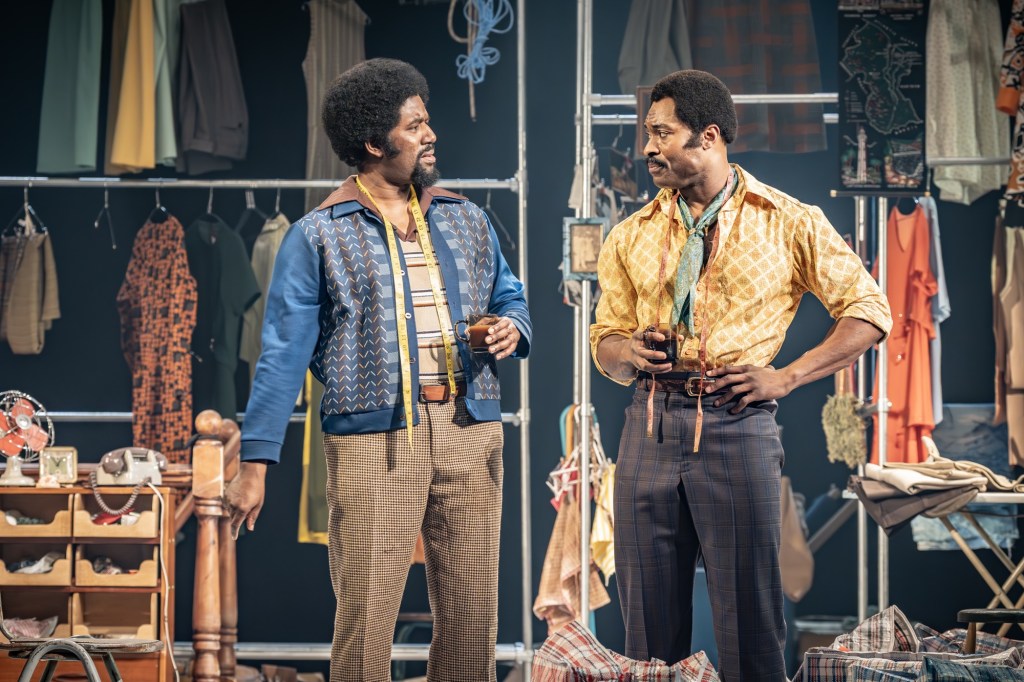
There’s really only one set (the clothing alterations shop of ambitious Guyanese Walker Holt, who projects for himself a future as a high end bespoke tailor, realised in an elaborate but superfluous dream sequence) and Linton and her designer Frankie Bradshaw do as much to open up the piece as possible, blasting it with music (fabulous, reggae-infused work by XANA, another of the director’s regular collaborators), mood-shifting lighting (Oliver Fenwick) and atmosphere. The dinginess and the unease of working class ‘70s London is accurately evoked, as is its vitality and urgency. With moments of stylised movement, a perpetually revolving set and rails of colourful garments flying in and out, it’s certainly striking theatre-making but it sometimes feels more borne out of a need to fill the space rather than to really serve a six character script.
As often with Linton’s work, it’s the detail in the relationships and the pinpointing of humour springing organically from the characters and their situations that is so impressive. The edgy dynamic between Arinzé Kene’s Walker and Horace (Karl Collins, gloriously louche and surprisingly sensitive), the flamboyant, upwardly mobile frenemy with designs on his wife, is superbly done. Cherrelle Skeete as said wife Darlene turns in a beguiling, multi-layered study of a woman whose natural exuberance and formidable strength is under constant attack from disappointment and exasperation at the unreliability of the principal man in her life.
There’s an absolute peach of a performance from Gershwyn Eustache Jnr as Buster, Walker’s co-worker constantly waiting on the phone for news from the hospital where his wife is about to give birth. Eustache Jnr is a natural clown, able to wring irresistibly funny business out of things as simple as asserting his right to a coffee break or passing round the celebratory liquor. It’s an endearing performance steeped in pathos: his reaction to the long awaited birth when it finally happens is a beautiful, heartwarming thing. A hugely likeable Raphel Famotibe brings a very different energy as Courtney, the second generation kid who’s now as much a Londoner as he is Guyanese, and who floats the interesting idea that the difficulties the older men have with fitting in are as much a generational as a racial issue. There’s fine work too from Colin Mace as Mr Nat, a moneyed white immigrant better able to assimilate in less enlightened times by dint of his skin colour.
Walker as a central character is a curious one. While his desires for betterment and the attendant frustration is easy to understand, it’s harder to feel sympathy for a man who isn’t just a terrible husband to Skeete’s magnificent Darlene but is also giving another (unseen) woman the runaround. An almost unrecognisable Kene invests him with a manic edge but ultimately the actor’s personal charm and charisma is doing a lot of the heavy lifting.
Abbensett’s script, with additional material by Trish Cooke, is racy and witty, shifting seamlessly between Caribbean patois and conventional English, the frequently gorgeous dialogue bouncing off the stage with a crowd pleasing vivacity. If it’s essentially all talk and little action, it provides an arresting snapshot of a moment in time, and Linton’s inclusion of a non-speaking Windrush generation couple and a cucumber cool modern day youngster usefully contextualises it within the history of Black Britons. There’s a lot here to love and to think about, but I can’t help feeling most of it would pop and focus so much more satisfyingly in a smaller house.
 ajhlovestheatre
Leave a comment