THE LAST LAUGH
written and directed by Paul Hendy
Noël Coward Theatre, London – until 22 March 2025
running time: 80 minutes no interval
https://thelastlaughplay.co.uk
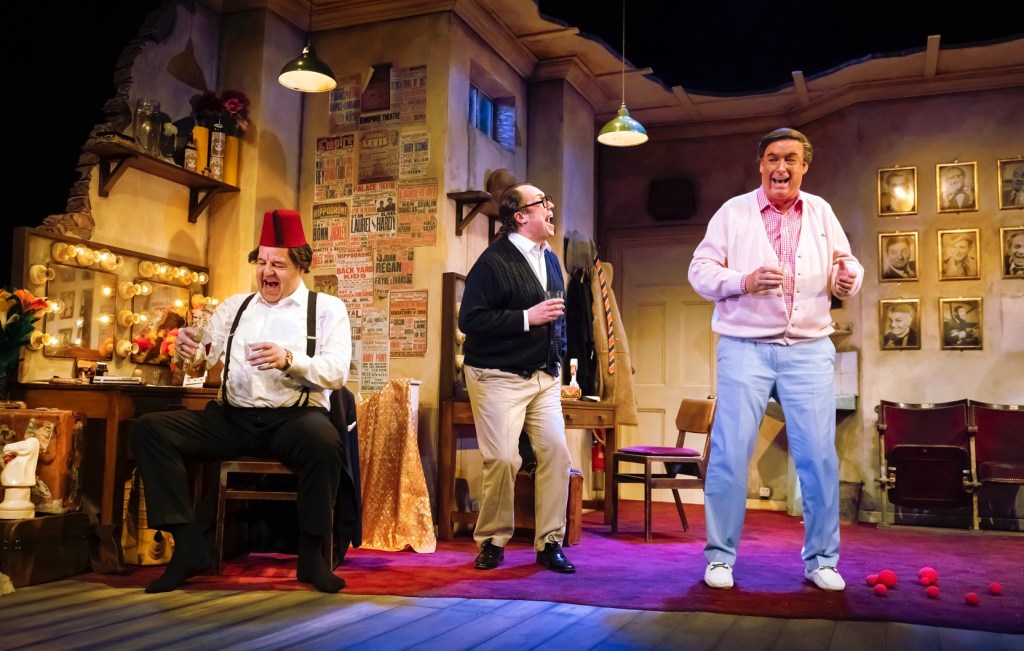
The basic format of Paul Hendy’s delightful play, based on his 2016 film of the same name and a smash hit at last year’s Edinburgh Festival, would seem to be quite simple: a trio of British comedy all-time greats (Tommy Cooper, Bob Monkhouse, Eric Morecambe) hang out in a dressing room shooting the breeze about their craft, careers and personal lives. It’s an opportunity to resurrect some of the most inspired gags and routines from these beloved titans of mirth, and the show does indeed buoy up its enraptured audience on a warm sea of helpless laughter.
But The Last Laugh goes a little deeper than that: the clues are there from the outset in the way that the dressing room mirror lightbulbs sputter and flicker, in the ghostly soundtrack of a distant audience roaring with joy, and the way that the first comedian we encounter, Damian Williams’s gorgeously realised Cooper, materialises out of darkness. It quickly becomes clear that the three men aren’t just reliving their past glories and providing mutual support in the face of demanding schedules and a tough business; each of them is preparing for what will be their final live performances, magically connected for the purposes of this play but in reality several years apart and in different locations, literally ‘the last laugh’.
This lends a poignancy to the merriment, and elevates what could otherwise have been a series of riotous sketches and uncanny impersonations into something truly special. Watching The Last Laugh is like receiving a warm hug immediately cooled by a brief icy breeze. Anybody who grew up with these comedians will adore this, but equally it’s required viewing for any younger people with a genuine interest in the history of comedy.
Bob Golding (Morecambe), Simon Cartwright (Monkhouse) and the aforementioned Williams are so good and so accurate that the show is almost as eerie as it is hilarious. Almost. Golding nails Morecambe’s off-the-wall joie de vivre and musicality while Williams brilliantly hints at the gleeful curmudgeon that lurked beneath Cooper’s endearingly bumbling exterior, along with his permanent sense that everything is about to go heroically, hysterically wrong. Cartwright beautifully suggests that Monkhouse was perhaps, under the debonair-borderline-smarmy persona, the sweetest of the three. He was certainly the most analytical of the trio when it came to appreciating their craft, and his working knowledge not just of the jokes but of who wrote them make him an easy target for the other mens’s affectionate mockery.
It’s Monkhouse here that makes the interesting observation that he differs from the other two because they are innately funny human beings whereas he just tells jokes well. All three actors transcend mere impersonation to create fully rounded characters, but with joyously familiar vocal tics and body language. They are simply astonishing.
Hendy directs with a commendable lightness of touch and a laser sharp precision. He has also done an inspired job of melding the anecdotes, comic schtik and familiar routines (there are even a couple of songs) into a coherent stage play. There’s zero dramatic conflict in what is essentially a celebration of three iconic talents. Some of the inclusion of biographical details feels a little clunky, and the writing loses momentum when the three men start to bemoan the difficulties of being in showbiz at their level. That said, Morecambe’s description of the addictive, exhilarating nature of making people laugh, citing one particularly successful instance, remembering the audience response itself yet not being able to recall the location or the joke told, isn’t funny in itself but serves as a piercing indictment of what makes funny people tick.
Lee Newby’s dressing room set and Johanna Town’s lighting are so atmospheric you can almost smell the greasepaint and the dust. As a whole, The Last Laugh is more on-the-nose than the phenomenally successful The Play What I Wrote which conjured up Morecambe and Wise in a more impressionistic way than what Hendy and gang are attempting here. The impersonations are phenomenally good but the humanity behind the comedy genius is potently evoked in all three cases. It’s perhaps a rather slight piece but it is a wonderfully enjoyable one, and nostalgia has seldom felt so seductive or so uplifting.
 ajhlovestheatre
Leave a comment