EAST IS SOUTH
by Beau Willimon
directed by Ellen McDougall
Hampstead Theatre, London – until 15 March 2025
running time: 100 minutes, no interval
https://www.hampsteadtheatre.com/whats-on/2024/east-is-south/
With the intriguingly named East Is South, American writer Beau Willimon successfully parlays technology (specifically AI), religion, superstition and humanity into a snappy thriller. It may not be High Art but it’s engrossing popular entertainment, feasible enough to be gripping but (hopefully) not so nightmarishly prescient that it’ll keep you awake at night.
Best known here for the US edition of TV’s House Of Cards, author Willimon’s sole Broadway credit to date is the Uma Thurman vehicle The Parisian Woman and, as someone who bore witness to that wan mess, I approached this world premiere with something like trepidation. As it turns out, I needn’t have worried: East Is South is an infinitely more interesting and engaging piece and, for the most part, Ellen McDougall’s oil-smooth production is very well acted.
The beginning isn’t promising, to be fair, with a bunch of impenetrable techy phrases being hurled around as a coder is interrogated over a possible malfunction or transgression concerning a mind bogglingly sophisticated AI creation. Stick with it though as it’s merely set-up for a story, told partially in flashback, that has a cumulative, and affecting, human interest and asks some genuinely fascinating questions about how both technology and authority impact on our lives, and whether God is real or something which we’ve created to help make sense of the mess of the universe.
In a series of intense, terse scenes we see lovers and co-workers American Lena (Kaya Scodelario, best known for her extensive screen work but here making an impressive stage debut) and Russian Sasha (Luke Treadaway, superb and fielding a creditable hybrid accent) being questioned. Their interrogators make a classic ‘good cop-bad cop’ pairing with Nathalie Armin’s reasonable, kind but firm Dr Darvish contrasting pleasingly with the simmering aggression of Alec Newman’s bullish, steely Olsen (“I’m not the smartest guy but I’m smart enough to know that”).
Willimon gives us tantalising glimpses of Lena and Sasha’s lives before they were submerged in the murky waters of highly sensitive, life changing tech work. She grew up in a religious cult (Newman also doubles, chillingly, as the Pastor father who disowned her) while Sasha is a polymath cultural expert. There’s a particularly striking, not to say downright horny, sequence where he seduces her while commentating on the music of Bach. The play’s principal intrigue comes less from its preoccupation with the chaos and/or influence on humanity than on the questions of who is manipulating how in these
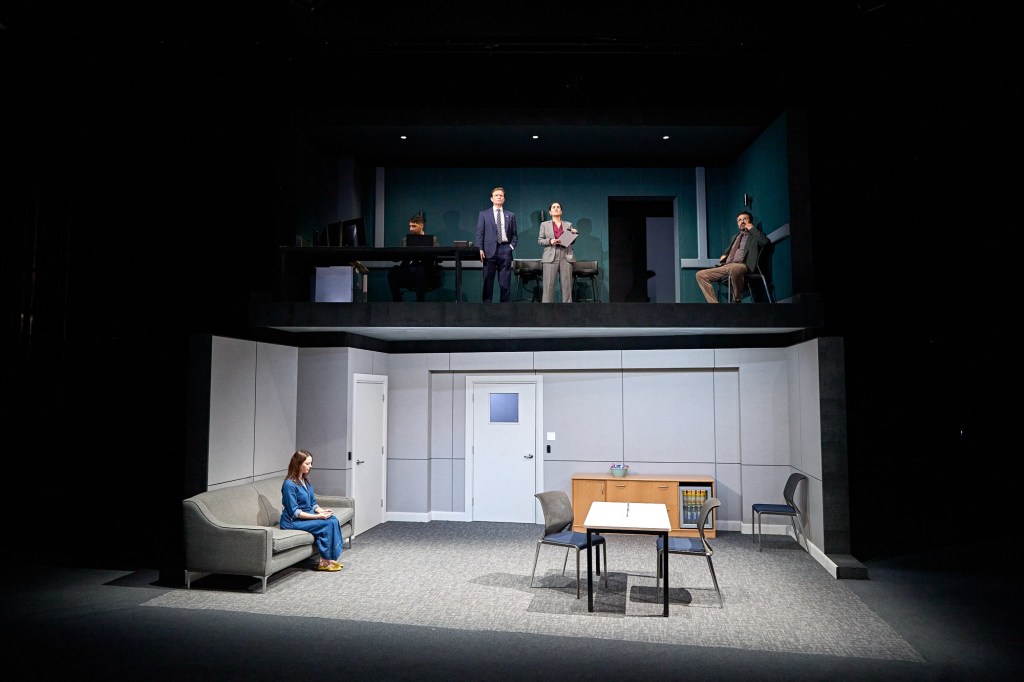
Scenes bleed from one into another with a cinematic fluidity, and the sense of dread when Olsen leaves the observation bureau on the upper level of Alex Eales’s starkly effective set to intervene in the interrogations below is keenly felt. There are some head scratching moments even beyond the scientific posturing and pontificating, such as a hymn singing sequence (though the idea of a bunch of high ranking bureaucrats suddenly bursting into religious song feels apiece with an America currently in the grip of Christian extremism, however performative) or the Māori Haka which closes the show.
This last is performed by Cliff Curtis as a conscience-tormented academic with Jewish and Māori roots and a possible drug problem. This character, Ari Abrams, feels a little like Willimon hurling everything at the wall to see what sticks. Curtis is a fine screen actor but his lack of stage experience is apparent initially, with muffled line deliveries and an unfocused energy, but he improves considerably as the evening progresses. Interestingly, Scodelario also works predominantly in television and film, but exerts a quiet power on stage that lingers in the memory. Armin, the only other woman in the cast, delivers beautiful, detailed work as an official whose duty comes to be at odds with her humanity.
The sound design by Tingying Dong, threatening yet delicate until it explodes in a flurry of sensory overload in tandem with Zakk Hein’s vivid video, is ingenious and almost an extra character in the play. The ambiguity of the principal characters’s back stories adds to the feeling of mounting unease, and Willimon’s dialogue has real punch and snap.
For all its contemporary dressings, this is more potboiler than profound, and not always as clear as perhaps it should be. Still, McDougall’s production has bags of atmosphere and tension, and it’s a pleasure to see a play that so assuredly mixes together the intelligence and the thrills.
 ajhlovestheatre
Leave a comment