LAVENDER, HYACINTH, VIOLET, YEW
by Coral Wylie
directed by Debbie Hannan
Bush Theatre, London – until 22 March 2025
running time: 2 hours, 30 minutes including interval
https://www.bushtheatre.co.uk/event/lavender-hyacinth-violet-yew/
Queer legacy, allyship, platonic friendships and, er, horticulture come under the spotlight in this highly original and deeply lovely new play. Coral Wylie wrote the Alfred Fagon award nominated script and plays Pip, non-binary, mixed race, in their early twenties, and full of questions.
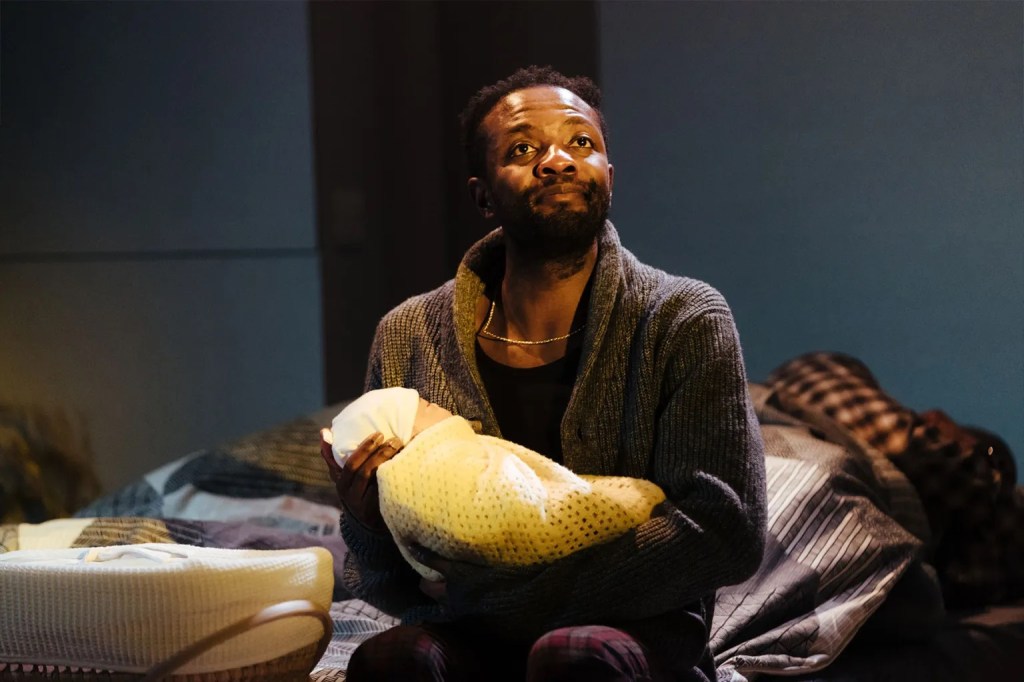
Most of those questions are directed at their parents, Lorin and Craig (Pooky Quesnel and Wil Johnson respectively), a genuinely lovely pair of humans who clearly partied hard in the ‘80s and ‘90s but have come out the other side, albeit with emotional scars that run deep. The source of those scars is the now deceased Duncan (Omari Douglas, entrancing), the chance discovery of whose diaries gives Pip a tantalising glimpse into the youngsters those parents once were.
It also sets in motion an explosive emotional daisy chain that sees Pip accusing Lorin and Craig of denying them their heritage as a queer person of colour. It’s rich, engaging stuff, served up with one hell of a dramatic wallop as Craig confronts his feelings over losing his best friend to AIDS, and Lorin addresses her own sidelining in the mens story. Duncan was a clever and creative gardener (there’s a particular queer significance to each of the flora that make up the play’s title) and, if the concreting over of his garden by Craig following his death is hardly subtle as metaphors go, there is a satisfying symmetry between his horticultural artistry and Pip finding their place in the world.
Max Johns’s traverse set undergoes a simple but rapturous transformation in the final scene that, in tandem with Wylie’s inspirational words as Duncan addresses Pip down the years (exquisitely delivered by Douglas) will have anybody with a heart and soul reaching for their hankies. Debbie Hannan’s production, punctuated with banging late 20th century dance tracks, slickly negotiates the shift in decades, and draws a quartet of outstanding, truthful performances.
Even at Pip’s stroppiest, Wylie is totally lovable, in the grip of pain and confusion rather than spite. Quesnel and Johnson don’t belabour the fact that their characters are ageing up and down by decades from scene to scene but achieve differentiation mainly by alternating their energy levels according to which year we’re in: it’s subtle and it works. They entirely convince as a pair of well rounded, essentially kind humans, damaged but not beyond repair. Douglas will break your heart.
Lavender, Hyacinth, Violet, Yew isn’t perfect. Some of the writing is a bit clumsy: there are sections where the characters sound like people in a play rather than people just talking, and making the act one closing moment a revelation about Lorin’s sexuality feels a little cheap. These flaws are perhaps more apparent because so much of the play simply soars.
It feels simultaneously like a very young and a very wise piece. Young in terms of the energy and the way that the poetic and pedestrian don’t quite comfortably co-exist, mature in the way it understands the corrosion that denial and repression can wreak on a soul, however noble, and of the bittersweet nature of wondering what might have been. There’s a pleasing sophistication in Wylie’s writing where dialogue echoes between scenes with Duncan in Lorin and Craig’s memory and present day sequences with their bright, sensitive, troubled child. It also powerfully suggests that death isn’t necessarily an end when you have people that love and remember you.
Duncan’s final exhortation to Pip to “turn your chest to the sun, little one…dig your fingers deep in the mud…cake your nails in the soil and clay…know that the worms that jump out, writhing and churning, I taught them to dance, for you” is sublimely affecting. Wylie is clearly a talent to watch and I just want to live with these wonderful humans they have created.

 ajhlovestheatre
Leave a comment