BACKSTROKE
written and directed by Anna Mackmin
Donmar Warehouse, London – until 12 April 2025
running time: 2 hours, 25 minutes including interval
https://www.donmarwarehouse.com/whats-on/33/by-anna-mackmin/backstroke
If, following on from the twin triumphs of The Fear Of 13 and The Great Comet in Tim Sheader’s new leadership of the mighty Donmar, Anna Mackmin’s new play feels like a slight disappointment, it’s still a rewarding, if harrowing and overlong, evening. Backstroke sees mother Beth (Celia Imrie) and daughter Bo (Tamsin Greig) fight, struggle, support and attempt to understand each other over decades. While such family struggles aren’t particularly original subject matter, they unerringly provide fertile dramatic possibilities.
It’s partially a memory play, the series of reminiscences triggered by Beth’s stroke (the title is a play on words) which has left her incapacitated and hospitalised. It’s also a pretty tough watch: there are graphic depictions of the physical problems (thrush, constipation, reactions to withdrawal from pain relief) that can occur in the long term bed bound, representations of dementia, and the hospital scenes are played out naturalistically and in real time, which may feel like excessively punishing viewing for some audience members. Even the happiest moments, such as when twenty something Bo and her mother joyfully dance to T-Rex’s ‘Get It On’ in their kitchen, come tinged with the sepia hue of melancholy, because, unlike the two women, we know what’s to come.
The acting is magnificent. The script is almost a duet for mother and daughter, and three very fine actors (Lucy Briers, Anita Reynolds and Georgina Rich) are slightly wasted in their functional roles as healthcare professionals, although Reynolds has some lovely moments as the most empathetic of the trio. Despite struggling with her lines at the press performance I saw, Celia Imrie, attired in bohemian shabby chic but before it got trendy, nails Beth’s unique combination of garrulous eccentricity and ruthless manipulation. An artist of sorts and a drifter, she’s the kind of woman who weaponises guilt trips and fat shaming and who happily discusses her enjoyment of cunnilingus in front of her appalled daughter. She’s vain, self-mythologising, slightly monstrous but impossible to entirely dislike, although that may be as much down to Imrie’s charm as anything in Mackmin’s writing. At one point Bo cries “I’m not like you, I don’t have the maternal instinct!” but we don’t see much evidence of that.
Greig is brilliant in the tougher role, having to leap around in playing age from fifties to nine and much in between. This she does with rock solid technique, great sensitivity and exquisite comic timing while never playing the easy laugh, or attempting to ingratiate the character. She acutely finds the rawness of feeling, the helplessness when faced with seemingly impossible choices around the welfare of loved ones: not only is Bo dealing with her mother but she has an adopted daughter with severe behavioural issues. Few actors can match Greig when it comes to conveying civilised women on the edge of despair or possible mania, and she’s on top form here. Her tear-soaked eulogy to her mother at the conclusion is as fine a piece of acting as you can see anywhere in London right now, and it’s matched by a simplicity and beauty in Mackmin’s words that pierces the heart.
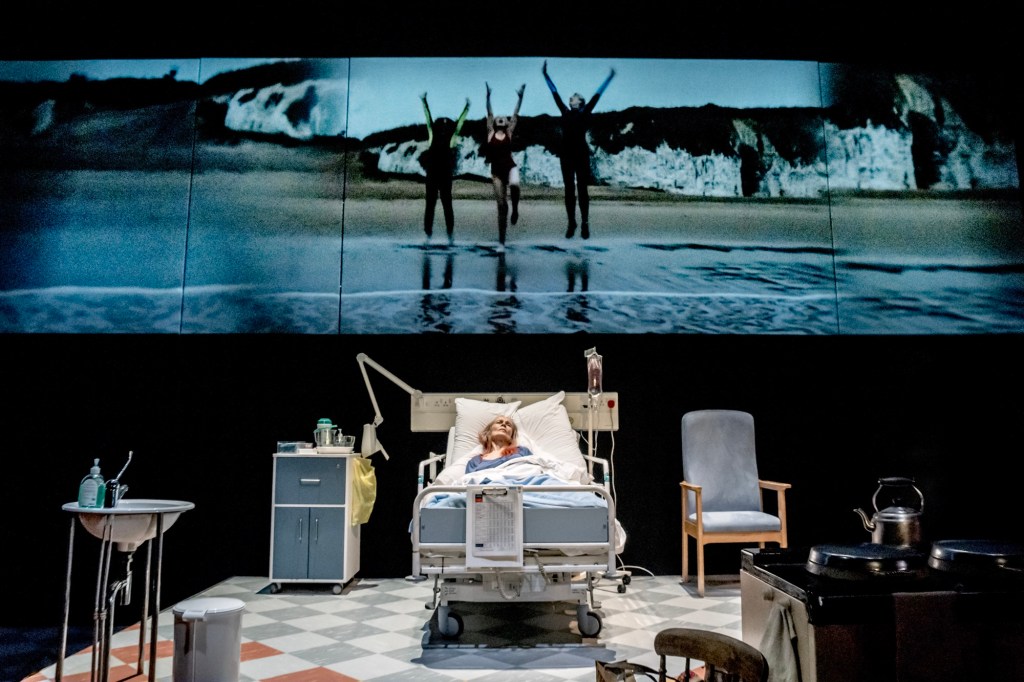
Elsewhere, the writing isn’t always so successful. The spiky dynamics of the mother-daughter relationship rings true and is expressed in salty, vivid dialogue, and the grim realities of end-of-life care also come over with clear-eyed, grim accuracy. Structurally though, the play is baggy and confused. Greig’s character spends far too much time on her mobile phone in a bid for the author to demonstrate just how demanding this woman’s existence is, and the terse, brief scenes come to seem formulaic. Having film (striking work by Gino Ricardo Green, Richard Holmes and Damian Daniel) running behind Lez Brotherston’s hybrid hospital/kitchen set, showing both women in different aspects of their lives is more bewildering than elucidating and again becomes wearyingly repetitious.
The play’s title implies that water will somewhere be involved and so it proves of the second half where a young Bo is cajoled into swimming by her mother. It’s a beautifully realised section but it’s not clear if water is supposed to be a metaphor for something, and feels like a bit of a non sequitur. The confusion is exacerbated by footage beamed on the back wall of the two actresses in swimming gear but very much looking as they do now. It’s hard to see what Mackmin is getting at, either as writer or director.
Ultimately, that’s true of the play as a whole. There’s a lot of pain here, a lot of accuracy, and a lot of love. There’s also some bizarre misjudgment, such as a scene involving genital thrush in a hospital bed, that doesn’t know whether it’s hard hitting realism or sitcom. See Backstroke for the acting. Watching performers of this calibre in an intimate space will always be worthwhile.
 ajhlovestheatre
Leave a comment