ELEKTRA
by Sophokles
translation by Anne Carson
directed by Daniel Fish
Duke of York’s Theatre, London – until 12 April 2025
running time: 75 minutes no interval
Well, you can’t accuse Brie Larson of playing it safe. For her West End debut the Oscar winner has chosen this bold, eccentric and (I suspect) highly divisive project which sees avant garde American director Daniel Fish (primarily known here for his radical rethink of Broadway classic Oklahoma!) and Canadian poet Anne Carson take on Sophokles (or Sophocles, depending on which spelling you favour). This Elektra (not Electra, got that?!) is likely to piss off as many people as it delights but, love it or hate it, there’s no denying that Fish’s alienating vision of revenge and matricide in a war torn world is all-encompassing and uncompromising.
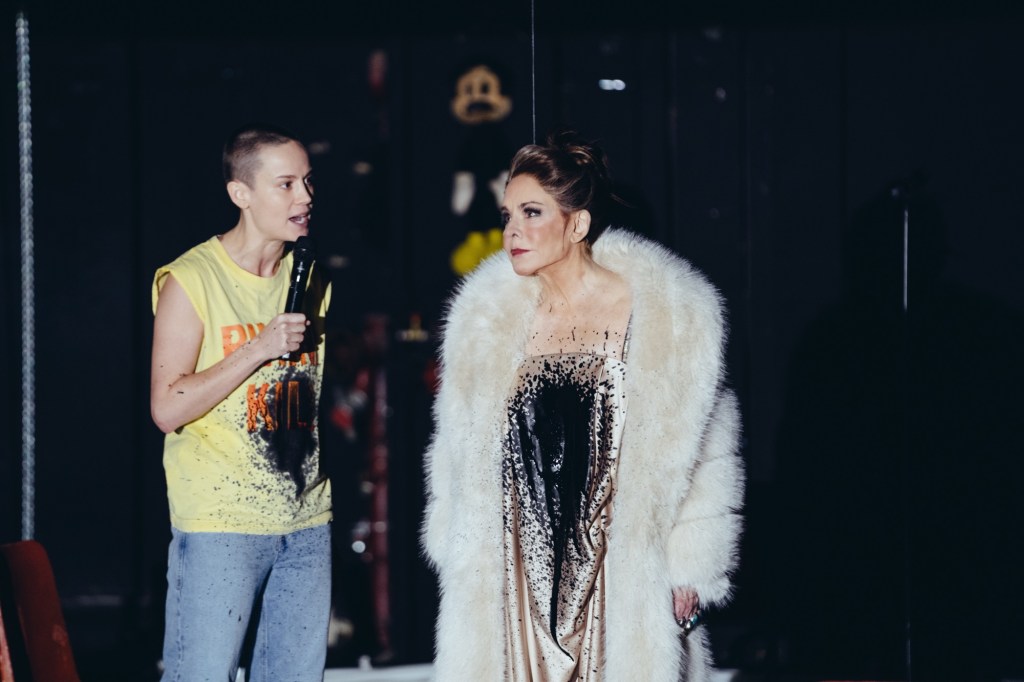
The trappings are modern (Larson wails into a microphone, Patrick Vaill’s Orestes carries a motorcycle helmet, a wan-looking cuddly toy hangs on the bare brick back wall, a war correspondent’s reportage of recently clearing al-Assad’s torture prisons in Syria is amplified over the sound system as dry ice engulfs the revolving stage), but the production has a ceremonial feel. With the dissonant choral chanting, stylised movement (choreography by Annie-B Parson) and all-pervasive sense of foreboding, it’s more holistic, cathartic event than traditional play, speaking to the theatre of Ancient Greece that Sophokles was writing for, as much as it does to the playhouses of today.
Gawd knows, it won’t be for everyone but it’s a legitimate attempt to reinterpret classical tragedy through a contemporary lens without sugaring the pill by making it into a more comfortably familiar dramatic form. It’s resolutely strange and desolate, and singularly unwilling to ingratiate: you’ll either embrace Fish’s concept or you won’t, but you may find yourself haunted by it, just as the black ink seeps inexorably all over Doey Lüthi’s costumes and what there is of Jeremy Herbert’s set as the bitter tale progresses, as if to suggest that the destruction of war and bloodthirst for vengeance contaminates everyone and everything.
“To exist is pain” moans Carson’s text, pitched somewhere between poetry and living nightmare much as Fish’s staging is suspended between performance art and relatable drama, and less adventurous theatregoers may find this very thought flashing through their minds in the course of this challenging eighty minutes. The tendency of Greek tragedy to tell rather than show coupled with this show’s propensity towards static tableaux (at moments the only movement on stage is the revolve, a rising scrim and the machine squirting black gunk everywhere) suggests that boning up on the story before you go might be a good idea if you’re a Sophocles/Sophokles neophyte. But whereas on, say, last year‘s West End celebrity casting misfire Opening Night, there was a palpable sense that multiple talented creatives were pulling in different directions resulting in a show that never coalesced, here everyone seems to be singing from the same hymnsheet, however esoteric that may be.
There are recurring motifs – every time Elektra’s murdered father Agamemnon is mentioned there’s the sound of a gunshot, when usurper Aegisthus’s name comes up everybody spits, while each mention of Orestes prompts a noble thump to the chest – that add to the overall impression of a ritual being played out, and the emotional temperature remains cool. Larson does a potent line in disaffection and fury but isn’t required to plumb the soul searing depths Zoe Wanamaker reached in the acclaimed 1997 version at the Donmar and later on Broadway, and her crew cut, t-shirt clad punk princess is also a million miles from Kristin Scott Thomas’s raw grief in the Old Vic production from a decade ago. It’s a creditable stage debut, entirely without vanity, but not a spectacular one.
Stockard Channing’s commanding, fur coated Clytemnestra, her bejewelled fingers tinged with deep green like a verdigris substitute for blood, is a magnetic, witty presence (“that’s no way to talk to your mother!”). An underused Greg Hicks briefly impresses as Aegisthus, her murderous, guilty-as-hell consort Aegisthus, and Vaill as Orestes and Marième Diouf’s Chrysothemis – Elektra’s siblings – make valuable contributions to the landscape of howling misery, although the latter sometimes suffers from audibility issues.
The chorus of women (Hannah Bristow, Wallis Currie-Wood, Jo Goldsmith-Eteson, Nardia Ruth, Rebecca Thorn, Adeola Yemitan) is probably the most successful aspect of the show. By turns sympathetic then sinister, dressed in a sports gear meets flowing robes combo that marries the concept of Ancient Greece to the present day, and delivering Ted Hearne’s complex harmonies with spinetingling clarity and precision, they are the damaged heartbeat of the piece.
As I said, this is not going to be everybody’s idea of a rewarding piece of theatre, but it has an integrity and consistency that is impossible to write off, and it’s remarkable to find such a bleak, borderline impenetrable staging in a commercial West End house. The sense of the tragedies of Ancient Greece echoing down the centuries to our time is keenly realised and visually it’s often quite astonishing, but emotional connection is scant. I admired much about this Elektra, but did I actually enjoy it? Not massively, no.
 ajhlovestheatre
Leave a comment