KYOTO
by Joe Murphy and Joe Robertson
directed by Stephen Daldry and Justin Martin
@sohoplace, London – until 3 May 2025
running time: 2 hours 50 minutes including interval
https://nimaxtheatres.com/shows/kyoto/
Anybody wondering if theatre can still be truly relevant needs to see Kyoto. It’s an epic full of fire and fascination, a cracking piece of entertainment with a deeply serious core. Of course, authors Joe Murphy and Joe Robertson, and their Good Chance Theatre company who are co-producing with the Royal Shakespeare Company, have form when it comes to creating theatre that breaks the normal rules of playmaking, while speaking urgently to the world we live in now.
Murphy and Robertson were the iconoclastic creatives behind 2018’s The Jungle, which was developed and set in the Calais refugee camp, and went on to win acclaim and prizes globally. That was a rich tapestry of humanity characterised by a searing intelligence while simultaneously wearing its heart on its sleeve, and this is similarly stirring and impressive.
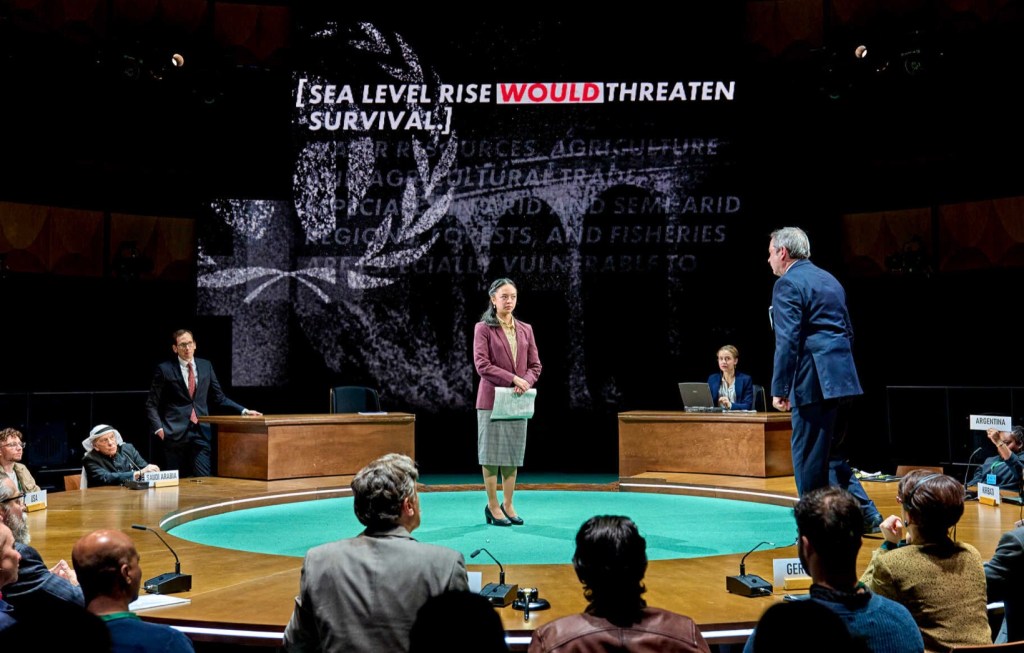
Kyoto, centring on the historic 1997 international climate change conference which saw an unprecedented unanimity from global representatives to drastically cut carbon emissions, is a glossier affair, as thrillingly directed by Stephen Daldry and Justin Miller, but has the same grit, compassion and bravura theatricality. In a series of punchy vignettes, Murphy and Robertson dramatise the run-up to the Kyoto summit, all watched over by a Mephistophelean narrator, oil lobbyist Don Pearlman (a powerfully laconic Stephen Kunken). Facts and figures are hurled at us by actors and from video walls at rear of the playing area and all around the auditorium, yet the individuals doing the talking, while little more than sketches in some instances, resonate strongly as human beings. The command and delivery of information recalls James Graham at his most meticulous and energised, while the dynamism of the deluxe staging suggests a team of creatives at the very top of their game.
A terrific international cast, representing delegates from all over the world, ricochet around Miriam Buether’s imposing, all-encompassing conference room set (which features actual audience members seated at the central circular table), dextrously changing character and appearance in the blink of an eye, bringing to life a fascinating array of people, some familiar, others less so. Ferdy Roberts is a bluntly funny, sympathetic John Prescott representing the EU, and Kristin Atherton captures accurately Andrea Merckel’s unique blend of warmth and severity. Jorge Bosche is a ribald delight as Raúl Estrada-Oyuela, the Argentine diplomat who brokers the Kyoto Procotol with a mixture of bonhomie and bloody mindedness, and Nancy Crane makes a strong impression as the embattled American delegate.
Daldry and Miller employ a flamboyant raft of theatrical techniques to flesh out this compelling story, but the focus, despite all the sound and fury, never wavers. The stagecraft on display is dazzling… this is tremendously exciting total theatre, propulsive and vital, yet the clarity and gravitas are never sacrificed to mere entertainment.
But entertaining Kyoto most certainly is, playing out with the grip and menace of a thriller, as the ‘Big Oil’ controllers, who fund and influence Pearlman, appear out of the murk like the Seven Sisters of the Apocalypse, accompanied by Paul Englishby’s threatening sound score. If that sinister group represents the darker forces pulling at the morally ambiguous Pearlman then his questioning, good-hearted wife (lovely performance by Jenna Augen) personifies the light.
It’s also frequently very funny, sometimes bleakly so, such as the sequence where Pearlman introduces delegates one by one at the conference before stating the carbon emissions caused by each individual’s international journey. The laughter catches in our collective throats though when it is revealed that the fossil fuel conglomerates have been aware of the damage to the planet since 1959 but chose to suppress the information. Remarkably, the play never descends into preachiness, but the sense of time being of the essence for this compromised planet is palpable, and the raw excitement and catharsis to the final thrashing out of the agreement is pure drama, and becomes genuinely moving.
Whether observing from the sidelines, cynically haranguing the audience, or cracking open with rage, Kunken achieves a magnificent UK stage debut. Murphy and Robertson charge the real life figure of Pearlman with a similar jet black wit and energy as Tony Kushner found for the admittedly more openly malevolent Roy Cohn in Angels In America. The writing is caustic, muscular and literate, peppered with wit and expletives.
The production ends on a quizzical, visually arresting note – Pearlman’s widow alone on stage as the cherry blossom dances around her – that initially feels hopeful and poetic but cools to downright chilling when you recall the Japanese diplomat’s repeated point that the blossom falls earlier every year due to alterations in the climate. This utterly brilliant show, a smash hit in Stratford-Upon-Avon last year and surely on course for further success in London and probably beyond, is a clarion call for change, for mutual understanding and collaboration, and for holding our leaders to account. It should also be on every school’s curriculum. Essential, unforgettable, and, hopefully, life-changing theatre. You have to see this.
 ajhlovestheatre
Leave a comment