FIREBIRD
by Richard Hough
based on the memoir by Sergey Fetisov and the screenplay by Peeter Rebane and Tom Prior
directed by Owen Lewis
Kings Head Theatre, London – until 9 February 2025
running time: 85 minutes no interval
https://kingsheadtheatre.com/whats-on/firebird
Based on Sergey Fetisov’s memoir and its acclaimed film adaptation, Richard Hough’s new play is a gay love story set against a background of modern history in Soviet Union-occupied Estonia in the late 1970s. Combat pilot Roman (Robert Eades) meets aspiring actor Sergey (Theo Walker) who is whiling away his Russian National Service on a Tallinn airbase, just as the Soviets join the war in the Middle East, heightening Cold War tensions. Owen Lewis’s production is peppered with recordings of Brezhnev’s speeches at the time, conveniently translated into excitable English.
Firebird as a script has a surprising amount of humour, given its setting and themes, and is gripping enough that you seldom notice how uncomfortable the seating in the Kings Head’s main house is. There’s also an unadorned brevity that doesn’t fully do justice to a story that should be more gut-wrenching than it appears here. It’s hard to know if it’s the acting or the writing, but the urgency of feeling between the two men doesn’t really come across, and they go from illicit kisses to full-on co-habiting in just a few pages of script, rather as though crucial scenes for the storytelling were somehow jettisoned or lost during the creative process, an impression further reinforced as the play continues. The tragedy that engulfs the principal characters doesn’t sear as one hopes it might.
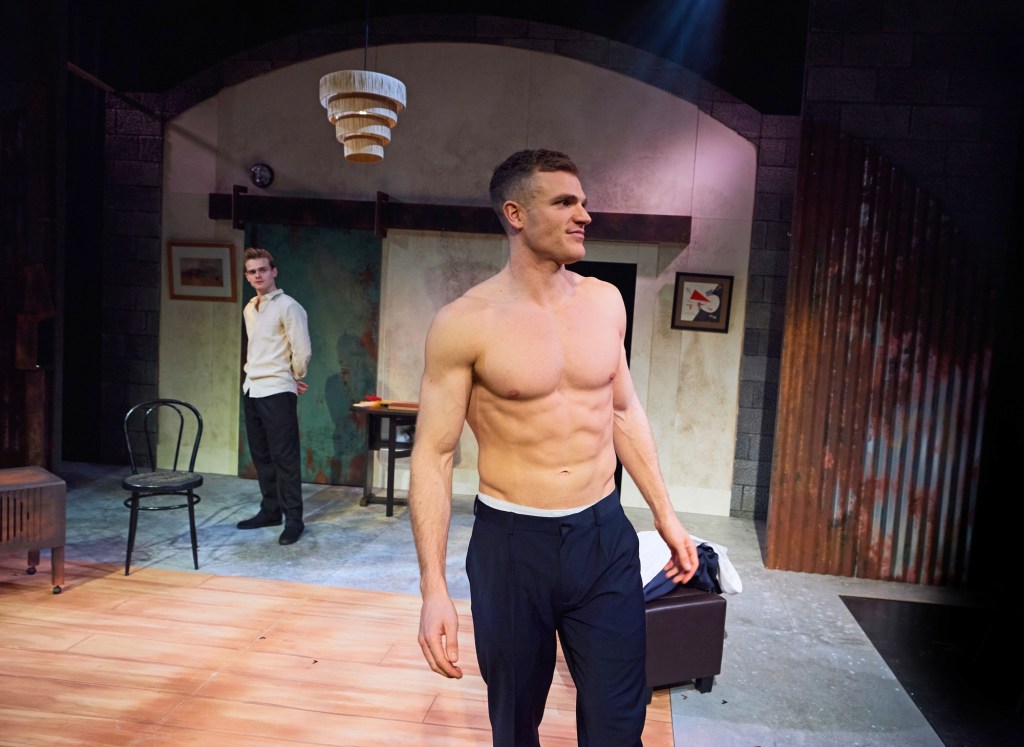
Eades is all chiselled physical perfection as the man devoted to his flying career until love derails that (somewhat) but is a bit stilted in his delivery of the dialogue, while Walker brings a boyish self-possession to the more emotionally available Sergey. Apart from some snogging and teasing removal of shirts, the connection between the men seems unhelpfully tepid: there’s very little chemistry.
Intriguingly, the heterosexuals fare much better in this play. Nigel Hastings delivers a compelling, multi-layered account of Colonel Kuznetsov, a high ranking air force official who may just understand more than he lets on. Hastings convincingly conveys the humanity beneath the starched authoritarianism in a beautifully modulated performance. Even more fascinating is Sorcha Kennedy, marvellous as Luisa, the Estonian clerical worker who befriends Roman and Sergey before becoming unwittingly embroiled in their personal lives. Kennedy invests this good-hearted young woman with irrepressible warmth and sass, but also an endearing vulnerability. There’s a moment where the penny drops about the true nature of Luisa’s best friends‘s relationship and Kennedy plays it exquisitely. There’s a Rattigan-esque wistfulness and delicacy to a scene where Luisa meets with her former boss Kuznetsov over tea and confesses to her isolation and depression in the wake of an unwise marriage, and a rueful final scene between Luisa and Sergey is beautifully, heartbreakingly well done.
Lewis’s staging is strong on atmosphere thanks to Gregor Donnelly’s suitably grim period setting and a striking lighting design by Clancy Flynn. It’s also heavy on music and sound effects (nice work by Jac Cooper) although the lengthy scene transitions have a tendency to interrupt the storytelling flow.
Altogether this is an agreeable ninety minutes but it doesn’t hit as hard as it should. There doesn’t feel that there is as much at stake as there should be, but it’s a highly watchable insight into a recent period of modern history, lent an added piquancy by the fact that it’s true story.
 ajhlovestheatre
Leave a comment