CAT ON A HOT TIN ROOF
by Tennessee Williams
directed by Rebecca Frecknall
Almeida Theatre, London – until 1 February 2025
https://almeida.co.uk/whats-on/cat-on-a-hot-tin-roof/
This surprising, affecting Cat On A Hot Tin Roof is the apotheosis of Rebecca Frecknall’s deconstructed Tennessee Williams trilogy for the Almeida. Where her 2018 Summer And Smoke elevated a B-grade play to something profound and moving, and the Paul Mezcal-Patsy Ferran Streetcar (returning briefly to the West End in 2025 before heading to NYC) found a humanity beneath the archetypes of Stanley and Blanche, this Cat refocuses the relationships in a play that, although written with Williams’s characteristic bruised poeticism, can sometimes feel excessively precious and long winded.
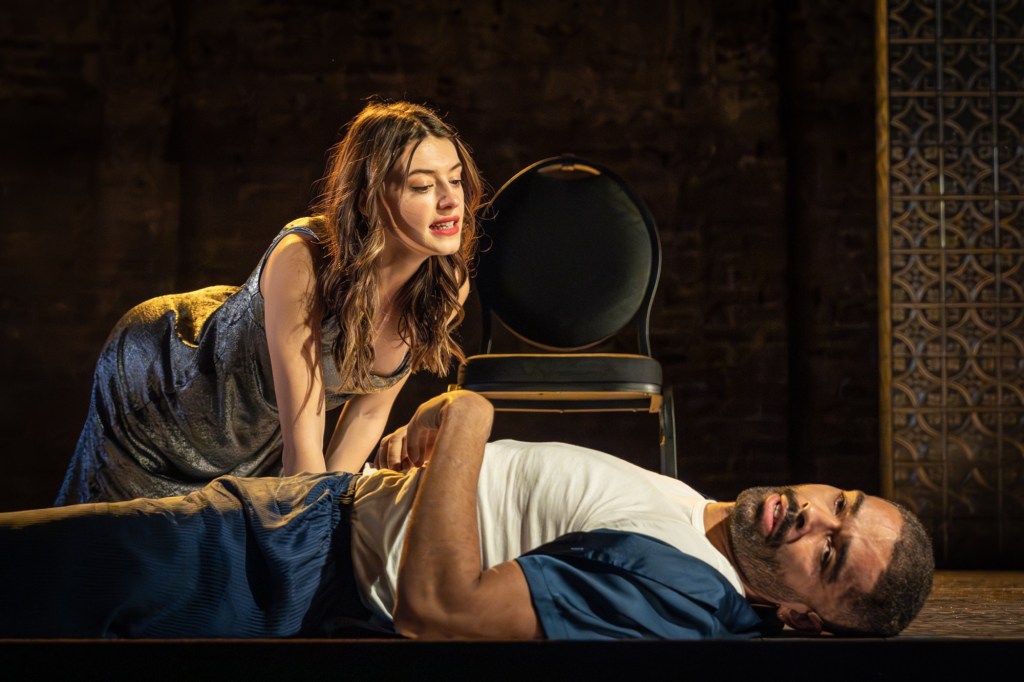
True to form, Frecknall goes for style and expressionism over the cooking heat that usually typifies this play. Some of it’s a bit heavy handed (having Daisy Edgar-Jones’s Maggie the cat crawling about like a real feline scores few points for subtlety) but this is an infinitely more satisfying version than the last London production in 2017 which saw Jack O’Connell and Sienna Miller as its photogenic Brick and Maggie wandering around naked on a bizarre, copper-coloured set that rendered more than half of the dialogue inaudible.
The first act is essentially a monologue for Maggie as she berates, cajoles and tries to get through to her increasingly catatonic husband, tortured former sports star Brick, while his plantation owner father’s birthday party is in full swing throughout the house outside their bedroom. I’ve seen it defeat more seasoned stage actresses than Edgar-Jones but she acquits herself magnificently here, even though she seems a little youthful. With her flashing dark eyes and auburn mane, red talons and sheer slip, she looks like a debauched version of Anne Hathaway (the film star), and she captures with graceful precision and piercing emotional acuity Maggie’s mix of sensuousness, anxiety and desperation. There’s a compelling vulnerability too: note the way she sucks her breath back in almost before it has left her body. She knows she has lost Brick already but is too self possessed to admit defeat.
Frecknall has the words delivered against the steady tick-tock of the metronome sitting atop the grand piano that dominates Chloe Lamford’s austere set. It’s a hypnotic effect that lulls us into a false sense of peace before the piano keyboard takes an absolute pounding at moments of high stress and conflict. Frecknall’s earlier Williams stagings employed music in a similar way.
She also reuses the convention of having a named but usually unseen character as a constant onstage presence. Personally, I thought having Skipper (a magnetic Seb Carrington), Brick’s best buddy (and something more) who drank himself to death, close to the centre of the action, playing piano, observing the marital tussles of the central couple, and getting progressively more soused, was the most potent example yet of this storytelling device. There’s a moment in the second half when Kingsley Ben-Adir’s Brick, drunk, in deep despair and cowering from yet another volley of recriminations, sinks down onto the piano stool and Skipper tenderly puts his arms around him. It’s a heart-piercing image that’s worth a thousand words, even when the words are as beautiful as Tennessee’s.
Good as Edgar-Jones is, this production decentralises Maggie to the extent that after the first act she effectively becomes just another bystander to Brick’s ongoing dance of death with the bottle and his beloved, lost Skipper. I have never seen a more moving or dangerous Brick than Ben-Adir. Out of his mind and on a clear course to self-destruction from the get-go, his torment and misery writ large across his features, he also conveys with devastating clarity the character’s detachment and his casual cruelty. He’s pitiful but you can’t take your eyes off him.
The centrepiece, arguably of the somewhat unwieldy script but undoubtedly of this production, is the electrifying showdown between Brick and his father. Usually a feast of grandstanding and recriminations, here it’s repurposed as a much more sensitive exchange, charged with implicit understanding (look out for the brief but astonishing moment when Big Daddy talks about tolerance). Lennie James is utterly brilliant as a man able to turn on a dime between kindness and cruelty. James makes obvious but never overplays the cancer eating him up from the inside and to which he is oblivious, and his irascible disrespect towards his long-suffering vulgarian wife (a strangely sympathetic Clare Burt, absolutely terrific) is superbly done.
This isn’t colour blind casting either: this wealthy black man has worked his way up from the lowliest positions in the plantation to being master of all he surveys, and it results in a more compassionate and multi-layered reading of the role than usual, and James is turning in a truly great performance. There’s magnificent support too from Ukweli Roach as the feckless, overlooked other son, Pearl Chanda as his envious, endlessly fertile wife (here given an intriguingly ambiguous attitude towards the more glamorous Maggie) and Guy Burgess as a hilariously fey local preacher.
Hugely watchable as this is, and at times it is completely riveting, I do think Frecknall has reached the end of the road with Williams and his ghosts. I also don’t think I’ll ever see a finer Brick and Big Daddy than Ben-Adir and James. Nor will I be able to forget the look on Burt’s face when she learns the truth about her husband’s health.
The three hours pretty much fly by and it all holds together: it’s just not necessarily the Cat On A Hot Tin Roof that we all thought that we knew.
 ajhlovestheatre
Leave a comment