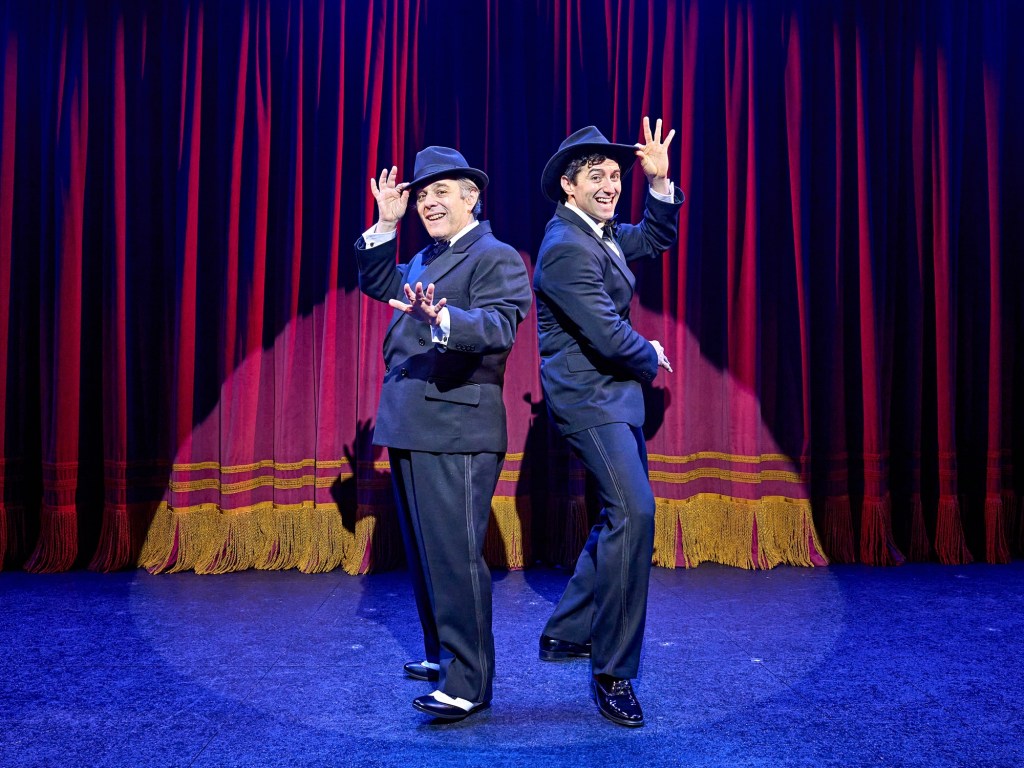
THE PRODUCERS
Book by Mel Brooks and Thomas Meehan
Music and lyrics by Mel Brooks
directed by Patrick Marber
Menier Chocolate Factory, London – until 1 March 2025
https://www.menierchocolatefactory.com
“It was shocking, outrageous, insulting…and I loved every minute of it.” So reads Andy Nyman’s unscrupulous Broadway producer Max Bialystock from a review of his new show, the astonishingly bad taste “Springtime For Hitler”, which he needs to flop epically so that he can pocket the investors’s cash, having deliberately over budgeted to the tune of $2 million. That same hyperbolic statement isn’t a bad summation of Mel Brooks and Thomas Meehan’s musical, receiving its first London revival since the original production at Drury Lane.
You’ve got to hand it to him, Brooks is an equal opportunities offender. This rambunctious slice of Broadway, lovingly adapted from his 1967 movie, takes comic potshots at so many pockets of humanity (senior citizens, gays, Jews, theatre luvvies, Europeans, even Jesus this time around who turns up as a loincloth-wearing cocktail server in an exceptionally camp household) that it’s hard to know what to be affronted by first. Or maybe just buckle up and enjoy the ride of this high octane tuner that is as well-crafted as it’s crazy, and was hailed at its 2001 New York premiere as a glorious example of old school musical comedy in the grand manner.
Susan Stroman’s original staging of this tale of an attempt to create a bona fide Broadway disaster, was a glossy, huge affair; Patrick Marber, directing his first musical, goes for a much more downbeat aesthetic (Nyman’s Max, for example, looks like Dickens’s Mr Quilp with his scruffy grey hair and greasy-looking jacket) that suits the smaller space perfectly. When Paul Farnsworth’s costumes turn on the dazzle dazzle, such as for the tap-dancing chorines or the statuesque German clichés served up as frothy flights of fantasy in the show-within-a-show section (“don’t be stupid, be a smarty! Come and join the Nazi Party!”) complete with giant pretzels, sausages and steins of beer, they’re a marvel to behold, but overall the emphasis is more on grit than glamour.
Similarly, Scott Pask’s unit set of a massive metal grid reminiscent of those lightbulb-filled advertising hoardings that sit atop the theatres of Manhattan’s west 44th street, is mainly transformed by a few simple additions, and the inspired use of Richard Howell’s dazzling lighting. When the material and cast are this good, the lack of obvious spectacle matters surprisingly little, especially when Marber’s production, which perhaps leans more into the innate Jewishness of the material than ever before, whips along at such a cracking pace.
Furthermore, Lorin Latarro, represented recently on Broadway by her inventive work on The Heart of Rock’n’Roll and The Who’s Tommy, is gaining a reputation as one of the Great White Way’s foremost dance creators. Here she comes up with dynamic choreography, energised but mindful of tradition, that brilliantly utilises the limited space, and more than matches Stroman’s original work.
The treatment of the Nazis throughout is (rightly) merciless: Hitler (Trevor Ashley, jawdropping) is carted on as a golden, high camp amalgam of himself, Caligula and sundry Broadway divas (“I’m the German Ethel Merman don’t you know”); we get dancers dressed as U-boats, tap dancing stormtroopers…it’s truly ridiculous. With the global emboldening of neo-Nazis and their extreme views, the show now exists in a very different world from the one that the original production opened in, and this gives Marber’s staging a real edge, even as it admirably demonstrates Brooks’s theory that the best way of disempowering something is by laughing at it. And laugh we surely do, even while occasionally cringing.
This is a show that, for all its snark, is in love with the theatre, and the vivid gallery of characters Brooks created in egotistical director Roger De Bris (Ashley again, firing hilariously on all cylinders: “that whole second act has to be rewritten. They’re losing the war? Excuse me? It’s too downbeat!“), his “common law assistant” Carmen Ghia (Raj Ghatak resplendent in lip gloss, sheer black and a mid-career Liza Minnelli wig) and their household of camp creatives are recognisable tropes. Also, for all his kvetching and bawling, Nyman’s Bialystock feels like a legit theatrical type who takes a bizarre pride in his ability to con little old ladies out of their money to put on his appalling productions.
Nyman is more low key than Nathan Lane and his successors in the original, but he’s very good indeed. There’s a real sense of desperation and desolation about this Max, his comedy (of which there is plenty, most of it delicious) rooted in truth rather than the vaudevillian ‘business’ of his predecessors. He properly stops the show with ‘Betrayed’, the tour de force eleven o’clock number where the jailed shyster recaps the entire show in three minutes flat.
As the other titular producer, nebbish Leo Bloom, the put-upon accountant seduced by the bright lights of showbiz, Marc Antolin turns in a gorgeous study of somebody in a permanent state of anxiety, his body bent out of shape, his eyes wide and swivelling, his limbs somehow seeming too long for his torso. He’s achingly funny and totally endearing. He even dances in character: a marvellous mover usually, his awkwardness gives way to something fleet-footed and entrancing when he gets together with his beloved Ulla.
The Ulla character, the Swedish blonde bombshell secretary-cum-starlet employed by Bialystock mainly because he fancies her, was very much a product of the time in the movie (original actress Lee Meredith was required to do little more than go-go dance in a bikini) but thankfully book writers Brooks and Thomas Meehan gave her more agency and material in the musical. Marber goes even further this time around, making her more wise to Max’s lechery and amused by the idiocy of the men she’s dealing with. It’s a subtle change, but it’s welcome, and she is clearly smitten with Antolin’s charming goofball from the get-go. Joanna Woodward brings an irresistible joie de vivre, a preposterous accent and a sensational singing voice to the role, as well as a knowingness that suggests that this stunning young woman is way smarter than Leo or Max realise. She’s utterly fabulous.
Another interpretation that manages to improve on the original is Harry Morrison’s Franz Liebkind, the lederhosen wearing, tin helmeted Nazi sympathiser (and Springtime For Hitler author) hiding out in Greenwich Village with his pigeons and a massive chip on his Teutonic shoulder (“the führer was BUTCH!”). Morrison plays him like a psychotic manchild who turns on a dime from guileless grinning idiot to gun-waving maniac, with a booming operatic voice and an imposing presence. Crucially, while the performance is alive to the lunacy of its surroundings, it’s infused with an unsettling sincerity and real sense of danger that makes him all the more hysterical.
Brooks’s tunes sound like something from the Golden Age of Broadway, and Larry Blank and Mark Cumberland’s orchestrations package them with punchy energy but finesse. The quicksilver lyrics, ranging from witty to crude, have a rare brilliance and the beauty of Niamh Gaffney and Terry Jardine’s rousing but never overwhelming sound design is that we can actually hear them.
The Menier Chocolate Factory had an enviable track record of transferring their more successful productions (particularly the musicals) into the West End prior to the pandemic. This delightful, classily outrageous show feels like a triumphant return to form. The Menier run is already sold out so it seems inevitable that a further life will be announced shortly. The Producers looks set to make a lot more people pleasurably appalled but mostly deliriously happy. As Max’s critical nemesis said, I loved every minute of it.
 ajhlovestheatre
Leave a comment