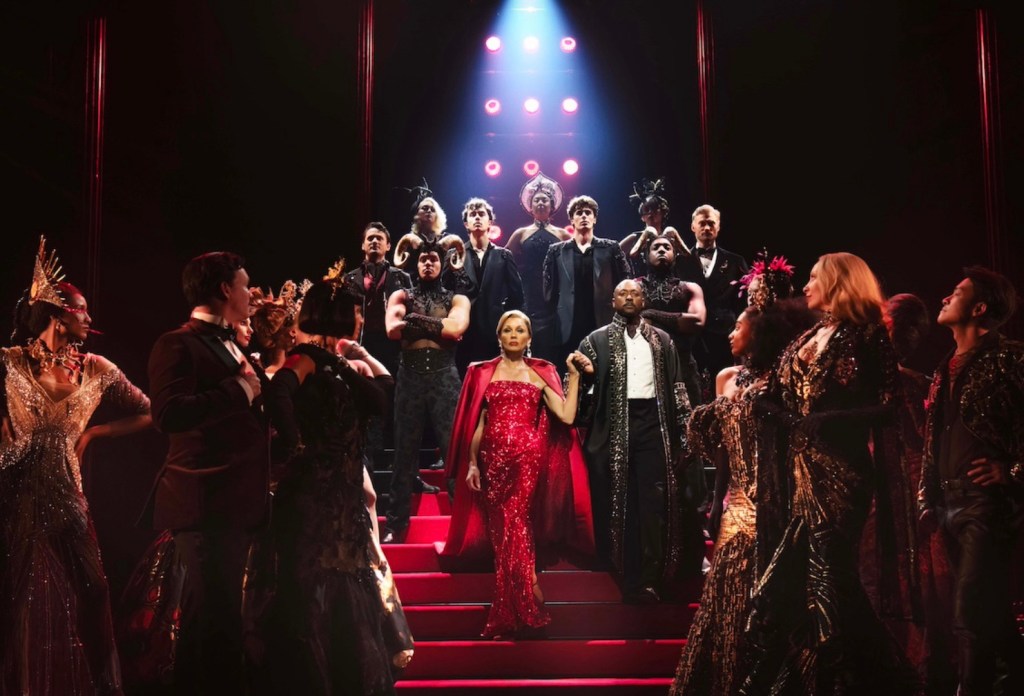
THE DEVIL WEARS PRADA
Music by Elton John
Lyrics by Shaina Taub and Mark Sonnenblick
Book by Kate Weatherhall
based on the novel by Lauren Weisberger and the Twentieth Century Motion Picture screenplay
directed by Jerry Mitchell
Dominion Theatre, London – open ended run
https://devilwearspradamusical.com
Slinging money at something is fine in the short term but doesn’t necessarily work as a lasting solution. Theatrical evidence of that is currently to be found at the Dominion where The Devil Wears Prada, a new musical adapted from the beloved Meryl Streep-Anne Hathaway movie of 2006 and Lauren Weisberger’s roman à clef inspired by her tenure as an intern under Anna Wintour at Vogue, has landed in a sumptuous production, one of the most lavish on any current London stage. It’s not a great tuner but it has a flash and sparkle that will keep many theatregoers happy for now and you certainly won’t be questioning where the cost of your ticket went.
The opulence is all – big cast, expansive sets, mostly gorgeous costumes, fabulous wigs and make-up, ingenious state-of-the-art lighting – but it can’t mask the fact that this feels like a show created by committee (albeit a distinguished one including Tony winners Elton John and Shaina Suffs Taub, both of whom seem to have been asleep at the wheel when crafting this one) with no discernible purpose beyond the fact that nobody else had turned The Devil Wears Prada into a musical yet. It scores highly on slickness and gloss but falls short in many other areas.
This is apparently the season for adapting Meryl Streep movies for the stage what with this opening within weeks of the triumphant Death Becomes Her musical on Broadway. But that thrilling gothic camp-fest scores because it legitimately feels as though those glamorous, overwrought undead divas and their acolytes would express themselves through song, while The Devil Wears Prada’s characters (mostly glamorous, very much alive divas) don’t automatically feel like people who would sing and dance.
That’s especially true of Miranda Priestly, the tyrannical high fashion magazine editor immortalised by Streep on film and embodied here by Vanessa Williams in a performance remarkably similar to her Whilemina Slater in TV’s Ugly Betty. Williams is divine of course – charismatic, commanding and unimpeachably elegant – but she has an innate warmth and sense of underlying mischief that suits the imperious Miranda less well than Streep’s infinitely chillier portrayal. Giving her songs (although, interestingly, no big solo) makes things worse as having a character sing gives an insight into their heart and soul, and humanising Miranda in this way compromises her mystique and authority. Still, it’s wonderful to have Williams back on the London stage following the 2020 City of Angels Donmar transfer that didn’t even make it to opening night thanks to the pandemic, and you’ll be in no doubt that you’re in the presence of a true star.
She’s not the only star in Jerry Mitchell’s production. Amy Di Bartolomeo’s passive-aggressive, fashion obsessed personal assistant is a glorious, vivid creation, and one of the few examples of the musical equalling the screen original. Her comic timing is marvellously on point, she sings like a diva and, similarly to Emily Blunt in the film, you like her even when she’s being perfectly dreadful, mainly because Di Bartolomeo, who emerges here as the sort of talent whole productions get built around, suggests a deep insecurity underneath the high gloss bitching.
Georgie Buckland inherits Anne Hathaway’s mantle as Andy Sachs, the aspiring scribe who sees her position as PA on an upmarket fashion magazine as a mere stepping stone to her loftier literary ambitions, and is principal victim of Kate Weatherhead’s book’s simplification and defanging of the tart cruelty of Aline Brosh McKenna’s original screenplay. Where Hathaway’s Andy was comically befuddled by being such a fish out of water and got some lovely self-deprecation to play, the stage version just comes across as jarringly whiny and self-serving, becoming plain obnoxious when she gets to Paris and discovers she loves the glamour and the limelight. She’s now simply not an interesting or likeable enough figure to carry the generic belty numbers that close each act. Having her apologise for her behaviour to her manipulative boyfriend (Rhys Whitfield, doing his best in a thankless role) near the end feels like another misstep in this day and age. Their playful duet about only loving each other for their bodies is presumably intended to be sexy and ironic, but is mostly just excruciating.
As Nigel, the art director who guides Andy through the Manolos and the Choos, Matt Henry has less to work with than Stanley Tucci in the film but does nicely by his heartfelt number about the gay boy from the sticks who fulfilled his dream of being influential in the fashion business. While obviously musical theatre and the screen are very different mediums, Weatherhead’s stage script quotes whole chunks of the film verbatim while never offering anything revelatory or stimulating in the areas where it deviates from the familiar.
John’s buoyant but unmemorable music often has a country flavour, which feels strange for a story set almost entirely in Manhattan, and Taub and Mark Sonnenblick’s lyrics are serviceable. The nearest things to outright showstoppers that the show can muster – Priestly’s ‘House of Miranda’ introduction, the title song and Nigel’s aspirational disco banger ‘Dress Your Way Up’ – tend to beat you into submission by sheer volume (Gareth Owen’s sound design is nothing if not forceful) and repetition rather than inspiration. This is a far less ambitious score than John’s Tammy Faye which has just flopped hard on Broadway.
Where The Devil Wears Prada really does soar on stage is in its visual aspects. From Tim Hatley’s gleaming scenery, conjuring up the NYC and Paris of our dreams from deluxe corporate offices to catwalk to elegant supper club, Bruno Poet’s richly textured lighting and Gregg Barnes’s couture-adjacent outfits, this is a real feast for the eyes.
Probably best not to dwell on the statuesque female ensemble members suddenly being attired in 1940s wear with their shoulder pads, cinched waists and elaborate hats when the show moves to the City of Light (the story’s set in the early 2000s), or that Mitchell’s undistinguished choreography seems to consist mainly of standing about with one arm raised heavenwards, or voguing and pointing. I get it that it’s hard to dance in heels but a little more effort wouldn’t go amiss, especially at these ticket prices. Still, Vanessa Williams’s first entrance, up through the floor in scarlet power dressing and outsize sunglasses, is pure showbiz, and the climactic red, gold and black costume ball that ends the first half, on a gargantuan staircase giving Phantom a run for its money, is seriously stunning.
The Devil Wears Prada isn’t a bad night out, and the sense of occasion that accompanies the arrival of a show on this scale is always exciting, but it does seem disappointingly by-the-numbers as a musical. There’s a latent cynicism in its prioritisation of bombast and easy spectacle over real originality and character exploration: where some stage-to-screen adaptations such as Hairspray, Billy Elliot or the aforementioned Death Becomes Her elevate their source material, this one slightly diminishes it. It’s enjoyable but it ultimately feels like an expensive, beautifully wrapped gift package with very little inside it.
 ajhlovestheatre
Leave a comment