MY FAIR LADY
Book and lyrics by Alan Jay Lerner
Music by Frederick Loewe
adapted from George Bernard Shaw’s Pygmalion and the screenplay by Gabriel Pascal
The Curve, Leicester – until 4 January 2025
Lerner and Loewe’s beloved classic gets trotted out fairly often (Opera North and Leeds Playhouse co-produced it earlier this year and the New York Lincoln Center version played a summer season at the London Coliseum in 2022 before touring extensively) and its choice as Leicester Curve’s 2024 Christmas musical seems like a sure fire bet to get bums on seats. Director Nikolai Foster and an outstanding creative team don’t treat My Fair Lady like a museum piece however, breathing vibrant life and projecting interesting insights at a show that, while exquisitely crafted, runs the risk of over-familiarity. There is clearly a lot of respect for the original material here but also a bracing freshness that interrogates it with intelligence and affection.
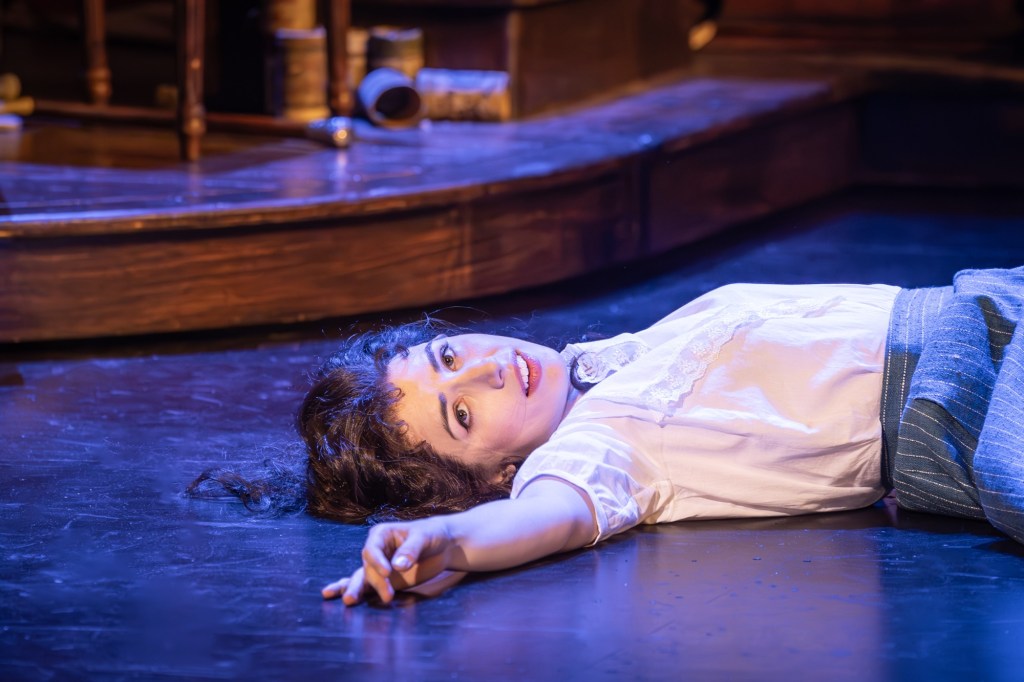
Any production stands or falls by its Eliza Doolittle, the Covent Garden flower girl who transforms into a society lady, and Professor Higgins, the phonetics expert who navigates that transformation, and Foster’s new version has struck casting gold. Molly Lynch’s dazzling Eliza has unique passion and fire tempered with the suggestion that she is already a somewhat damaged soul (observe the way she reacts when she thinks she’s about to be hit) desperately clinging to this one-off opportunity to rewrite the story of her life. She’s tremendously loveable but also tough, it’s the most complex and satisfying reading of the role I’ve seen to date, and watching her progressing empowerment is exhilarating. Vocally she’s absolutely thrilling, seamlessly traversing from chest to head voice with sweetness and power. It’s a demanding sing, nearer to opera than musical theatre with the demands it makes on the soprano, but Lynch makes it seem easy. This is a genuine star performance.
Equally sensational is David Seadon-Young as a more youthful than usual Higgins. Seadon-Young plays him like a restless child, petulant and impetuous, somebody who lives entirely in the moment, regardless of the consequences for himself or others. This doesn’t excuse the character’s frequently appalling behaviour but it certainly makes it fully credible. Unlike many of his predecessors in the role, Seadon-Young sings the role as written and does so exquisitely. He’s also surprisingly moving, turning the song ‘I’ve Grown Accustomed To Her Face’, usually merely regretful and reflective, into a full blown cri de cœur to stunning effect. His physical relationships with two of the senior women in his life is very telling: note the way that, energy spent following a tantrum, he rests his head on the shoulder of his housekeeper (a wonderfully warm Sarah Moyle who also doubles as a hilarious society matron), or how his mother (Cathy Tyson, coolly commanding) freezes when he initiates comforting contact with her.
Foster finds other fascinating perspectives on a show that has been done to death but can have real bite when looked at as smartly as it is here. Minal Patel’s superb Pickering is played as actually Indian rather than an old colonialist returned to London, and he is explicitly portrayed as being in love with Higgins. Housekeeper Mrs Pearce is a member of the suffrage movement, which makes sense given the man-child she is dealing with on a daily basis, and Eliza has a forthright sensuality which I’ve never seen before and lends an intriguing ambiguity to her dealings with Djavan Van de Filert’s fresh-faced, gorgeously sung Freddie.
Steve Furst’s magnetic, amoral rough diamond Alfred P Doolittle is a terrific creation and authentically stops the show with the second act crowd pleaser ‘Get Me To The Church On Time’, staged with barnstorming panache by choreographer Jo Goodwin, whose work throughout is glorious but verges on the rapturous in this number. Foster spreads the action generously throughout the auditorium, and he and Goodwin make delightful use of Curve’s youth theatre members (having them as galloping jockeys in the Ascot scene is particularly inspired).
Michael Taylor’s handsome set, imposing for Covent Garden and mind-bogglingly cluttered for Higgins’s study, is generally effective (the mood-shifting lighting is by Mark Henderson) and his costumes are lovely. The sound design by Adam Fisher is more boisterous than one would normally expect on a Golden Age musical like this one, bringing to the fore the percussion in George Dyer’s adapted orchestrations. This is far and away the loudest Fair Lady I’ve encountered, and while it sounds punchy and vital there are moments when the relentless volume has a slightly flattening effect. The ensemble singing is wonderful though.
That sound quibble aside, this is a superlative production that will delight traditionalists but provides sufficient innovation and excitement for anybody who might have thought of My Fair Lady as a bit staid. The two leads are worth the ticket price by themselves, and a festive trip to Leicester is essential for musical theatre fans.
 ajhlovestheatre
Leave a comment