BARCELONA
by Bess Wohl
directed by Lynette Linton
Duke of York’s Theatre, London – until 11 January 2025
With Camp Siegfried at the Old Vic in 2021, American playwright Bess Wohl gave London audiences a two hander that starts out pretty innocuously before becoming deeply unsettling. Now she’s at it again with Barcelona, which predates the other play by several years but packs just as potent a punch, served up with a side order of intrigue, a lot of humour, some menace, and, in Lynette Linton’s exquisitely calibrated, shape-shifting production, irresistible star power.
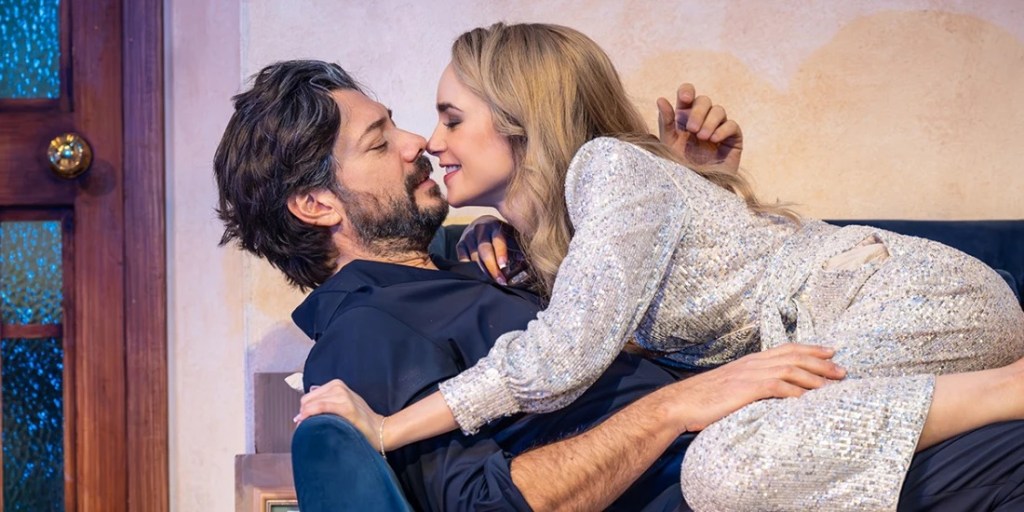
This UK premiere features the stage debut of Netflix smash Emily In Paris’s Lily Collins, once again playing a kookie, sometimes crass, American adrift in an unfamiliar European city, in this case the capital of Catalonia, home to Gaudi and Miró. La Sagrada Família is just something Collins’s Irene has read about in a guidebook though: when we first see her, visiting Barcelona as part of a bachelorette party, she’s hammered, bursting into an apartment, wrapped around Manuel, a local guy she picked up in a bar. This production is also the British stage bow of Spanish star Álvaro Morte, best known here as a lead in another Netflix show Money Heist, and his performance turns out to be just as much of an event. The sexual tension between the two actors is combustible, and so is the sense of implied threat when required (there’s a moment where Manuel informs Irene that there are no other people in the building, and it’s like an ice cold wave briefly breaking over the stage).
Initially, Irene is every European’s worst nightmare of vulgar Americans abroad -puke drunk but motormouthed, using Italian instead of Spanish phrases, constantly calling Manuel “Manolo”, harping on about being proud to be an American without giving concrete reasons why- and she’d probably be pretty unbearable were it not for Collins’s innate likability. Collins displays the comic instincts and physicality of a true clown (“I nearly fell” she mutters, having ended up spreadeagled on the floor). Morte’s Manuel watches her with a detached mixture of amusement and exasperation.
One of the principal pleasures of the early section of the play is observing the wildly differing energies of these two characters: Irene’s a caffeinated ball of self-absorption while Manuel has a panther-like sensuality and off-handed charisma. They could almost be human metaphors for their respective continents of origin. The sparky banter about cultural and political differences -her sunny eagerness contrasting with his laconic bemusement- is pretty predictable but the charm of the actors and the steady eroticism keep it interesting. Wohl laces her text with surprises; Irene is more perceptive and less of a naïf than she first appears, and Manuel is nursing a deep well of hurt. It’s a love story of sorts, but not in the way one might presume.
There are clues from the get-go: watch the subtle projections (by Gino Ricardo Green) as they dance on the back wall of the stage before the play even begins, as well as at certain points in the performance. Frankie Bradshaw’s detailed apartment set poses its own questions; it’s cosy yet strangely discomfiting, especially in tandem with Duramaney Kamara and Xana’s complex, doomy soundtrack. Lighting designer Jai Morjaria bathes it in the warm orange of a Catalan night, which changes tellingly over the course of the hundred minute duration. It’s a play that refreshingly defies categorisation and Linton has assembled a team fully alive to its quicksilver shifts in mood, power and focus. Visually the show shimmers, dramatically it alternates between balm and sizzle, and at the centre of it all is a pair of note perfect performances, playful but deeply felt.
Lynette Linton also helmed the previous occupant of the Duke of York’s, the marvellous Shifters, another inspired two hander, which transferred from the Bush Theatre, where she is artistic director until next year. This exquisite production demonstrates the same flair, freshness and loving attention to detail in an unabashedly commercial project, as she brings to homegrown ventures at the West London venue she has transformed into a powerhouse of artistic integrity and effortless cool.
Wohl’s dialogue is snappy and funny, but taps into rich veins of feeling when necessary, and Collins and Morte inhabit it fully. Barcelona is ultimately a fairly slight play, but it’s genuine entertainment, and such care and talent have been lavished on it for this West End premiere that it feels like a deserved popular hit. I hope this isn’t the last we see of Collins and Morte on the British stage.
 ajhlovestheatre
Leave a comment