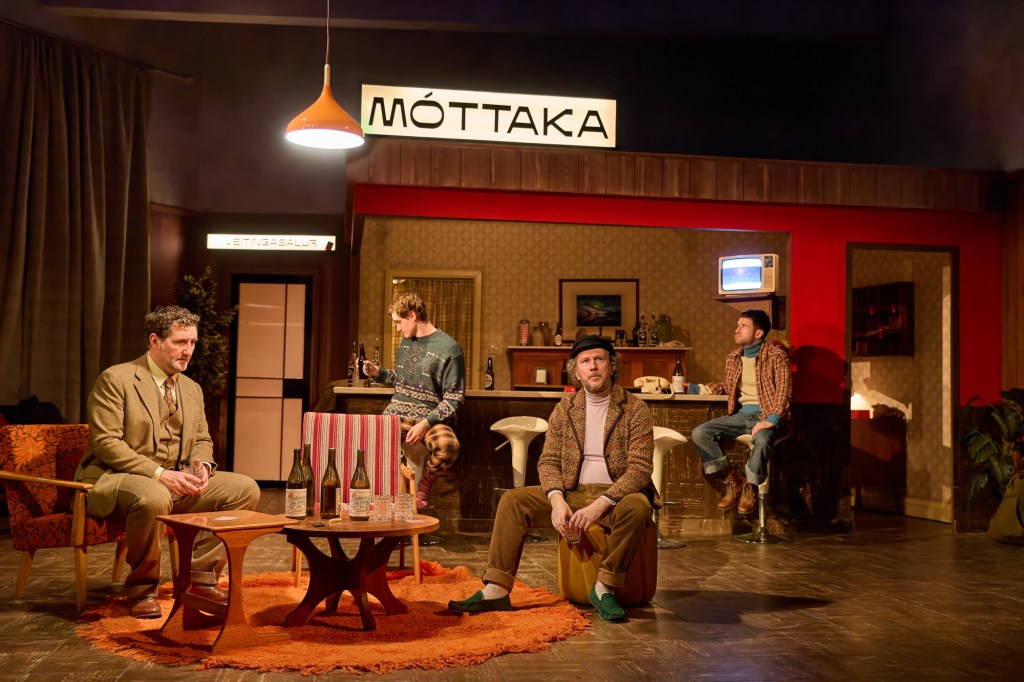
REYKJAVIK
by Richard Bean
directed by Emily Burns
Hampstead Theatre, London – until 23 November 2024
https://www.hampsteadtheatre.com/whats-on/2024/reykjavik/
Imagine a fusion between Conor McPherson’s The Weir, where the regulars of a rural Irish pub sit around scaring each other with ghost stories, and the gritty, character-driven idiosyncrasies of Jez Butterworth. Leaven that with ripe low comedy, and further enrich with trenchant social commentary and a unique evocation of recent history… then you’ll have some idea of what to expect from Richard Bean’s engrossing if uneven new play.
Set in the late 1970s in the aftermath of the UK referendum on membership of the Common Market (Bean wisely doesn’t beat us over the head with modern parallels but they’re certainly there) Reykjavik begins in the offices of a Hull fishing trawler firm, rendered spookily dusky in Anna Reid’s detailed set. One of the company’s fishing fleet has come to grief off the coast of Iceland and owner Donald Claxton (John Hollingworth, excellent) is working a late night dealing with the fallout from that. He’s disturbed by the arrival of Lizzie, one of his workers wives (Laura Elsworthy, all blazing eyes, querulous dignity and aggrieved fury) and an almost-seduction surprisingly occurs. Hollingworth and Elsworthy have palpable chemistry, but that turns out not to be the point of the play.
Actually the first half is more of a milieu-establishing curtain raiser for the much longer second half which relocates the action, such as it is, to the lobby of the Reykjavik hotel (another period-specific masterpiece of sublime grimness by Reid) where the survivors of the fishing ship disaster are temporarily lodging. These include Jack, Lizzie’s bullying, possibly unstable “nasty bastard” of a husband (played with alarming intensity by Matthew Durkan, in impressive contrast to the mild-mannered young vicar he portrays in act one). Claxton arrives to check up on the men and the play becomes an interesting exploration of the division between management and workers (a point powerfully underlined by a quietly haunting final tableau) and, by extension, class.
Bean’s script touches on traditions within the coastal communities, and the mysticism and treachery of the sea, and the characterisations of the men are vividly drawn. The women, which also include a gauche secretary to Claxton, and Einhildur, a comically fierce Icelandic hotelier (both played with considerable skill and glee by Sophie Cox), feel less fleshed out. Elsworthy and Cox are so good that the somewhat trite way Bean has their characters drop their defences and change their attitudes doesn’t really hit home while you’re actually watching the play unfold, but it’s the men who carry the bulk of the somewhat static text.
Emily Burns’s staging is longer on atmosphere and garrulousness than action, but it is superbly acted, and beautifully augmented by striking lighting, sound and compositions by Oliver Fenwick, Christopher Shutt and Grant Olding respectively (the sea shanty singing is authentically stirring). If most of the second half consists of the men telling a selection of tales (of varying levels of interest, to be honest) to keep each other amused, the tension and suspense ramp up satisfyingly when required.
This being a Richard Bean play, there is a welcome vein of comedy running through the play. The section where the fishermen conflate and mansplain, with mounting frustration and incoherence, the common phrases regarding pissing on chips and pissing on someone when they’re on fire, is hilarious, and culminates in an unexpected bit of stage business. There’s even some macabre comedy involving a deceased seaman and his coffin that wouldn’t look out of place in Joe Orton.
Despite the comic flair of Cox’s performance, I didn’t quite buy sceptical Einhildur’s capitulation to Adam Hugill’s gormless romantic chancer, nor his decision to remain behind in Reykjavik after the other men have returned, but the drip-feeding of information throughout is very nicely done. Bean’s ear for salty, sparky dialogue (Lizzie self describes as “I’m thirty three. I look older. It’s the wellies” when asked her age) and bold use of language remain a frequent delight.
Bean’s writing and Hollingworth’s performance are too intelligent to make a villain out of Claxton’s capitalist trawler owner, and the other men are similarly nuanced. Paul Hickey delivers a quietly astonishing double as critical Claxton Sr. and Quayle, a loquacious Irish sea dog with a gift for tall tales and an ambiguous connection to the supernatural.
That ambiguity hangs over Reykjavik like a sea mist. It’s a slightly overlong evening, but an enjoyable, intermittently intriguing one that depicts a community and a tranche of humanity seldom seen on stage.
 ajhlovestheatre
Leave a comment