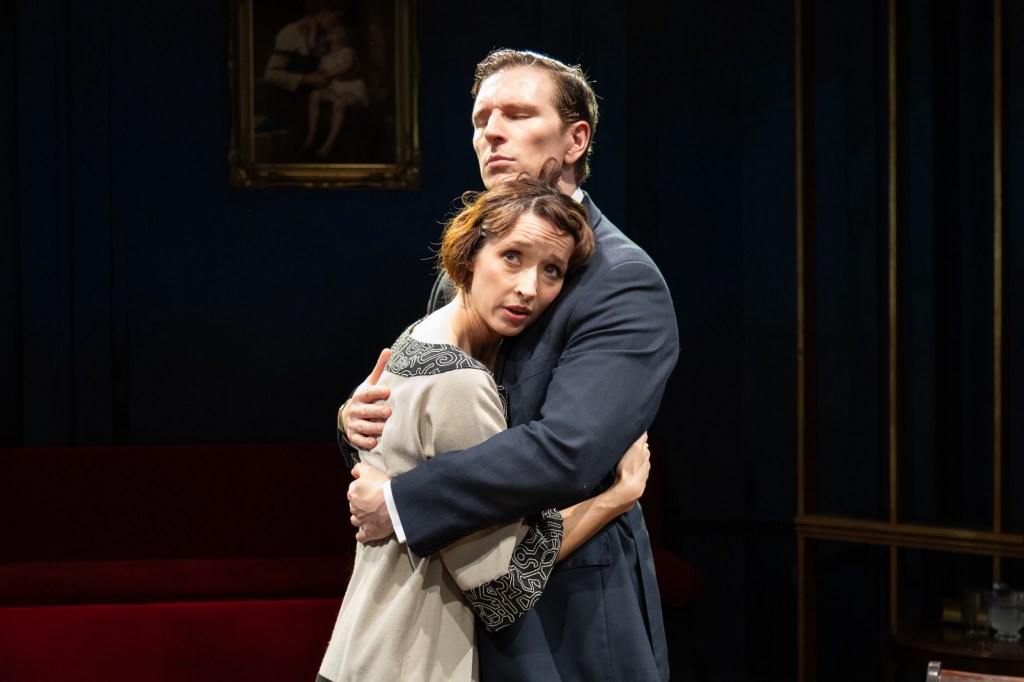
Alix Dunmore and George Watkins, photograph by Carla Joy Evans
THE SILVER CORD
by Sidney Howard
directed by Joe Harmston
Finborough Theatre, London – until 28 September 2024
https://finboroughtheatre.co.uk/production/the-silver-cord/
Not seen on the London stage since the original West End production of 1927, this American play feels like a remarkable rediscovery, one that genuinely begs the question why isn’t this engrossing, engaging piece seen more often. It’s not a stretch to imagine Sidney Howard’s script, which is neither comedy nor melodrama although it has delicious lashings of both, on one of the National stages, or at the Almeida or the Donmar. Anyway, here it is in a flawless, wonderfully acted in-the-round production by Joe Harmston in one of the fringe’s most intimate yet enterprising venues, and it’s a real gem.
Set in the 1920s in an affluent household in rural New England, The Silver Cord (the title is a reference to the mythical bond between parent and child, but particularly mother and son) sees an emotionally manipulative widow Mrs Phelps (Sophie Ward, in a sensational return to the London stage) wreak devastation on the relationships of her two grown-up sons. DH Lawrence in Sons and Lovers would recognise the dynamics in this play, as would the Tennessee Williams and Noël Coward who gave us The Glass Menagerie’s Amanda Wingfield and The Vortex’s Florence Lancaster respectively: there is something especially fascinating about mother’s love going awry. When a life-giving force curdles into something strangulating and poisonous, that sense of nature perverted makes for great drama, and so it proves here.
Mrs Phelps is a grimly glorious creation. On paper she looks like Mother Of The Year but in reality she’s nearer to a species that eats its young. A wealthy widow whose marriage was unfulfilling, she controls her children by subtly pitting them against each other (she craftily tells whichever son she’s talking to any given moment that he takes after her, whereas the other one is like their late father), and referring often to a life-threatening (and fictitious) heart condition that could carry her off at any moment. It’s telling that older son David (George Watkins) has to move 3000 miles away to fall in love.
The role is an absolute gift for an actress and Ward unwraps it joyfully. She is all surface charm, with a beatific smile that with just a small adjustment of the eyes turns from benign into something completely chilling. This is the sort of woman who can make a single word sound like a weapon of mass destruction: note the deadly way she repeats the name “Omaha” when learning that is the home state of her newly acquired daughter-in-law, just dripping with judgement and dismissal. There is a surprising degree of high camp to Howard’s writing for her (she’s prone to grand, deranged pronouncements like “everybody knows that aviators are lunatics!”) but Ward plays it, brilliantly, for real which adds to the sense of underlying danger. It’s a magnificent performance, one that commands the stage by stealth.
Equally terrific is Alix Dunmore as Christina, the daughter-in-law who proves Mrs Phelps’s match, at least until she wavers in her conviction that this is even a battle worth fighting. Dunmore imbues the younger woman, a biologist on the verge of a stellar career in a field where women are scarce, with an innate kindness and a fierce intelligence. When she squares up to her tyrannical maternal nemesis, demolishing the carefully constructed walls of the toxic family edifice with the precision and insight of a scientist, it’s thrilling to witness. She’s also extremely affecting as she delivers a heartbreaking ultimatum to her new husband. This is acting of the highest order.
The writing for the female characters is outstanding. Jemma Carlton also excels as Hester, the fragile partner of infantilised second son Robert (Dario Coates, superb), who gets a glorious worm-turning moment near the end where she proclaims she is off to marry an orphan….and really who can blame her. George Watkins does a fine job of conveying older son David’s anguish as he’s torn between a wife he adores and a mother whose metaphorical teeth are embedded deep within him, even making sense of some bewilderingly fast changes of allegiance, one of the few shortcomings in the text.
What’s remarkable is how modern the play feels, despite some of the language and the spare period elegance of Carla Joy Evans’s costumes and Alex Marker’s set which feels simultaneously and appropriately like an opulent home and a cage. The psychological insights are so acute, the relationships so plausible…it’s impossible not to become invested, especially in such an intimate space. The kitschy artworks on the wall, each depicting sugary, romanticised visions of parenthood, look harmless enough when you enter the auditorium but feel positively sinister when glanced at while you’re leaving.
This really is an event. A majestic, criminally overlooked play, rediscovered in an utterly marvellous staging. The Finborough is tiny, tickets are scarce, but this really is a must see for anybody who craves meaty, multi-faceted drama. This is a hell of a resuscitation job.
 ajhlovestheatre
Leave a comment