THE REAL ONES
by Waleed Akhtar
directed by Anthony Simpson-Pike
Bush Theatre, London – until 26 October 2024
https://www.bushtheatre.co.uk/event/the-real-ones/
Waleed Akhtar’s The P Word, an astonishing, urgent drama of two gay Pakistanis finding the UK a less than welcoming environment, was an event that deservedly won the 2022 Olivier for Outstanding Achievement in an Affiliate Theatre, an award that for several years seems to have come with the Bush Theatre’s name pre-engraved upon it. This is Akhtar’s first new play since, and expectations are inevitably high, especially as it’s at the same venue and boasts the same director (Anthony Simpson-Pike). It’s disappointing to report that, while perfectly watchable, The Real Ones is less interesting and a lot less affecting than the earlier play.
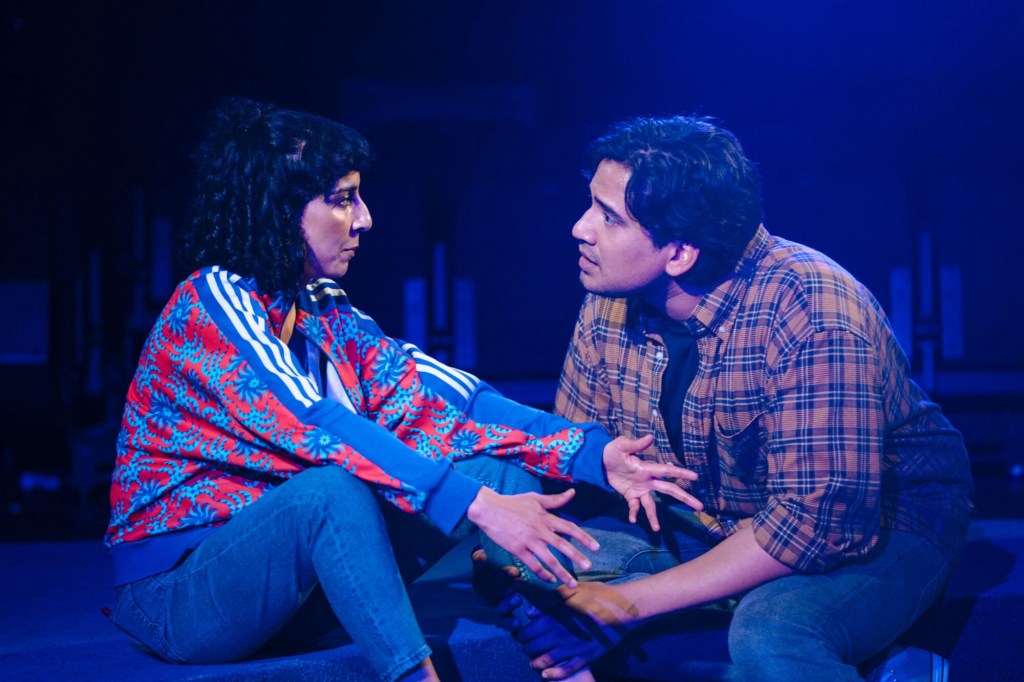
It’s a story of friendship between two British Pakistanis, feisty, forward-thinking Neelam (Mariam Haque) and blustering, Peter Pan-ish Zaid (Nathaniel Curtis), both aspiring writers, and both slightly at odds with their traditional families. We see them between the ages of nineteen to thirty six, their ages for each section projected into the back curtain of Anisha Fields’s spare, open set. When the play begins, Neelam is no virgin and Zaid is coming out as gay, both facts that are likely to cause consternation within their families should they ever find out.
It’s an interesting premise but Akhtar is more concerned with tracing the arc of friendship from teenage to just before middle age. He also explores, albeit not very deeply, racism and snobbery in non-white communities as Neelam gets into a relationship with a British Nigerian (Nnabiko Ejimofor’s Deji) whose family consider themselves several social strata above her.
Although beautifully played by Ejimofor, an alumni of the original cast of For Black Boys…., Deji seems a bit too good to be true, even willing to pretend to be Muslim in order to mollify Neelam’s parents and gain permission to marry their daughter. I didn’t completely buy that. Nor did I believe that Neelam and Zaid’s friendship would be so damaged by the arrival of her first child. Temporary estrangements in friendships under such circumstances, where participants have wildly differing commitments and domestic arrangements, are surely a fact of life, but it feels as though this is being offered up here as something revelatory.
Akhtar’s dialogue is funny and authentic though, particularly in the way Neelam develops from raw and streetwise to more articulate and subdued, but with the spiky edges still occasionally forcing through. Haque embodies her brilliantly, following off-the-cuff statements with a momentary intense stare as if to gauge how what she’s just said is going down. She’s at once fierce but not quite comfortable in her own skin, at least not at first. The scene where she turns on a well intentioned but patronising white theatre practitioner trying to get her to spice up her play dealing with her own community (“so you want me to change my play for your white audience and you’re not even going to pay me?”) is savagely well done.
By contrast, Zaid feels irredeemably self absorbed and whiney, at least in Curtis’s rather one-note performance. While one sympathises with his coming out struggles, Zaid ends up living his best life having his play produced, living with an affluent boyfriend yet still manages to appropriate other people’s dramas: he wants to come out to his dad straight after the man has had a life-threatening stroke, despite Neelam’s entreaties not to, and manages to make his friend’s postpartum struggles and his partner’s unemployment anguish all about him. Although he’s good at throwaway comedy, Curtis struggles to make any of Zaid’s hurt or anguish, whether it’s about being temporarily homeless or uncertainties over the sexual opening up of his relationship, seem deeply felt. There are indications in the text that Zaid should be as scrappy and streetwise as Neelam but there’s nothing in the performance to indicate that.
Zaid’s partner, white, older Jeremy (a convincing Anthony Howell) is also a playwright and as his professional star wanes just as Zaid’s rises, Akhtar starts but quickly discards a potentially fascinating study of increased diversity in the arts and how the whole “pale, male and stale” label has come into vogue. Elsewhere, the discussions around writing are frustratingly non-specific, although there is a suggestion that Neelam is the genuine talent, although she ends up not doing anything professional with it.
Simpson-Pike’s well paced staging is flashy and slick, although the decision to have the centre of the set a sunken circular space where a lot of the action takes place causes some sight line problems if you’re not at the front or the ends of the banks of seating. XANA’s ear-splitting sound designs and thudding music, and the very busy video work of Matt Powell, are all quite impressive but feel as though they are there more to deflect attention from a lack of real dramatic power in the script.
Although the storytelling is linear, the text is punctuated by a repeated sequence of young Zaid and Neelam off their faces on a dance floor swearing ongoing love and support (“we’re gonna be fucking brilliant!”) and it should be moving, but it doesn’t feel as though we’re given enough to care about in the course of the 100 minute duration, so emotional investment is hard to make. The ending is surprisingly bleak but your reaction to it may depend on how you view these central characters.
The P Word wasn’t Akhtar’s debut play, but it was a career-redefining one, and The Real Ones feels like that tricky second play. It’s enjoyable if frustrating, and there is some cracking dialogue in there. That, and Haque’s detailed, intelligent, emotionally charged work makes it worth seeing, but I’m more looking forward to seeing what Akhtar gives us next.
 ajhlovestheatre
Leave a comment