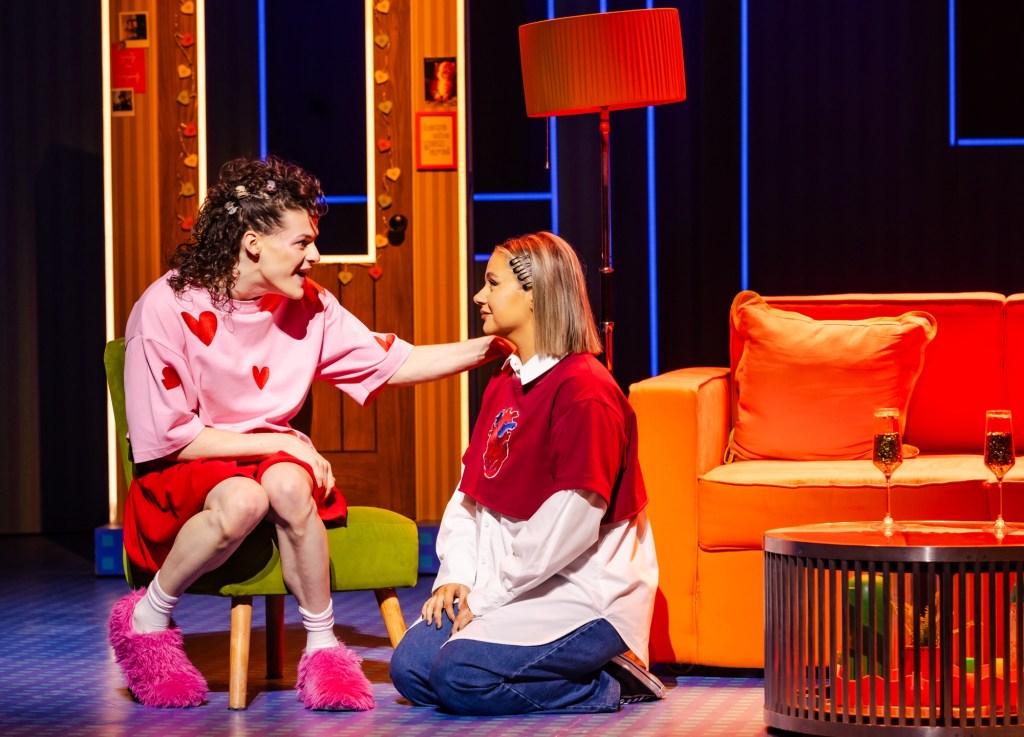
WHY AM I SO SINGLE?
by Toby Marlow and Lucy Moss
directed by Lucy Moss
co-directed and choreographed by Ellen Kane
Garrick Theatre, London – booking until 13 February 2025
If this review is harsher on a bouncy, tuneful and frequently highly entertaining new musical than perhaps it initially seems to deserve, that’s because it’s frustrating that a show with so many stellar elements has failed to coalesce into a satisfying, or even coherent, whole. In short, Why Am I So Single?, Toby Marlow and Lucy Moss’s follow-up to the lightning-in-a-bottle global smash Six, four years in the making and launched straight into the West End in a sparkly, bells-and-whistles staging when it would have benefitted from a smaller scale tryout elsewhere, should be better crafted than this.
Six is essentially an artfully witty concert rather than a proper tuner and, on the strength of this highly meta, self-proclaimed “Big Fancy Musical”, the jury’s still out on whether or not Marlow and Moss know what makes the genre tick. They certainly love, and are knowledgable about, musical theatre: even more than its predecessor, Why Am I So Single? is stuffed to the gills with references to other shows. The stand-out number ‘8 Dates’, which is infinitely more appealing live than on the promotional videos floating around, even samples Six’s title song.
But constantly alluding to other, better musicals does not in itself a decent musical make, and the book for WAISS, which depicts a pair of best friend creatives working on, you’ve guessed it, a “big fancy musical”, while simultaneously contemplating their lamentable love lives, is an absolute mess, with a bewildering string of false endings, several numbers that should never have made it past the first workshop, and a lack of specificity about the principal characters that makes it hard to care about them. Or at least it would were Jo Foster and Leesa Tulley not so utterly adorable in these roles.
Whatever else WAISS gets wrong, the casting for this world premiere, not just Foster and Tulley but also Noah Thomas as an acerbically cool mutual friend and a dynamic, personable ensemble many of whom are making their professional debuts, is absolutely spot on. The charisma and talent of the company is doing a lot of heavy lifting of sometimes iffy material.
The show looks at the sometimes brutal world of dating and relationships through a smart, tart Gen Z lens, and touchingly concludes that platonic friendships are every bit as valid as erotic and romantic liaisons. Tulley’s character Nancy, although winningly played, feels pretty conventional as she hankers after a lost boyfriend but Foster’s Oliver (the young writers are superfans of the Lionel Bart tuner, a point hammered home relentlessly) is genuinely special. It’s hard to think of another mainstream entertainment where the central figure is a non-binary human trying to take their place in the world and feel fully comfortable in their own skin, but where their inability to connect is as much down to their own determination to set up a veneer of sassy, comic self-protection as it is to an uncomprehending, unsympathetic universe. & Juliet’s May (which Foster has previously played) isn’t dissimilar but is a second wheel to the heteronormative relationships at that show’s centre. Oliver is a new type of musical theatre lead, and Foster is a new type of star, but a star they most assuredly are.
Foster, mining every ounce of cheeky humour, irrepressible wit but also despair-tinged melancholy from their role, gets the song where WAISS comes nearest to achieving genuine dramatic power. ‘Disco Ball’, a pounding, relentless dance track sees sparkles-clad Oliver on a platform above a melee of hedonistic revellers, belting about how hard it is to find love and self-acceptance when queer people have to subsume their humanity and desires beneath a shallow, glittery exterior in order to find acceptance. The juxtaposition of high energy, camp dance music with bleak lyrics (“no one wants to see the broken ugly pieces of a disco ball up close”) and an increasingly distraught Oliver, is authentically bittersweet and moving.
Elsewhere the songs are less theatrically and emotionally ambitious but collectively the score reinforces the impression created by Six that Marlow and Moss are brilliant at pop pastiche earworms. They extend their pallet here with nods to numerous musical theatre styles, and a few moments that actively parallel the numbers in Oliver!. At its most exhilarating, which in all fairness occurs several times in each act, their songwriting is reminiscent of the melodic ebullience of Max Martin.
Tulley gets a pair of gorgeous ballads, both delivered exquisitely, and there’s an inventive showstopper for Thomas (‘C U Never’, a witty dismissal of bad behaviour in online dating) deriving its beats from the sounds made by cellphones, and given thrilling, stomping choreography by Ellen Kane. An emo rock number blaming the sitcom Friends for a whole generation’s unrealistic romantic expectations is very funny, with the entire ensemble wigged and costumed up as Ross and Rachel. Not all the comedy songs work that well though: there’s a bizarre act one closer about finding a bee in Oliver’s flat that is more baffling than delightful, and jokily having the ensemble playing inanimate objects (fridge, curtains, dustbin, pot plant) in said flat is more student drama cringey than actually amusing.
Kane’s dances throughout are athletic and stylish, embracing a variety of styles but mainly occupying the sweet spot where contemporary musical meets pop video. It’s when the singing and dancing stops that show runs into trouble and the ennui sets in. Although Oliver and Nancy readily point out the flaws in the work-in-progress that they’re creating and that we’re witnessing, the show demonstrates little interest in improving on it and there are times when watching naff material is just, well, watching naff material. For all their friction and romantic disappointments, these best friends seem to live a life of cosy privilege, fuelled by takeaway pizza and an apparently endless supply of Prosecco, so that sometimes it’s solely the (irresistible) personalities of Foster and Tulley that cause us to care, rather than the writing.
Moss directs in a straightforward, presentational style (the only real excitement in the staging is due to Kane’s choreography) and one can’t help but wonder if the show wouldn’t have benefitted by a different person at that helm. Surely a more experienced and possibly ruthless director would have realised that Why Am I So Single? meanders on way past what’s bearable; the show could accurately be retitled Why Is This So Long?
There’s a punchy, hilarious, heartfelt ninety minute delight of a show entombed in this bloated two and a half hour extravaganza that in its present form – more sketch show with songs than well-crafted musical – is equal parts inspiration and self-indulgence. It’s just a shame that the creatives didn’t take, or weren’t given, the time to find it. Stephen Sondheim famously opined “musical comedies aren’t written, they’re rewritten” and, for all the frothy fun, moments of insight and uplift, and sheer elan of the performances, Why Am I So Single? needs a lot more rewriting. I can’t wait for the cast album though.
 ajhlovestheatre
Leave a comment