WORMHOLES
by Emily Jupp
directed by Scott Le Crass
Omnibus Theatre, London – until 10 August 2024
https://www.omnibus-clapham.org/wormholes/
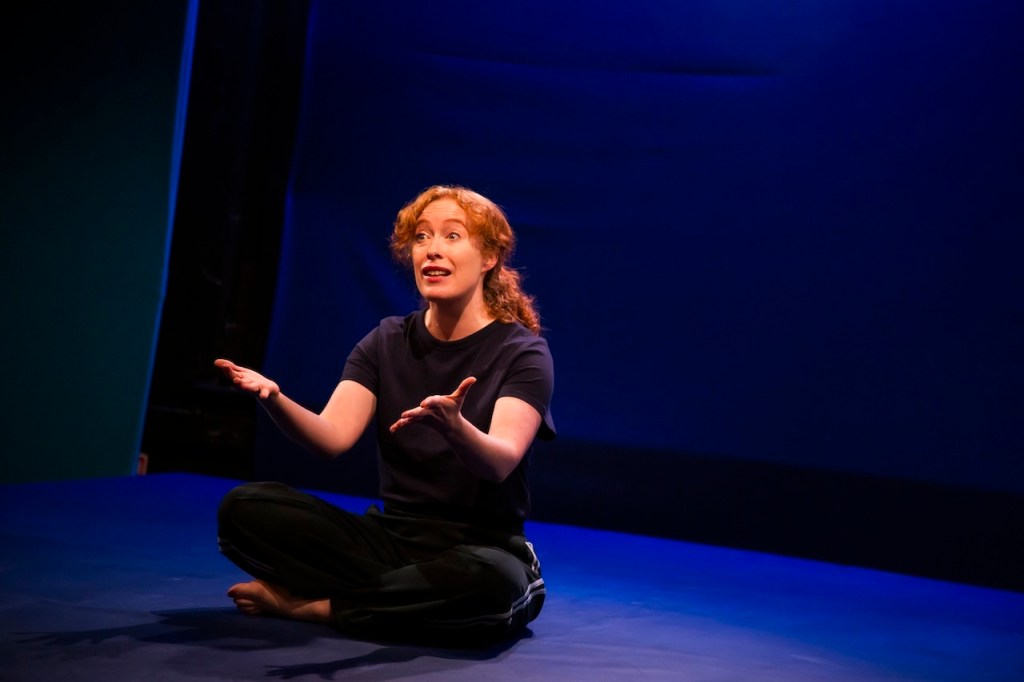
Monologues and thrillers are two of the trickiest theatrical genres to pull off successfully, but Emily Jupp’s Wormholes is a compulsive fusion of the two. This isn’t an exploitative thriller though; rather it’s a one-act play, a sort of confessional, infused with intelligence, tragedy, fury and humour, sensational only in that the writing, direction (Scott Le Crass) and acting (Victoria Yeates) are so damn good.
Wormholes is a story of domestic abuse, controlling behaviours and the way that one person’s mental health can be completely destroyed by a carefully calibrated combination of the two, especially when ignited by an irresistible dose of sexual chemistry. Victoria Yeates plays a cheerful, smart but essentially unremarkable young urbanite, with a decent job and social life, a positive outlook and a gaggle of supportive gal pals. She meets an unnamed man, has the most exciting sex of her life, and slowly but surely sees her self esteem, her external relationships and her sanity being whittled away.
It’s not a particularly original starting premise perhaps but the quality of Jupp’s script and Yeates’s performance plus the air of simmering unease, punctuated by moments of daylight, that Le Crass’s direction subtly brews, ensures that Wormholes is thoroughly gripping for its seventy minute duration. The breezy normalcy that Yeates’s Mary projects so effortlessly serves as a feint to draw us into the mire of the mental and physical torture this woman, who seldom comes across as a victim despite life’s efforts to cast her as such, goes through at the hands of an unstable man. The message seems to be that if it can happen to her, it could happen to anybody.
Yeates’s ability to switch between chummily anecdotal and total anguish is impressive, and the whole performance is a technically terrific example of a superb actress at the top of her game knowing exactly when and where to take her foot off the emotional pedal then when to go for absolute broke. Le Crass (who with his stunning post-pandemic production of Rose on stage and screen with Maureen Lipman, and the fascinating gay body image monologue Buff seen recently in London and Edinburgh, is a specialist in making solo plays take wing) has her talking directly to us, dancing with abandon, staring dead-eyed at a hopeless future, and, in a particularly harrowing sequence, reacting to a volley of horrible physical attacks. This is top drawer work, focussed, economical but able to go to extremes when required. The matter-of-fact-ness of roughly seventy per cent of the delivery makes the trauma of the remaining thirty per cent all the more astonishing and affecting.
The collaboration between writer, actor and director is seamless, except for one brief moment when Mary hurls abuse at a younger detainee in the facility where she has ended up after exacting a brutal, if dramatically satisfying, revenge on her tormentor. Momentarily, the play doesn’t quite ring true. Jodie Underwood’s subtle, detailed lighting, Leah Kelly’s soothing yet vaguely clinical set and perhaps especially Paul Housden’s sound and composition, full of distortion and dislocation, unsettlingly suggest being inside the head of a person who, through no fault of her own, is unable to discern which way is up.
It’s a powerfully female-driven show, as it needs to be, so it’s perhaps a little churlish to wish that the man who lays Mary so low wasn’t so sketchily drawn. I’m not sure that her dismissive mother rings entirely true either, but these are minor flaws in a sophisticated piece of storytelling that employs its red flags with subtlety and real skill. Jupp’s writing is terse, compelling, witty and, when it needs to be, utterly cruel. The wormholes metaphor that permeates the text (the parasitic guinea worm can live undetected in an apparently healthy human, the person’s increasing health niggles easily dismissed as something negligible, before exiting the body in the most agonising way possible…look it up, it’s terrifying) only occasionally feels forced, and makes a potent parallel with our heroine’s tangy but awful tale.
If Wormholes doesn’t end the way I thought it would, the ambiguity and sadness of its conclusion makes for memorable theatre. This is a haunting contemporary piece: intense and tough to take, but shot through with compassion and humour, and ultimately strangely uplifting thanks to the sheer quality of the artistry on display. Strongly recommended.
 ajhlovestheatre
Leave a comment