STARLIGHT EXPRESS
Music by Andrew Lloyd Webber
Lyrics by Richard Stilgoe
Creative dramaturg: Arlene Phillips
Directed by Luke Sheppard
Troubadour Wembley Park Theatre, London – booking until 16 February 2025
https://www.starlightexpresslondon.com
Look, neither Andrew Lloyd Webber nor Trevor Nunn, the shows original director, ever made any claims to Starlight Express being a great musical. It was always about the fun, the spectacle and the roller skating….and it still is.
Punch’s theatre critic, the late and often acidic Sheridan Morley, writing about the 1984 London premiere, famously likened it to being invited to watch a multimillionaire playing with some ingenious but ultimately wasteful toy engines. Arlene Phillips (who choreographed the original) and Luke Sheppard’s retina-searingly colourful reimagining for a whole new audience (although admittedly the first production ran so long that several generations of theatregoers cut their musical teeth on it) probably wouldn’t have convinced Mr Morley otherwise, but for the less lofty-minded, it offers a couple of hours of fast-paced, escapist euphoria.
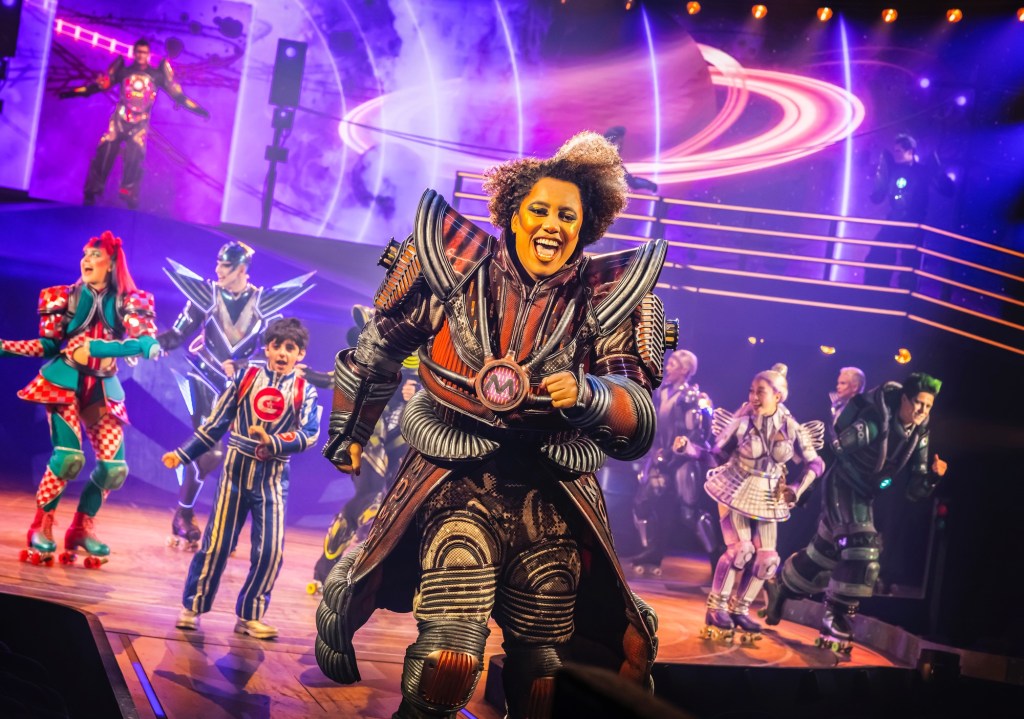
It feels like An Event. It was always closer to a Disney Theme Park ride rather than a coherent piece of musical theatre, but there’s something about Starlight, and particularly this expensive reboot in a venue transformed to house it, that feels appropriate for the stylish soullessness that now characterises Wembley Park, with its upmarket chain shops, hotels and skyscrapers. Compared to the original, this version makes it even more explicitly clear that we are watching a child playing with their model train set: when you enter the Troubadour’s reconfigured auditorium there’s a kids bedroom and a litter of toys in the centre of Tim Hatley’s set, and we are introduced to the child (Cristian Buttaci on opening night, but there are six young performers in rotation) in whose imagination the toy trains come to life as campy, roller skating glamazons of often indeterminate gender, engaged in racing for supremacy.
Where John Napier’s previous setting was a staggering feat of imagination and engineering that culminated in a gigantic railway bridge that tilted, spun and connected up the multiple levels of race track set that snaked all over the Apollo Victoria, Hatley’s is sleek, glossy, futuristic, suggestive of the decor for a particularly hi-tech TV game show (of course the Troubadour used to be a television studio). It’s visually impressive but because it’s more modest in scale, the individual personalities of the performers stand more of a fighting chance of breaking through the pyrotechnics, dry ice and acrobatics than in the earlier productions.
Chief amongst these is Al Knott in an irresistible professional debut as Greaseball the diesel engine, transformed from the Elvis-style male rocker of old into a stroppy, self-obsessed she-engine who’s tougher than her male rivals yet strangely likeable despite the hard time she gives Rusty the steam engine. Jeevan Braich and Kayna Montecillo bring an appealing wide-eyed freshness and fabulous vocals to the romantic duo of Rusty and new coach Pearl, despite their big reconciliation duet being the blandest song in the score. Jade Marvin is a deeply lovable powerhouse as Momma, the old steamer whose soulful common sense gives the show what heart it has. Ashlyn Weekes and Renz Cardenas are great fun as a pair of cheerful coaches, as is Emily Martinez as a villainously smiling race saboteur. Jaydon Vijn is a swaggering sensation as new character Hydra, a green (literally) alternative to the rust and smoke of the old steamers (“it’s not a matter of if/it’s a matter of when”), and is noticeably one of the strongest skaters in the cast.
Andrew Lloyd Webber has his detractors but you’d have to be pretty mean not to admit that his music for Starlight demonstrates his gift for a tune, and they’ve seldom been as well sung or played (Laura Bangay’s seven piece band sounds better than the original sixteen pieces ever did, playing spiffy new orchestrations by Matthew Brind with ALW) as they are here. There may not be much of a coherent style to the score as a whole, apart from insistent dance beats some of which are clearly inspired by the clickety clack of a train on a track, but it’s a zesty, boppy, propulsive collection of songs. It’s arguably even more eclectic than his score for Cats, taking in Country & Western (Dinah the Dining Car’s Tammy Wynette-inspired lament ‘U.N.C.O.U.P.L.E.D.’, performed with disarming histrionics by Eve Humphrey), electronica for ‘AC/DC’, Electra the electric engine’s spinetingling mission statement and the first bona fide showstopper of the night as led by an icily graceful Tom Pigram, R’n’B, lashings of good old fashioned rock’n’roll and the kind of uptempo numbers (Rusty’s super-cute ‘Crazy’, the newly added empowerment anthem ‘I Am Me’) that would sound equally at home in Eurovision or on the dancefloor at G.A.Y. Then there’s the thunderously rousing gospel ‘Light At The End Of The Tunnel’ finale. The popular music styles invoked tend to be broadly American which sometimes renders ponderous the English accents used throughout in this version.
Because there isn’t a governing style, anybody unfamiliar with the show’s earlier iterations (substantial rewrites and whole new numbers were added for the Broadway production, the London relaunch in the ‘90s, and the still-running Bochum version) won’t necessarily be able to detect what’s new and what isn’t. It doesn’t hang together particularly well as a score but then I’m not sure that matters; this is majorly loud theatrical pop designed to get the blood pumping and in that it’s highly successful. Richard Stilgoe’s lyrics veer between witty and clunky but mostly work fine.
Gabriella Slade’s gleaming costumes are garishly inventive, although the coaches look more like the queens of Six (which she also designed) on wheels rather than railroad stock, and crucially give the cast ample scope to execute Ashley Nottingham’s dynamic, often exciting choreography. Howard Hudson’s transformative lighting is completely sensational, and Gareth Owen proves once again why he is the go-to sound designer for any stage production with rock and pop elements: his work here is at once precise and bombastic, matching his outstanding efforts on MJ The Musical on both sides of the Atlantic and the glorious Alicia Keys tuner Hells Kitchen currently tearing up Broadway.
Where the first production had an unreconstructed twentieth century attitude to gender (male engines and freight trucks, female coaches) and a 1980s budget (i.e. excessive), this one has a much more loose approach to the former (I mean, it’s 2024 and these are toy trains anyway) and possibly didn’t, in real terms, cost as much to mount but it still looks a million dollars…several million actually. The updates and adjustments have been sensitively done, so as not to put the noses of fans of the original out of joint. Realistically, the median age of the core youthful audience for Starlight Express is probably younger now than it was forty years ago as older teenagers used to a diet of TikTok and sundry other social media might find it all a bit, well, wholesome.
Luke Sheppard has proved repeatedly (& Juliet, Just For One Day, the Adrian Mole musical) that he is the perfect director for whipping up a frothy, fun-filled confection into something with a satisfyingly true emotional centre, and that impression is further confirmed here where you find yourself genuinely caring about a love story between inanimate objects. Having Control, the young child (young Mr Buttaci is a sassy delight, undercutting the soppier bits of the show with the unselfconscious brutality of the very young), physically in the centre of the action at key points is a very useful emotional conduit and helps give this version a charm that the original production never achieved (the train set owner was a disembodied voice). Overall, this is less a nostalgia-fest revival than a complete rethink.
The final word (almost) goes again to Sheridan Morley who witheringly compared Starlight #1984 to the Eurovision Song Contest. Back then, that was an insult. Funnily enough, Starlight #2024 really DOES resemble Eurovision…. but as Eurovision is perceived now: joyful, exhilarating, good-natured, frequently nonsensical and stunningly well produced. There’s also still such a thrill and entrancement at the fleet gracefulness of the skating. Check your brain in at the door, and you’ll have a ball, and you won’t be able to get the tunes out of your head for a week; take a child under ten, and you might just create a theatregoer for life.
 ajhlovestheatre
Leave a comment