WEDDING BAND A Love/Hate Story in Black and White
by Alice Childress
directed by Monique Touko
Lyric Hammersmith Theatre, London – until 29 June 2024
https://lyric.co.uk/shows/wedding-band-a-love-hate-story-in-black-and-white/
First seen on stage in the US in 1966, this play by African-American writer Alice Childress is only now receiving its British stage debut. Kudos to the Lyric Hammersmith and director Monique Touko for giving UK audiences a chance to enjoy this challenging, thought-provoking piece, whose themes resonate down the ages. Set early in the twentieth century in South Carolina, as Black Americans started the Great Migration north to seek better work opportunities, it focuses on racism, miscegenation, female influences within the community… these are big, important issues, the stuff of enthralling drama and memorable, shattering theatre.
That sometimes proves the case with this production, but not always. It’s not clear if it’s Childress’s script or Touko’s direction, but Wedding Band only intermittently catches dramatic fire. While seldom less than engaging, the tone is bewilderingly inconsistent, at times sultry, at others comical, then edgy, often tragic, occasionally heartachingly poetic.
All of these tones and hues are valid and present in this story of a resourceful Black woman and the Caucasian man she loves, against a backdrop of mistrust and appalling racism. They don’t coalesce into a satisfying whole though, so a couple of impressive or moving moments and inspired acting or directional choices feel isolated from each other, which becomes frustrating so that an ending that should be cathartic feels a bit ponderous, although beautifully realised. There’s a rich seam of welcome humour running through Childress’s writing that plays well against the distressing material. All in all, it’s a heady brew of religious fervour, philosophical discourse, and eroticism, but it feels uneven.
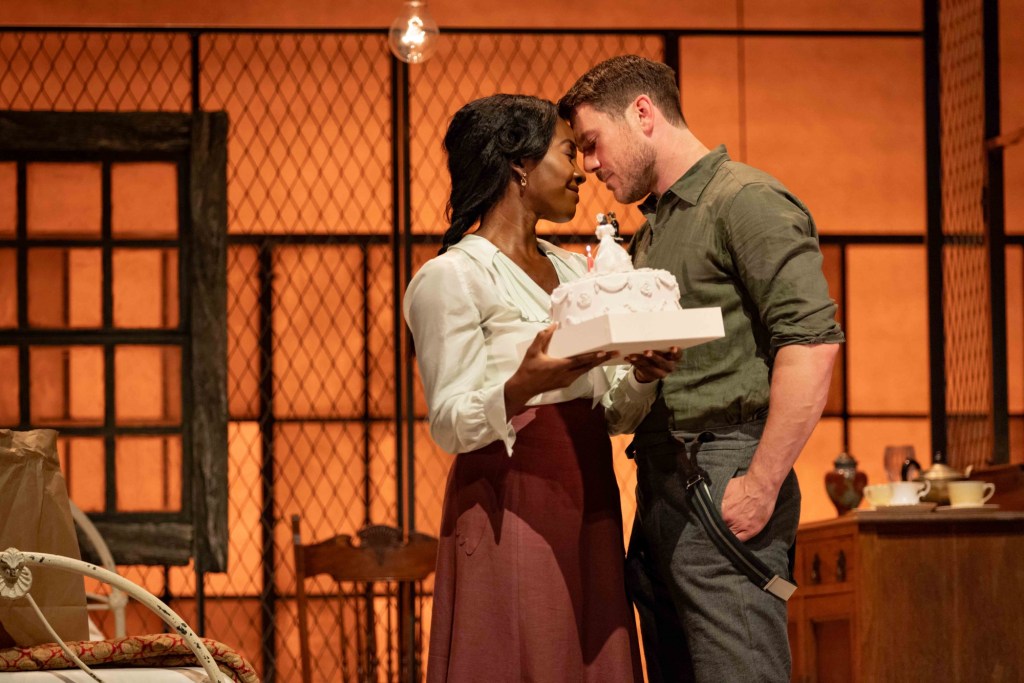
Theres’s a lack of palpable chemistry between Deborah Ayorinde’s Julia and David Walmsley’s Herman though. Although they make a strikingly attractive couple, the heat and feeling between them doesn’t feel overwhelming, which robs the play of some of its urgency. Individually, they make potent impressions but collectively something doesn’t quite gel. She’s strident but sensitive, and when she gives full reign to her anger in the second half, in a bitter showdown with his bigoted mother (Geraldine Alexander, powerful in a deeply unsympathetic role), she’s pretty magnificent. Walmsley delivers an affecting study of a straightforward man caught in a situation that in another life wouldn’t be problematic.
Some of the supporting performances are terrific. Bethan Mary-James delivers flawless work as a dour neighbour with a joyfully eccentric turn of phrase but a kind heart, innate intelligence and a tragic bond to the absent husband who abused her. Lachele Carl excels as a landlady whose surface gentility belies a surprising degree of sensuality and a penchant for mysticism that ricochets between comical and sinister. There’s strong work from Patrick Martins and Diveen Henry as, respectively, a troubled soldier and his mother.
Although it’s spare and elegant, the metal and mesh-framed set by Paul Wills doesn’t evoke a particularly strong sense of place or time, and Matt Haskins’s non-specific lighting doesn’t help. Shiloh Coke’s music is boldly effective and evocative however.
This is a decent production of a play that exerts a certain amount of power but which feels too diffuse to be really satisfying.
 ajhlovestheatre
Leave a comment