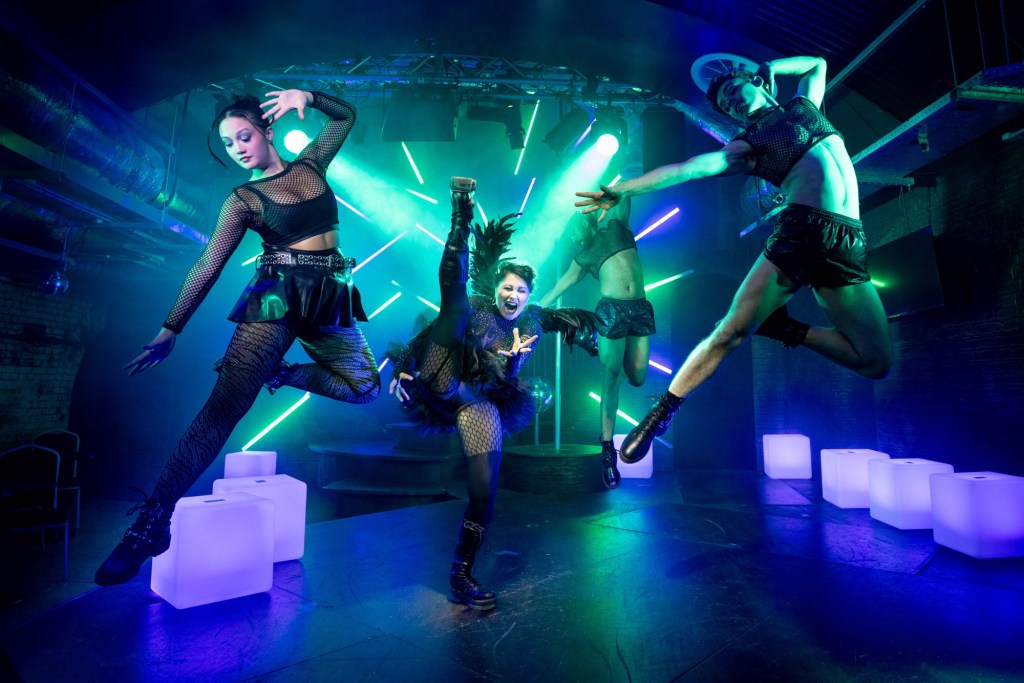
CLOSER TO HEAVEN
Book by Jonathan Harvey
Music and lyrics by Pet Shop Boys
directed by Simon Hardwick
Turbine Theatre, London – until 30 June 2024
https://www.theturbinetheatre.com/whats-on/closer-to-heaven
It may not be particularly radical now and the weaknesses in the writing seem more exposed, but the significance of Closer To Heaven in the canon of queer musical theatre cannot be overstated. Twenty three years (the show was first seen at the Arts Theatre in 2001 and has enjoyed two London fringe revivals since) may not be that long in historical terms but huge leaps and bounds have since been made in gay and queer representation, and back in the day this Pet Shop Boys-Jonathan Harvey collaboration felt like having a bucket of cold water thrown over you in that it didn’t sanitise or pretty up the gay experience: sure, we’d had La Cage aux Folles but that was comforting and cute, and Rent which was artsy and so NYC-centric. But Closer To Heaven rubbed our noses into 1990s(ish) London club culture in all its seedy, camp, dysfunctional glory. Where “the love that dare not speak its name” often still cringed in the shadows, this divine, imperfect show dragged it out into the sunshine, or rather the spotlight, and pulled few punches.
Any contemporary production comes up against the fact that attitudes have mightily changed, both to homosexuality, and to addiction, which is a more insidious theme in this darkly exciting confection. Simon Hardwick’s new staging turns the Turbine auditorium into a night club, with a stage-cum-runway and audiences arranged in tables which is a valid take: squint and you could be in Heaven. This ups the ante and the immediacy, but there’s an unfortunate pay-off: the idea that we’re all spectators in a club robs the play of some of its power. Scenes repeatedly have their truth and urgency diluted by performers playing to the audience rather than the characters they’re talking to. Harvey’s script, equal parts sleaze and sentimentality, has a soap operatic feel but when played to the hilt it can be genuinely affecting, but that seldom happens here.
As a result, the tormented relationships (boy meets girl who falls for him but also meets boy who he in turn falls for, a daughter trying to help her gay dad get off the drugs and booze) don’t have the depth or emotional resonance they need to make the catharsis of the ending really work. This is frustrating in a production that has a lot going for it elsewhere.
Chief amongst its glories is Frances Ruffelle as Billie Trix, the bonkers, sexually ambiguous club hostess-cum-cultural icon who presides over the whole torrid proceedings like a female version of Cabaret’s Emcee. Ruffelle is compelling, a pixie-ish (possibly Björk-inspired?) girl-woman who’s got by with charm, eccentricity and a blithe disregard for anybody else who comes into her orbit. In the original production Frances Barber felt more dangerous and feral, but Ruffelle invests her with a deranged charisma and gets some gorgeous comic mileage out of Harvey’s innuendo-infused script. She also sounds fabulous belting out the Pet Shop Boys numbers, most of which still thrill with their unique combination of thunder and melancholy. She proved in the 2017 London premiere of the LaChiusa The Wild Party that she does louche pretty well, and she’s wild, yet likeable, here.
Courtney Bowman is terrific as Shell, the go-getting record company talent spotter who ends up torn between her feelings for the eminently unsuitable Straight Dave and pseudo-parenting her own, deeply troubled Dad. Glenn Adamson’s perpetually grinning Dave has a cracking voice and a degree of swaggering charm but never plumbs the depths of despair and insecurity the role really requires: when tragedy strikes in the second half he seems more mildly inconvenienced than broken. A man telling a woman having a perfectly understandable extreme reaction to an unusual sexual/emotional situation, that “you’re going mad” plays quite differently in 2024 than it did in 2001 (thank goodness) but it does Adamson’s character no favours, and it’s just never really clear why everyone is throwing themselves at this slightly smug chancer.
Connor Carson’s strapping physical beauty and bell-like vocals seem at odds with the desperation and vulnerability ideally needed for nihilistic drug dealer Mile End Lee (“I’m easy to hate” he sadly states, but we get no real indication of that). Both David Muscat as a vile record producer and Kurt Kansley’s drug-addled club impresario, whose dark-night-of-the-soul aria ‘Vampires’ is a vocal highlight of the second half, could afford to go bigger and deeper with their characterisations.
Christopher Tendai’s striking choreography and David Shield’s neon-infused set that resembles a catwalk disappearing into a vortex of hedonism…or hellishness, are effective, and the use of TV screens to show cctv footage of other areas of the “club” is a nice touch.
The show has one of the best opening numbers of any modern musical, the infinitely catchy ‘This Is My Night’, which establishes character, milieu and relationships with wit, economy and booty-shaking dance beats. Hardwick and Tendai stage it exhilaratingly, although the night I attended it was marred by a microphone issue. Given the electronic nature of the score, I guess there is a case to be made for pre-recorded music (I think the Above The Stag version went down a similar route) but it inevitably saps the show of some immediacy and nuance, despite the generally excellent voices.
Still, the songs are earworms, Ruffelle is wonderful and the whole thing bowls along at quite a lick. With unapologetic depictions of drug taking, sexual voraciousness and consumerist greed, Closer To Heaven may be a bit grimy for nostalgia, but it is a piece that irresistibly evokes the grotty underbelly of London nightlife at a very specific time. Maybe to enjoy it at its fullest you had to have been there, but there is something rather lovely about the way it resolutely defies sanitisation. Rodgers and Hammerstein this ain’t, hell, it’s not even Taboo (the less uncompromising Boy George musical also rumoured for an upcoming revival).
 ajhlovestheatre
Leave a comment