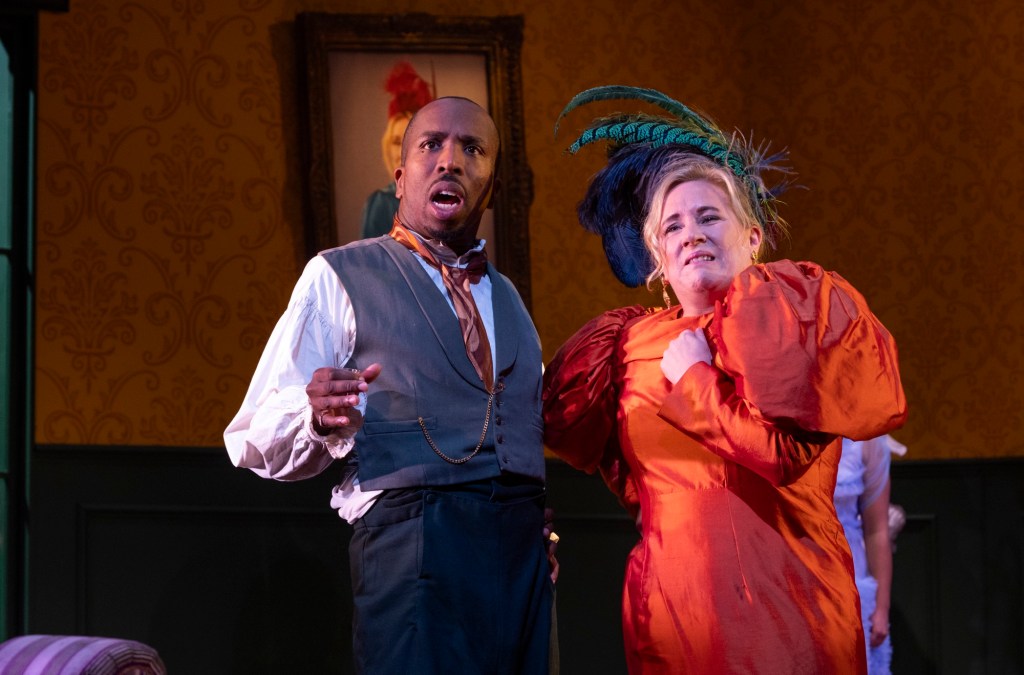
THE GOVERNMENT INSPECTOR
by Nikolai Gogol
adapted and directed by Patrick Myles
Marylebone Theatre, London – until 15 June 2024
https://www.marylebonetheatre.com
Farce is surely one of the trickiest theatrical genres to get right: play it too straight and it becomes leaden, make it too fast and it’s unintelligible, perform it too broadly and it feels like too little is at stake. Gogol’s mayhem of bureaucratic corruption and mistaken identity is a classic of the form and one that, for better or worse, will probably never not be relevant because the wells of human venality and vanity are unlikely to ever run dry. Patrick Myles’s handsomely mounted new production goes for a traditional period setting but relocates the action from 19th century Russia to England, and soaks the whole thing in a bath of cartoonish lunacy.
The result is a high energy show, performed mostly at a pitch of hysteria that proves pretty difficult both to sustain and to watch, that is seldom as funny as it appears to think it is. I don’t think the fault lies with the actors, whose commitment both to the sometimes inspirationally crude but rather charmless script and the relentless comedy shtick they’ve been given, could scarcely be faulted, but with the direction which dials everything up to ten from the get-go and allows a mishmash of acting styles that never coalesce into an onstage world that we can believe in or care about.
Not that Gogol was interested in creating a warm, fuzzy picture of humanity – all the characters in The Government Inspector are financially, socially or sexually on the make – but by denying them any root in basic reality, this version robs them, and us, of much of the hilarity that ensues when real fallible humans get everything spectacularly wrong. This is like grand opera without the singing…and only marginally more laughs.
As the down-on-his-luck posh boy that the hapless denizens of a rural town assume is the government official from the city, Kiell Smith-Bynoe, star of TV’s Ghosts brings admirable energy but disappointingly little finesse, in a performance that seems to confuse shouty with charismatic. Similarly strident is his television colleague Martha Howe-Douglas as the bossy, loquacious local dignitary’s wife who sees him as a means of social advancement. Dan Skinner as her husband shouts himself hoarse berating the audience for chortling at the comic goings-on (“you’re all laughing at yourselves!”) except that there wasn’t really all that much laughter. Chaka Gupta gets thrown around like a ragdoll as their unfortunate daughter, but it feels more uncomfortable than funny.
There are a couple of welcome pockets of restraint amongst all the bawling and posturing however: David Hartley is genuinely funny as a vicar with a predisposition for bloodily injuring himself, and Daniel Millar’s sexually and financially voracious manservant works so well because he’s played comparatively straight. Elsewhere, one certainly couldn’t accuse the actors of laziness – they’re working far too hard for that – but the go-for-broke imprecision frequently blunts the comic edge.
Skinner’s Governor gets a bilious, enraged speech near the end where he screams about the rich kid (Smith-Bynoe’s Percy) going back to his privileged life while leaving regular people to cope with the fallout from the damage he’s caused, and one gets the feeling this is supposed to draw a parallel with our own time and the (hopefully, soon) outgoing Tory government. The trouble is, it feels unearned, so, despite the volume and passion of Skinner’s delivery, goes for very little.
Melanie Jane Brookes has designed a fairly opulent set, encased in a giant golden picture frame, and some attractively garish period costumes. As a project, it clearly has had quite a lot of money lavished on it, it’s just a shame that it doesn’t quite hang together. The savagery of the satire is sacrificed to a showboat full of mugging, and the comic momentum very seldom gets going.
 ajhlovestheatre
Leave a comment