SUFFS
Book, music and lyrics by Shaina Taub
Directed by Leigh Silverman
Music Box Theatre, New York City – open-ended run
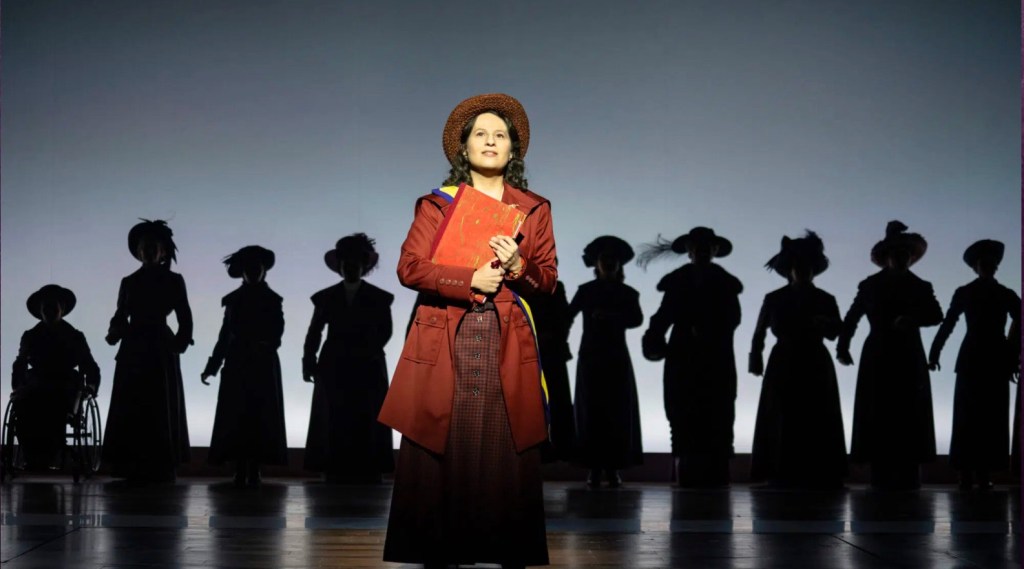
The struggles and setbacks encountered by the women’s suffrage movement is an incontrovertibly important matter and one of many admirable things about Shaina Taub’s worthy tuner, now on Broadway after considerable reworking from its original Public Theater run, is that it presents these grim challenges with equal parts gravitas and lightness of touch. A common accusation levelled at musicals trying to tackle “big” themes is that the song and dance treatment risks trivialising the serious points being made (much of Sondheim, Jason Robert Brown and of course Hamilton and Cabaret are notable exceptions), but nobody is likely to accuse Suffs of that either. Whatever its flaws, this bold new musical takes a clear-eyed, unsentimental look at not-too-distant American history, and appraises it with a cool head, a fire in its belly, and considerable wit.
On paper, Suffs sounds like the American answer to the Old Vic’s Sylvia, which filtered the English suffragists stories through a modern lens, including hip hop and rap, and came off a bit like a Brit Hamilton wannabe. However, in chronicling the history of American suffrage and the battle for women in the United States to get the vote, Taub’s compositions are more timeless, taking in influences from vaudeville, traditional Broadway, and the sort of anthemic chorales that characterised the pop operas of the 1980s and 1990s. There are some ballads too, usually performed by Taub herself as chief agitator Alice Paul, but they tend to be reflective and gentle rather than bombastic. It’s a pleasant score, and intermittently very rousing, but not an especially memorable one.
The all female company, fine voices all, sing it as though their lives depend upon it (which, in a way, they do) and Jason Crystal’s sound design and Michael Starobin’s subtly effective orchestrations ensure that the songs are showcased as compellingly as possible. The storytelling in Taub’s script is less successful however. It’s more of an episodic pageant than a conventional musical book, which works insofar as the cause is more important than any individual characters, but it does mean that most of the emotional engagement is achieved through broad, generalised brushstrokes, such as in the raging act one closer (“How Long?”) in which the collective of women attempt to reconcile the loss of one of their leading lights, Inez Milholland (Hannah Cruz in a luminescent Broadway debut), or the gorgeous, galvanising finale, “Keep Marching”, rather than connection to individual characters.
That is partly the point of course, that the sweeping subject is of far more relevance than the plight of individuals, but it can make for theatre that is sometimes repetitious and only intermittently involving. In the second half, the show includes the hunger strikes and force feeding while incarcerated that was endured by these early feminists, and the simultaneous gaslighting of the general public from the offices of President Woodrow Wilson (a chilling but sparkling Grace McLean), but none of this hits with the shocking impact it should, partly because the characters feel more like sketches than fully rounded people and Leigh Silverman’s stylish but sanitised staging seems intent at keeping us at arms length.
A face-off duet between Paul and society suffragist Carrie Chapman Catt (Jenn Colella, incisive, magnetic and customarily stellar) sees the latter change her mind about the former within the space of about a verse, which just feels like sloppy writing. Also, the tensions both within the Black contingent of suffragists and in relation to the rest of the movement are only addressed perfunctorily. All of this is essential, fascinating information but it often doesn’t feel fully fleshed out, as though through a need to keep the show down to a manageable running time.
Taub’s achievement here, as book writer, lyricist, composer and star, is extraordinary but one wonders if the piece would be structurally stronger if she had more collaborators. Her singing has an attractively plaintive quality that gives way to a sweet and surprising power in the upper register. She’s a solid actress yet Alice feels strangely unknowable as the centrepiece of the musical.
Ally Bonino and Nadia Dandashi have less stage time but register more vividly as two of her colleagues, and I loved Kim Blanck’s fiery, funny, staunch Ruza Wenclawska, whose self-dramatising histrionics would eventually secure her a career on the stage. Nikki M James finds complex layers in the brilliantly outspoken Ida B Wells and is a potent stage presence. Glorious Emily Skinner injects a welcome jolt of camp as society benefactress Alva Belmont.
Visually, the production is elegant (especially Paul Tazewell’s beautiful period costumes) but sometimes a bit too crisp and clean. There are a couple of ponderous choices, such as the bizarre half-horse creation with which designer Riccardo Hernandez recreates the famous image of Inez Milholland, clad as a symbolic herald, on horseback leading the 1913 Women Suffrage Procession: it’s a striking image for sure, especially when juxtaposed with the giant photo of the actual woman (and horse) that flies in at the end of act one, but the actual structure Cruz’s Milholland is perched upon is distractingly strange to look at, with it’s golden head, white body and neck and legs that appear to be constructed out of coathangers. It’s the sort of prop that looks as though it was cobbled together for rehearsals but should have been replaced for the stage. Elsewhere, Hernandez’s work is spare and unobtrusive, but never, to be fair, cheap-looking.
Ultimately, Suffs succeeds because of its ambition and originality, but most importantly because it talks about a fight that is still going on. It honours the work and sacrifices of the women who looked ahead for the generations of women who would come after them. It’s not a great musical, but it’s a richly significant one, and it doesn’t look or sound like anything else, not even the questionable Roundabout revival of 1776 from two seasons ago and which cast the (almost) entirely male dramatis personae with female and non-binary performers. That felt like a gimmick, but having an all-female cast here is a logical decision borne out by the themes and material.
The ovation at the end of the performance I saw felt as though it stemmed as much from a desire by audience members to stand up and be counted as much it did to acknowledge the undeniable excellence of this cast and (also all female) orchestra, and that’s pretty powerful. I suspect these suffragists will “Keep Marching” on Broadway for quite some time.
 ajhlovestheatre
Leave a comment