STEREOPHONIC
by David Adjmi
Original songs by Will Butler
Directed by Daniel Aukin
John Golden Theatre, New York City – until 18 August 2024
There is a common perception that while Americans are peerless at producing high energy musical theatre, we Brits have the monopoly on straight drama in the English speaking world. Obviously, there are exceptions, such as Williams, Miller, Wilson and O’Neill to name a few, but traditionally the received wisdom is that Broadway excels at musicals, while we are superior at the non-singing and dancing stuff. A play like David Adjmi’s engrossing Stereophonic, newly transferred to Broadway after a sold out premiere run at Playwright’s Horizons, poses a mighty challenge to those archaic preconceptions though.
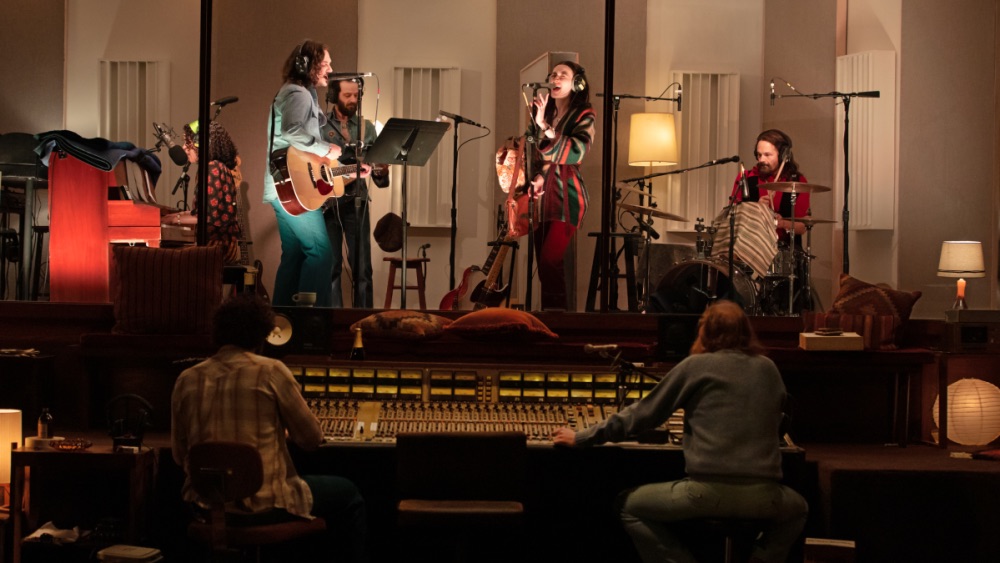
Like the works of Annie Baker and Stephen Karam’s 2016 Tony winner The Humans, this is one of those great American plays where seemingly nothing much happens…and yet everything happens. This rewarding slow-burner charts, with forensic precision, piercing wit and a clarity of vision that the characters themselves seldom possess, the progress of a rock band creating a career-defining album. It’s like a fly-on-the-wall documentary but performed live, and Adjmi carefully, lovingly builds up a picture of these people -their flaws, their insecurities, their loves, their eccentricities- so that they glow before our very eyes, with a rare richness of colour and detail. The first couple of minutes are bewildering, as the characters talk over each other, speak at levels and speeds that are naturalistic but not immediately accessible, but stick with it….
So sublime and real is the direction of Daniel Aukin and the flawless cast of seven (all but one of whom are Broadway debutants) that it’s hard to know where Adjmi’s script ends and the brilliance of the production takes over. It hardly matters. The play deals with the sometimes fraught, often random nature of the creative process, and of how success and validation can wreak havoc on personal relationships. Across three hours duration and a two year timespan (1976-77), the group’s journey from amazement at their new found success to ragingly huge egos, is beautifully managed.
Will Brill’s mercurial, meticulously well observed bass player Reg transforms from alcoholic, drug-infused mess to holier-than-thou but deluded health freak (watch for his reaction when Eli Gelb’s guileless recording engineer Grover points out to him that he does in fact still drink). Two romantic relationships break down irretrievably. There’s a particularly amusing second act scene where a couple are bickering vitriolically to the evident discomfort of the singer standing between them, but are able to instantaneously snap out of it to produce the most exquisite harmony.
A mesmerising Sarah Pidgeon brings Meryl Streep levels of truth and emotional engagement to Diana, the lead singer whose relationship with diva-esque, almost cruelly disengaged band leader Peter (Tom Pecinka) is imploding even as they try to make music together, and whose career may be on the verge of going stratospheric independently of the group. She nails the vulnerability of a young woman whose personal life is being torn apart while simultaneously suggesting the dual veins of insecurity and self belief that run through the core of true artists. Pidgeon is thoroughly convincing, even musically, with a rangy, haunting plaintiveness to her vocal timbre that recalls Stevie Nicks.
Pecinka and Brill are magnificent, capturing every aspect of their complex, often infuriating characters. Gelb and Andrew R Butler are cryingly funny yet oddly touching as the engineers trying to preserve some level of self respect while managing the band’s often outlandish behaviours. Despite wavering accents, Juliana Canfield and Chris Stack contribute invaluably as two English members of the group, she reassuringly stable until she absolutely isn’t, and he covering personal emotional pain with a veneer of scabrous sarcasm. The camaraderie between the two women in a predominantly male environment strikes a real chord. There’s not a single moment that doesn’t ring true (accents aside) and the tiniest of details becomes absolutely riveting.
Behaviourally, these people are often nightmares but, and here’s where Stereophonic becomes truly magical, when they find the sweet spot in their music, all is temporarily forgiven. Will Butler has crafted a selection of rock songs – galvanising, affecting, rousing, most of which we only hear fragments of – that aren’t just authentic, they’re completely wonderful. Like, this is an album one would go out and buy. The music is fully live, and the whole play becomes testament to its power to express, heal and uplift.
Presenting artists on stage agonising about their art can be tricky: if you don’t show any of the ‘work’ then audiences can feel cheated, but if you do present a taste of it and it isn’t very good (Steven Pimlott’s original NT production of Sunday in the Park with George is a case in point, where the act two Chromolume was eye-rollingly pretentious) it potentially invalidates everything you’ve been trying to point out about creative struggles. From this point of view however, Stereophonic is an utter triumph, these songs sear and soar.
That triumph extends further to David Zinn’s richly textured, intricate set, a hermetically sealed band box atop a scruffy but homey communal area, so evocative you can almost smell it, centred around a gigantic mixing desk. Ryan Rumery’s sound design is a masterpiece, balancing the two environments, and finding both the human and the monumental. It’s fascinating, even moving, such as in the final moments where Gelb’s lovable, shell-shocked Grover, alone in the recording studio, plays around with tracks, isolating then adding, making the full sound we’ve been listening to, then dismantling it, until we’re left with just the human voices, breathy, harmonious and timeless.
In all honesty, it is a bit long: Canfield’s Holly gets to deliver a lengthy pontification on the movie thriller Don’t Look Now that, although beautifully performed, distends an already punishingly lengthy second act, and doesn’t really add anything. Also, it takes a few minutes to tune in at the top of each act. For a piece that so steadfastly refuses to ingratiate itself (although the irresistible humour is an undeniable palliative), it’s still astonishing to see and hear the effect this show has an audience; the night I attended you could’ve heard a pin drop at key moments, and the ovation at the end was like being at an actual rock concert. I would imagine this’ll be a front runner for every Best Play award going, and will be seen in countless international productions. Sonia Friedman is one of the producers so it could well end up in the West End, although it wouldn’t look out of place at the National or the Almeida. If there’s any justice, wherever it ends up, it’ll be with this glorious original cast.
 ajhlovestheatre
Leave a comment