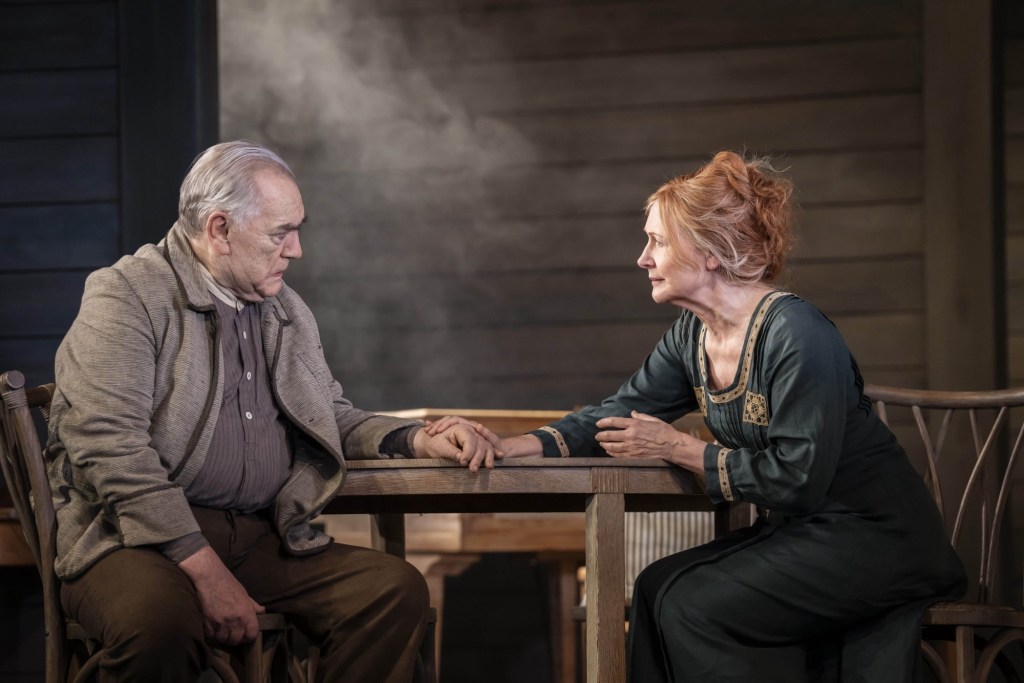
LONG DAY’S JOURNEY INTO NIGHT
by Eugene O’Neill
directed by Jeremy Herrin
Wyndhams Theatre, London – until 8 June 2024
https://longdaysjourneylondon.com
When it’s done well, O’Neill’s lengthy family drama is a soaring, searing indictment of human frailty and the ties of guilt, blood and co-dependence that bind people together, and when it isn’t, Long Day’s Journey Into Night can seem like an endurance test for audience and actors alike, the title less a description and more a warning. At the moment, Jeremy Herrin’s intermittently riveting but somewhat hesitant revival falls between these two stools.
I say “at the moment” because in a couple of weeks I suspect this script and this cast will be up to full strength, but on press night there were too many moments when the staging and some performances felt curiously undercooked, as though they would have benefited from another week of previews to really get to grips with the epic, unforgiving poetic nature of this classic American text. There are already magnificent individual elements but they don’t, as yet, coalesce into greatness.
The Tyrone family of the play so closely mirrored O’Neill’s own family story (retired actor father, morphine-addicted mother, one son a drunkard, the other consumptive), that the writer stipulated that it should not be published until 25 years after his own death. Certainly there is a mastery of detail, and a juxtaposition of raw tragedy with often dark humour that has the unmistakable ring of authenticity. The portrayal of Mary Cavan Tyrone, the mother, played here as a wistful wraith with a tang of bracing narcissism by the tremendous Patricia Clarkson, is particularly multilayered, full of compassion but with an unflinching honesty about the fallout from this woman’s addiction and the devastating effect it has on her husband and sons.
Brian Cox’s patriarch, the roaring, hard-drinking actor James Tyrone, has flashes of brilliance. He’s irascible, comically self-dramatising and convincingly wracked with guilt. The extended second half scene with Laurie Kynaston’s magnetically suffering younger son is a masterpiece of boozy anecdotage and fudged filial emotion. He’s less secure though when delivering back-and-forth dialogue, and it’s not clear whether some of the line fluffs are character choices or genuine stumbles. His stage presence is formidable however and this is a performance that will hopefully develop into something richer and more memorable for the right reasons given time.
Opposite him, Clarkson suffers from a similar uncertainty at the beginning but grows in stature as Mary withers, disheveled, before our eyes. The ghost of the conceited but devout young beauty is present in this Mary’s haunted gaze, and in the chilling, lightning fast switches from bathos to imperiousness. Clarkson shows us simultaneously the helpless selfishness of the addict and the equally helpless love of a mother for her children. Clarkson is American acting royalty and there are multiple moments in this performance that demonstrate precisely why.
There’s fine work from Kynaston, and Daryl McCormack invests his dissolute older brother with an authentic rage and sense of lost control. Perhaps the most satisfying performance, and certainly the one that ignites the whole production with a welcome jolt of energy in her all-too-brief scenes, comes from Louisa Harland as the spiky, sassy Irish maid emboldened by the whisky an increasingly strung out Mary plies her with in an attempt to beat back the engulfing loneliness.
Everything about the production, from Lizzie Clachan’s design to Jack Knowles’s dim lighting and Tom Gibbons’s doomy sound design and music, is classy and muted, so as not to detract from the central protagonists and drama. The problem is that, currently, the core of the show isn’t potent or focused enough to sustain the punishing length…the second half alone runs at over 100 minutes. The uninitiated will likely still realise they’re in the presence of greatness, but for swathes of the evening the raw power of O’Neill’s mighty drama is as elusive as the fog metaphor that permeates the text. It’s worth seeing but, as yet, it’s not essential.
 ajhlovestheatre
Leave a comment