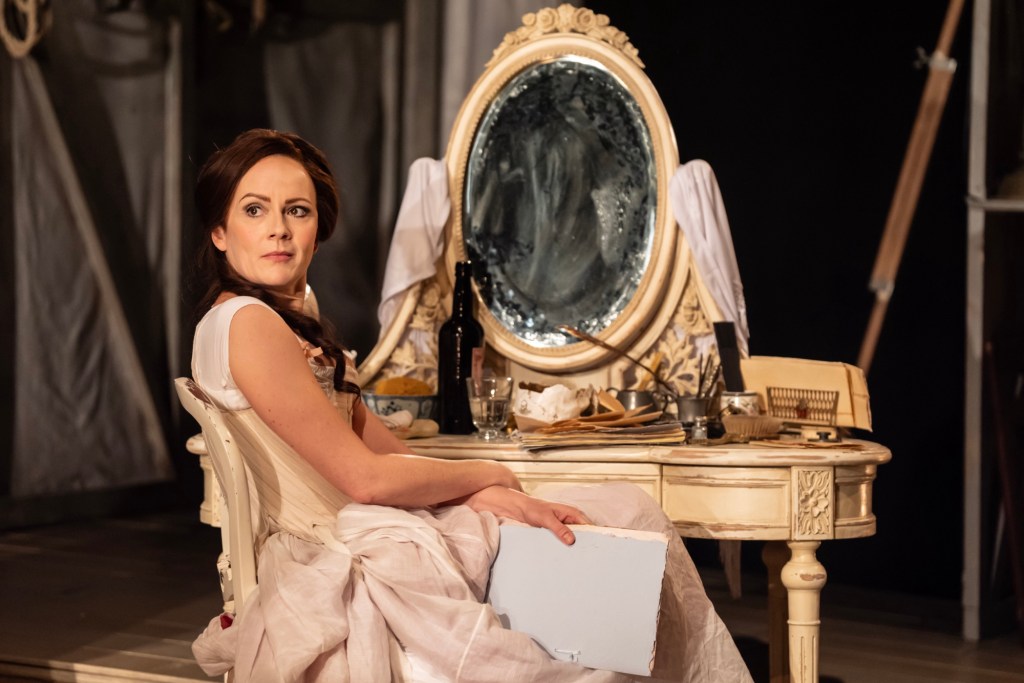
THE DIVINE MRS S
by April de Angelis
directed by Anna Mackmin
Hampstead Theatre, London – until 27 April 2024
https://www.hampsteadtheatre.com/whats-on/2024/the-divine-mrs-s/
With this imaginative, sometimes anachronistic, peep into the life of legendary 18th century actress Sarah Siddons, April de Angelis has created possibly the most quintessentially theatrical play since Michael Frayn’s Noises Off. Not that the two pieces are similar; if anything, The Divine Mrs S ends up closer in tone to Morgan Lloyd Malcolm‘s acclaimed Emilia with its grandstanding fury at the inequality between the sexes, but this is a play in love with the theatre, with its traditions, challenges and idiosyncrasies. It also recalls de Angelis’s own Playhouse Creatures from thirty years ago which looked at the assimilation of women into Restoration theatre.
Under Anna Mackmin’s direction, this is a richly enjoyable evening, fruity, epigrammatic and very very funny. There’s something Black Adder-ish about the relish with which de Angelis presents her dramatis personae of self-regarding, impassioned and frequently preposterous actors and their assorted hangers-on, and her vision of Siddons herself is brought to bewitching, eccentric life by an irresistible Rachael Stirling firing on all cylinders. The dialogue is played at a hell of a lick, although seldom at the expense of clarity, and has a heightened, declamatory style that matches de Angelis’s writing.
With her throaty voice, statuesque charisma and innate warmth, Stirling is the sort of talent plays are created for (just ask Mike Bartlett); I don’t know if this role was written especially for her, but it’s hard to imagine any other actress equalling her work here. She captures with precision and glee the self-aggrandising, mercurial nature of an old school theatre creature, somebody absolutely steeped in all things connected to the stage: the kind of woman prone to fainting fits, who can dismiss Shakespeare’s Titus Andronicus as “an experimental tragedy about a pie”, who can destroy a scatter cushion in a fit of fury then a split second later, in honeyed tones, request if her maid could repair it. It’s a gorgeous performance, revelling in its own artifice but rooted in truth.
The high camp comic histrionics (of which Stirling is a total mistress, as evidenced by her equally scenery-chomping turn in Bartlett’s modern day Restoration riff Scandaltown at the Lyric Hammersmith a few years ago), is underpinned by a subtle melancholy. When she mourns the loss of her children, it’s painfully real. She’s by turns passionate then withering, and if the lightning quick changes in mood sometimes mean that we’re not always sure which emotions are entirely real, then neither does Siddons. In a further stroke of ingenuity, in the sections where we see Siddons on stage acting, Stirling and Mackmin make clear that she is an extraordinary talent, head and shoulders above the people surrounding her.
Dominic Rowan matches Stirling with a performance of brilliantly wrought bombast and sweaty desperation as Sarah’s actor-manager brother John Philip Kemble, acutely aware that his sister is the far greater talent, exasperated by her yet also in her thrall. A terrible actor (Kemble, not Rowan), such power as he has over the wiser, better women surrounding him is by the happy accident of being born male.
These women are formidable: Sadie Shimmin is a tart joy both as a censorious theatre aficionado and as a messy comic actress, Anushka Chakravarti makes something delightful and oddly touching out of Patti, Siddon’s maid-cum-dresser and Eva Feiler dextrously juggles a quintet of roles, excelling particularly as a female playwright running the gamut from triumph to despair as her work is recognised then discarded.
Gareth Snook gets some fabulous comic mileage out of a trio of faintly ridiculous men, although the performance would benefit from a greater differentiation between each.
There are points in the second half when the characters start to sound a bit like mouthpieces for opposing views rather than people, despite the stellar efforts of the cast. That the play has strong fire in its belly is a wonderful and essential thing, it’s just a shame that the writing suffers when the anger rears up. Also, there’s a near-rape of Sarah’s beloved Patti by Kemble that is pretty much glossed over.
Despite this, the play does a fine job of balancing the campy fun (of which there is a lot) with serious, necessary points about the social and professional inequalities between women and men. de Angelis makes Siddons a vivid, specific figure but ends the play enshrining her as a sort of theatrical everywoman pioneer walking into a spotlight that could be on any stage, illuminating any actress who has trodden the boards. It’s a powerful moment, beautifully lit by Mark Henderson on Lez Brotherston’s attractively chaotic playhouse set.
The Divine Mrs S is predominantly a rollicking comedy for people who love all things stagey, full of specialised references and in-jokes (the way brother and sister react every time the title of the Scottish Play comes up is hysterical), but it has a satisfyingly serious core, and writing that is a little patchy but frequently soars. Even if the rest of the cast weren’t as good as they are, it would still be worth catching for the divine Ms S (S for Stirling).
 ajhlovestheatre
Leave a comment