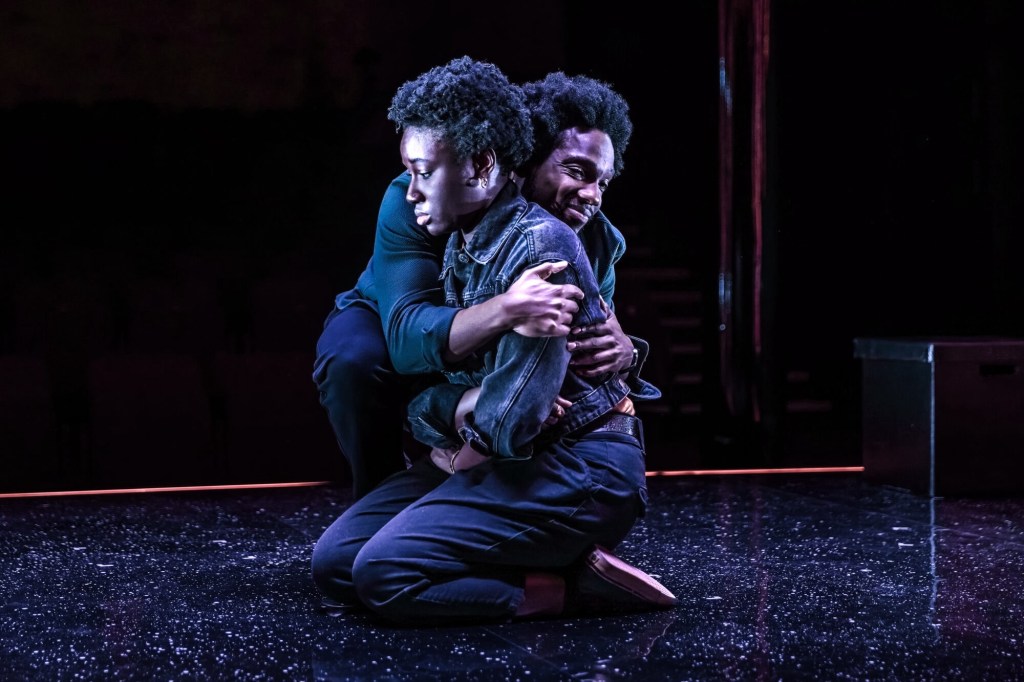
SHIFTERS
by Benedict Lombe
directed by Lynette Linton
Bush Theatre, London – until 30 March 2024
Dream and Destiny seem to be made for each other. They’re super-smart young Black Brits – he’s of Nigerian heritage, she of Congolese extraction – they’re both funny, creative (chef and painter respectively), self-aware, deceptively sensitive and hugely lovable. Life doesn’t always pan out the way it should though, and sometimes the scars from past trauma and loss prove almost insurmountable. Such is the central premise for Shifters, Benedict Lombe’s ravishing new play, a zingy, punchy, multi-faceted romantic tragi-comedy with a beautiful bruised heart and a handle on human yearnings and pain that delights as much as it sears.
In Heather Agyepong (Des as she’s referred to, short for Destiny), Tosin Cole (Dre, for Dream) and director Lynette Linton, Lombe has the ideal interpreters of her work. It’s tender and often hilarious, and a lot more complex than it initially appears, but it’s staged and performed with such confidence, sensitivity and skill that the material soars. It’s simultaneously a very “young” play (we see the characters between the ages of 16 and 32) yet a very wise one as it explores the concepts of loss (at the opening, Dre is mourning his beloved grandmother who mostly brought him up, and Des’s mother died when she was very young), legacy, abandonment, and the ramifications of the life roads one didn’t take.
It’s sloppy critical thinking to liken every two hander that tells a non-linear love story, to Nick Payne’s genre-busting, time-bending Constellations, but Shifters can bear the comparison better than most. While Lombe doesn’t give Des and Dre actual alternative realities, she has them consider other versions of themselves (“if you chose a different path, you’d probably have a different life, in a different world, with a different person, right? So that means there has to be more than one out there for us” says an anguished Des at one point) that has intriguing theatrical currency but also rings entirely true of young, curious, restless minds.
Lombe’s writing has a poeticism that never sounds forced, and is periodically punctured by bouts of irresistible humour. It’s also deeply touching, and I can’t remember the last time I was so invested in the joint romantic fate of two central characters in a stage play. The chemistry between the actors is like a living, breathing thing.
Agyepong and Cole are sublime. She’s energised, humorous but watchful, suggesting a chasm of hurt beneath a fiery but constantly engaging exterior. By contrast, he is laid back and totally charming, then devastating when he turns up the emotional heat. The flawless naturalism in the performances yields rich dividends as vital pieces of information about their lives together and apart are detonated like tiny explosions as the scenes switch backwards and forwards through the years, and the ability of both actors to age up or down by a change of vocal timbre and physical stance is remarkable.
It may be a very personal story but it has a universality that eventually brings a tear to the eye. Under Linton’s mighty direction, meticulously detailed yet flamboyant when it needs to be, apparently banal activities like searching for a player to spin some vinyl records on, or Des removing the knots from Dre’s hair while he luxuriates contentedly in her lap, become strangely riveting. The lightning fast changes in year come so frequently in the latter part of the play that it’s not always easy to keep up, yet it hardly matters so assured and specific are the playing and direction. Tellingly, for huge swathes of the performance, you’d be able to hear a pin drop as the audience members hold their collective breath, willing these fractured, loving, unconventional young people to make the right choices.
Linton’s production is abstract but vivid, playing out on the gleaming obsidian black of Alex Berry’s bare stage under a forest of mood-shifting, multicoloured tubes of light (design by Neil Austin) like an uncommonly enjoyable art installation. The sound score by Xana provides a constant haunted thrum of different musical styles that enhance but never detract from the text.
A fine, sparky piece of writing, thought-provoking and entirely accessible, deeply felt but also a heck of a lot of fun, in an exquisite, state-of-the-art staging…this is the sort of thing that the Bush does best. Vital, inclusive, life-enhancing theatre, featuring a pair of authentic rising stars. Get tickets while you still can.
 ajhlovestheatre
Leave a comment