JAB
by James McDermott
directed by Scott Le Crass
Finborough Theatre, London – until 16 March 2024
https://finboroughtheatre.co.uk/production/jab/
How soon is too soon? That’s the question I found running through my head during the brief hiatuses between scenes in this short, tense dramatic rewind to 2020 and the dark early days of the pandemic. It’s a testament to the performances, the direction and much of the writing that during the scenes themselves, it’s impossible to focus on anything else, like the fact that the Covid shutdowns and what came next are still raw in many people’s minds. Still, we’ve currently got Breathless on the telly, and now we have Jab on stage.
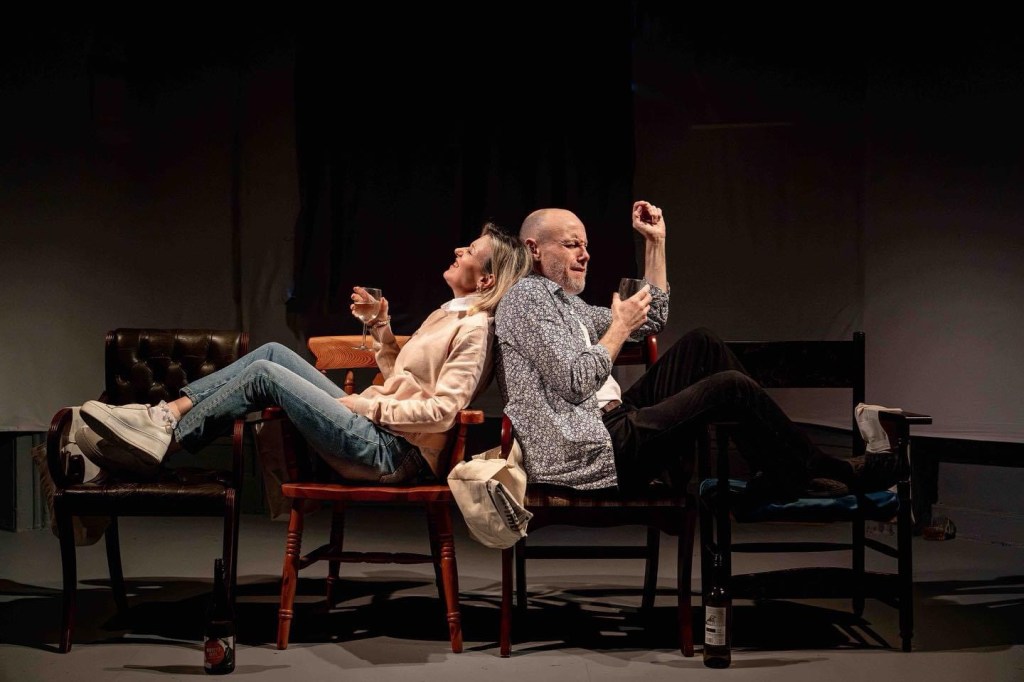
Partially inspired by his own parents lockdown experience, although really these characters could be anyone and everyone, McDermott presents a couple married for 29 years whose combative but loving status quo (she works for the NHS, he runs a vintage shop that never turns a profit) is undermined by being closeted together against their will. The dynamics of their relationship is conveyed in tiny, telling details, the affections, the irritations, the weaponising of words, and Kacey Ainsworth’s Anne and Liam Tobin’s Don are so exquisitely naturalistic that it feels like we’re eavesdropping into real lives.
That specificity and recognition is vital because when everything is ripped apart (which it will be, quite devastatingly) it’s all been set up with so much care that the emotional fallout carries genuine weight. Scott Le Crass’s direction is remarkable, mining the script and actors for every nuance, and making even the most trivial of activities (eating a bag of crisps, counting bank notes, studiously ignoring each other while watching TV) quietly riveting, and loaded with a significance that pays off later on.
The title is ambiguous. A jab is of course another word for vaccination, the receiving of which becomes a huge bone of contention between these Anne and Don, but it also could mean the short, staccato blows that fighters land on each other. The blows here may be predominantly verbal (“non-essential. You’re non-essential” says Anne witheringly to Don near the beginning) but they get more and more vicious as the resentments and discontentments pile up. In that sense what McDermott has written here is as much a study of a marriage breaking down as a response to Covid, as though Strindberg had set one of his plays in the North of England. The text is studded with oblique references to the current death toll as time goes on, (“twenty thousand now…”, “sixty five thousand”), that also feel like jabs.
Le Crass employs just the two terrific actors and Leah Kelly’s set of four mismatched chairs and a curtained window to convey easy domestic intimacy, then marital crisis, social distancing, and finally the unimaginable. It’s simple but extraordinarily effective, punctuated by Jodie Underwood’s malleable lighting and a nightmarish sound score by Adam Langston that sounds like an aural equivalent to the paranoia that was roiling through most of our minds at the time.
The play is structured as dozens of short scenes (or jabs?), some wordless and lasting barely a minute, that collectively build up to a picture of ordinary people in a crisis not of their own making, and struggling to maintain control of increasingly fractured lives. If Anne’s trajectory is marginally more convincing than Don’s, that’s partly because she has more stage time, but also that the text requires some shifts into aggression, sexual and otherwise, for him that don’t entirely convince, despite Tobin’s superb performance. Ainsworth’s unforgettable Anne is a masterclass; so human and relatable, whether raging, sobbing or just getting on with her life with a dogged resignation that will be familiar to so many who can bear to cast their minds back nearly three years.
If this isn’t always an easy watch, it is often a surprisingly entertaining one. The humour is keenly observed, and the use of pop music (particularly Eurythmics, who are always worth a listen) and dance is very intelligently done. The production ends with a low-key coup de theatre that suggests hope, renewal and healing. This is powerful, engaging stuff.
 ajhlovestheatre
Leave a comment