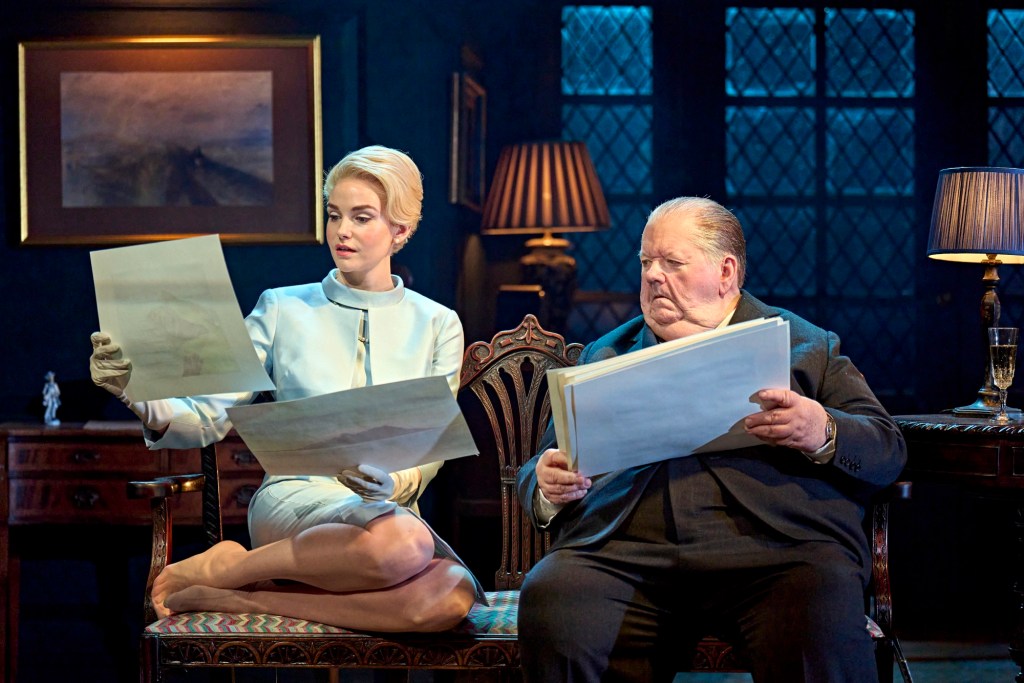
DOUBLE FEATURE
by John Logan
directed by Jonathan Kent
Hampstead Theatre, London – until 16 March 2024
https://www.hampsteadtheatre.com/whats-on/2023/double-feature/
Anybody interested in the creative process behind movies is going to be fascinated by Tony and BAFTA winning American writer John Logan’s new play. Double Feature has taken a decade to pen, and accordingly has matured like a fine wine, full of complex notes and intriguing aftertastes, as it hits the Hampstead stage in Jonathan Kent’s classy if static production.
Alfred Hitchcock and his sinisterly controlling relationships with assorted leading ladies still exerts a horrifying fascination, and was explored to fine theatrical effect in Terry Johnson’s 2003 Hitchcock Blonde. Logan covers some of the same thematic ground here, specifically with Tippi Hedren, the actress Hitchcock held under personal contract having elevated her to film stardom from appearances in TV commercials. This is a less flashy piece than that Royal Court smash hit, but it is quietly shocking in its contemplative explorations of power abuses, coercion and artistic differences in an industry with more than its fair share of problematic individuals.
Double Feature, true to its title, juxtaposes an uneasy combination of power play and confrontation between the director and star of his 1964 movie Marnie, with a comparable, but differently accented, encounter between actor Vincent Price and his enfant terrible director Michael Reeves while they’re working on the 1968 horror flick Witchfinder General. Theatrical piquancy is added by having both meetings play out simultaneously and on the same set (a luxuriously appointed, faux rustic lodge, in an atmospheric, detailed design by Anthony Ward).
In a fun extra layer, the set may look the same but it actually represents two separate locations, as well as two differing time periods: Witchfinder General was shot in East Anglia while Hitchcock had a replica English cottage built on his Hollywood film set for him to use while filming. Hugh Vanstone’s complex lighting does a lot of heavy lifting here to differentiate between the two locales.
The amount of research and veracity of detail means this is a play that will appeal primarily to the nerdiest of cineasts, but the production values, the sheer quality of the acting and much of the writing ensure that it more than commands the attention even for people less film-obsessed. Furthermore, the Hedren-Hitchcock portion of the play addresses centuries of male on female abuse that extends far beyond the reaches of Hollywood.
Logan’s script and Kent’s staging get off to a cracking start with Rowan Polonski’s nervy, mercurial Reeves alternately cajoling and attempting to bully Jonathan Hyde’s magnificently grand but playful and affronted Price into not abandoning the film project. It’s riotously funny, and meticulously well observed as the power balance shifts between the two men apparently at opposing ends of their career trajectories (tragically, the real Michael Reeves died aged only 25 not long after Witchfinder General came out). Both actors handle the whip-smart dialogue and lightning fast changes in mood and attitude brilliantly, and Hyde offers up an uncanny Vincent Price with a rare mixture of high status grandiloquence and innate warmth.
The temperature cools perceptibly with the arrival, albeit taking place half a decade earlier and thousands of miles away, of Hitchcock and Hedren. This section occasionally proves pretty hard to watch, such is the accuracy and truth in the performances of Ian McNeice and Joanna Vanderham. The latter, abetted by Ward’s period-perfect powder blue suit, captures exquisitely the on-edge poise of the young star covering up her desperation with a veneer of sophistication, and she’s ferociously authoritative in a tense worm-turning scene that may have you silently punching the air in approval.
It’s essentially a very talky piece, and a small amount of research into the figures involved and the movies in production, would definitely benefit the lay viewer. There’s a beguiling symmetry in the way individual spoken phrases ricochet and replicate between the two separate scenes, as though to suggest, depressingly, that some things never change. The convention of having both sets of actors on stage even when half of them aren’t engaged occasionally creates a vacuum of energy that threatens to detract from the scene being played out, but the magnetism of the actors mostly overcomes that. Similarly, the decision to shakily (and loudly) revolve the set by a few degrees to expose the messy bed chamber that never gets used, feels a little ponderous and unnecessary.
Despite these reservations, this is nonetheless a Rolls Royce piece of theatre, one that deserves to have a further life beyond this brief premiere season. It’s worth pointing out that a production of this world class quality is happening at a venue which lost both its Arts Council funding and Artistic Director within the last eighteen months. Hampstead Theatre has come out swinging with what looks like one of their most exciting seasons for years, off to an impressive start with this intelligent, elegant offering. This North London institution remains an essential destination for discerning theatregoers, it’s imperative that it’s supported and Double Feature, for starters, is well worth your time and money.
 ajhlovestheatre
Leave a comment