DEAR OCTOPUS
by Dodie Smith
directed by Emily Burns
National Theatre/Lyttelton – until 27 March 2024
https://www.nationaltheatre.org.uk/productions/dear-octopus/
A major West End success before and after the Second World War, Dodie Smith’s 1938 dramedy family saga has seldom been seen since. This opulent National Theatre re-evaluation shows us what we’ve been missing while intriguingly suggesting why the piece has been neglected for decades. Theatre historians and completists will surely flock to Emily Burns’s long but luscious staging, but it may prove a harder sell to theatregoers who prefer their shows flashier and more dynamic.
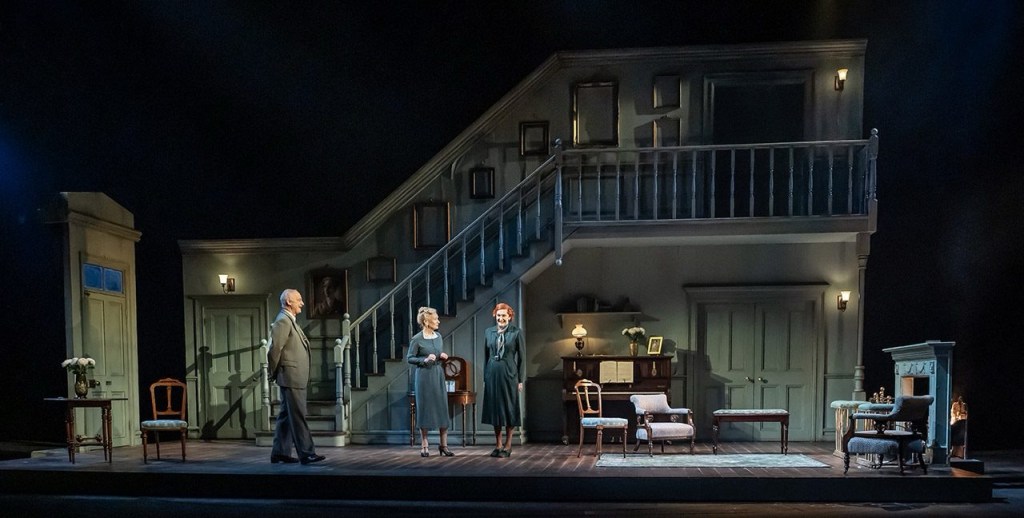
The title Dear Octopus refers to the ties that, tentacle-like, bind a family together, however geographically far removed they are, and Smith’s play is not so much plot driven as nudged in different directions by shared memories and mutual grievances. The setting is the gaslit country pile (gorgeously designed by Frankie Bradshaw) of the moneyed Randolph family, four generations of which are gathered to celebrate the golden wedding anniversary of eccentric, religiously devout matriarch Dora (Lindsay Duncan) and her benign, doting husband Charles (Malcolm Sinclair).
Tensions rise, reconciliations happen, two unrequited loves get contrasting solutions, it’s all tremendously civilised. How interesting it is will depend on how invested one can get in the tribulations of the privileged few, and also perhaps on how easy it is to draw parallels with the Randolphs and one’s own family. The detail in the production is a thing of considerable beauty, from the muted flair of Bradshaw’s costumes to the richly atmospheric lighting by Oliver Fenwick and Nico Muhly’s delicate underscoring, which gives the whole thing an almost filmic quality. There’s even an etiquette consultant employed (Lucy Cullingford).
That detail doesn’t extend to all of the casting. Most of the leads are spot on, but there’s some alarmingly wooden acting from some of the supporting company. Sinclair is in fine fettle as doting, contended Charles, and Kate Fahy brings a brittle edge to family friend Belle whose joie de vivre masks an inner hollowness that quietly tugs at the heartstrings.
Lindsay Duncan is brilliant as Dora, as kind as she is deliciously withering (“she’s always been very honest about her make-up. Dear me, it must be worrying to take a face like that out in the rain”). Duncan even convinces in the ponderous sections where Dora discusses her faith with her non-believing husband, moments which in lesser hands could easily become a lot of theatrical dead air. Bethan Cullinane, Jo Herbert and Amy Morgan do striking, slyly funny work as three contrasting daughters, and Bessie Carter makes something vivid and true out of long standing ladies companion Fenny’s fixation on Billy Howle’s apparently confirmed batchelor son Nicholas. Herbert’s OCD suffering estate agent Hilda is especially delightful.
There’s an elegant savagery to much of Smith’s dialogue (“only a very happy woman could dare to trust to nature as your mother has”) that genuinely stings and entertains, but the whole play is so dated that it sometimes shocks for the wrong reasons (there are several references to the weight of Morgan’s Margery that take the breath away with their sheer insensitivity).
Realistically, only somewhere like the National would have the resources nowadays to stage a play like this, and the whole enterprise reeks of quality. Whether or not the play itself was really worth the effort and the money is a question. It’s gently enjoyable, but you may come out thinking that there’s a reason why Dodie Smith is best known for 101 Dalmatians…
 ajhlovestheatre
Leave a comment