MACBETH
by William Shakespeare
directed by Max Webster
Donmar Warehouse, London – until 10 February 2024
https://www.donmarwarehouse.com
We may be into the last two weeks of 2023, but it’s undeniable that David Tennant is giving one of the performances of the year in the new Donmar Macbeth. This play, at this venue for the first time, and including the stage return of Cush Jumbo as a striking Lady Macbeth, would have been highly anticipated anyway, but Tennant’s presence turns it into a major cultural event.
He’s worth the hype, giving us a charismatic but preoccupied soldier who goes on an entirely convincing journey from initial bewilderment via unassailable bravado (“none of woman born shall harm Macbeth”) to dead-eyed acceptance. He makes the uncertainty, the cruelty and the vaulting ambition of the character all of a piece in a truly compelling performance. More than that, you see the precise moment where this Macbeth realises he’s a dead man walking, and it’s simultaneously chilling, and makes for tremendously satisfying theatre.
Tennant‘s Thane is at the centre of a production by Max Webster, a director who has form with mixing intelligence and raw theatricality and overlaying well worn texts with a crisp layer of anachronism, that is simultaneously vitiated and slightly sabotaged by a couple of bold central ideas. The most obvious is the use of binaural sound: every audience member experiences the performance wearing headphones, allowing Gareth Fry’s vivid sound score and the haunting, ethereal Celtic-inspired music to penetrate right into the ears and brain.
It’s an interesting, and intermittently very effective, conceit, sometimes reminiscent of the sound and light installation adaption of the novel Blindness with which the Donmar reopened during the Covid pandemic. The “weird sisters”, the witches who accost Macbeth on the blasted heath and hail him as the future King of Scotland, are the primary beneficiaries of this approach: instead of being physically impersonated by actors, they are a series of disembodied voices, so close that their plosives set off a chain reaction from your inner ear to the hairs on the back of your neck, then on down your spine. They sound seductive, soothing….yet deeply troubling. The murder of Lady Macduff (Rona Morison, delicate but mighty) and her children is done in pitch darkness with only the terrifying sounds, and our imaginations filling in the blanks: it’s horrific and deeply upsetting, and so it should be.
The constant thrum of underlying noise, the black modernish costumes, starkly dramatic lighting (Bruno Poet) and perhaps most of all, the use of Shelley Maxwell’s stylised movement, gives the overall sense of this Macbeth being more of a dark satanic ritual than a conventional play. There’s an air of shuddering suspense and dread that grips and discomforts. When the atmosphere explodes into action (terrific fight choreography by Rachel Bown-Williams and Ruth Cooper-Brown), it feels genuinely dangerous.
Having the actors mic’d and beamed straight into our ears is a reminder of how much covert whispering and how many duplicitous asides there are in this most bloody and dark of tragedies and thanks to the technology, we don’t miss a single word, even the most desultory murmurs. Personally, I would like to hear the voices acoustically from time to time though: the Scottish accented delivery of the verse here is uniformly exquisite. Tennant’s command of the language is particularly beautiful, fully alive to the poetry but making perfect sense of every line, living inside of it. His version of the “Tomorrow and tomorrow and tomorrow” soliloquy, just after learning of his wife’s death, is perhaps the most effective I’ve seen.
The second defining central concept explored by Webster is the idea of the Macbeths having lost a child, and being haunted by that loss. It’s psychologically acute and speaks directly to much of Shakespeare’s writing for Lady M, but feels a little over-egged by the end of the two hour, interval-free evening, with a small boy taunting Macbeth on the battlefield or peering through the gloom behind the clear back walls of Rosanna Vize’s simple but striking dais set. Those see-through walls serve a useful dramatic purpose too, as the supporting cast stare from the other side or sometimes bang disconcertingly on them like the collective conscience of the two principal characters.
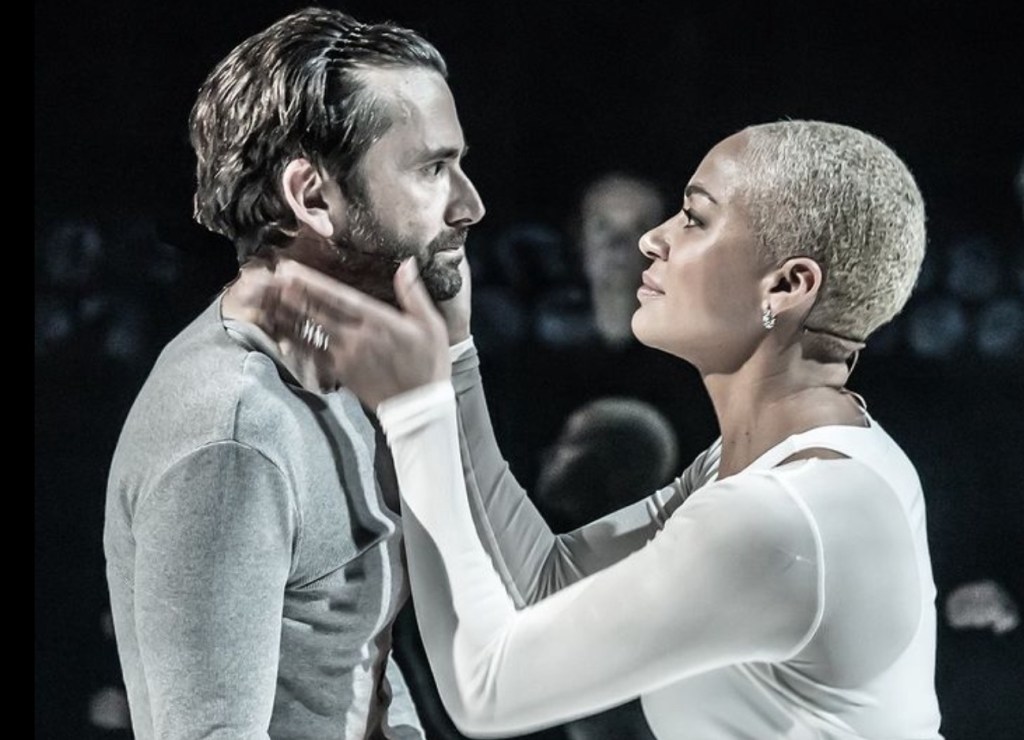
Cush Jumbo’s fine Lady Macbeth is clad in figure-hugging white, in vivid contrast to the darkness of the other costuming, but this disturbed and disturbing figure is no angel. Jumbo points up her intelligence and pragmatism but also an undercurrent of real brutality. Interestingly, the robust strength she demonstrates earlier renders her vulnerability and distress in the famous sleepwalking scene all the more powerful. Jumbo and Tennant don’t have the sexual chemistry Saoirse Ronan and James McArdle brought to the 2021 Almeida production for Yael Farber but that feels deliberate, this coupling feels driven more by status and ambition.
The supporting cast are uniformly strong. Nouf Ousellam is a fiery, heroic but human Macduff and Cal MacAninch brings authentic depth and colour to Banquo. Jatinder Singh Randhawa works hard as the Porter and is cheeky and likeable despite being saddled with some rather belaboured audience interaction.
All in all, despite a couple of reservations, this is a fascinating, atmospheric Macbeth and Tennant is predictably brilliant but brilliantly unpredictable. A superb end to an excellent year at the Donmar.
 ajhlovestheatre
Leave a comment