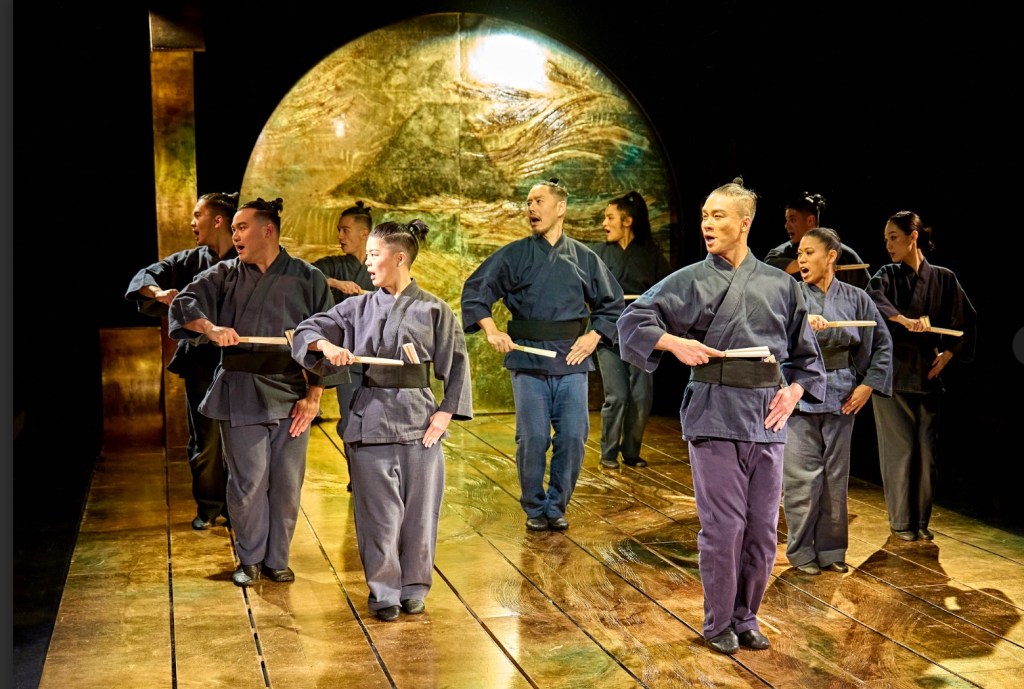
PACIFIC OVERTURES
Music and lyrics by Stephen Sondheim
Book by John Weisman
Additional material by Hugh Wheeler
Directed by Matthew White
Menier Chocolate Factory, London – until 24 February 2024
https://www.menierchocolatefactory.com/tickets/pacific-overtures/
Sandwiched chronologically between A Little Night Music and Sweeney Todd, Pacific Overtures, first seen in New York in 1976, is generally considered to be one of the most challenging of the Sondheim canon, and is certainly produced less often than its waltzing and throat-slashing siblings. Matthew White’s visually attractive but dramatically inert new staging, a co-production between the Menier and Japan’s Umeda Arts Theatre (where this version was first seen in Osaka and Tokyo) demonstrates why. It contains much to admire but only intermittently soars.
An attempt at imagining, from a Japanese perspective, the effects on the “floating kingdom” of outside interference, led by America in 1853, on a country isolated for centuries from the outside world, Pacific Overtures was always about as far removed from the traditional Broadway musical as it’s possible to conceive. This version begins in a museum filled with historical Japanese artefacts, the narrator (or ‘Reciter’ as the conventions of Kabuki theatre which so informed Harold Prince’s original vision, would have it) being the tour guide (a charming, sparky Jon Chew in decidedly modern dress and coiffeur).
Figures from the past – the ruling Shogun and guards, a fisherman, a samurai and his wife, sundry merchants – waft onto the traverse stage in formation, lending a ceremonial air as we are transported back to a rigorously disciplined, delicately unspoilt pre-modernisation Japan (“We sit inside the screens /And contemplate the view /That’s painted on the screens /More beautiful than true…As the centuries have come, they’ve gone / In the middle of the sea”). The lyrics are elegant, simple but never simplistic, with fiendishly clever internal rhymes, not all of which get across here, alas.
Sondheim’s music for Pacific Overtures is some of the most ravishing and ingenious even he ever created, enhanced by Jonathan Tunick’s orchestrations which meld East and West, strings and percussion, to produce aural bliss. It’s a phenomenal score, lyrical yet edgy: delicate and exquisite as a silk screen but thrillingly bombastic when it needs to be.
John Weidman’s book is a much drier affair. It filters the seismic change in Japan’s relationship to the outside world through the friendship between samurai Kayama (Japanese stage and screen star Takuro Ohno, in his UK debut) and fisherman Manjiro (a haunting, gorgeous-voiced Joaquin Pedro Valdes). As a script it has a cool detachment from much of the drama in the story, playing out instead as a sort of ritual, an approximation rather than a flesh-and-blood saga. For it to really captivate (as it did in the stunning, entirely satisfying Donmar-Chicago Shakespeare Theatre production twenty years ago), it needs to have a meditative focus and emotional clarity, both mostly missing here where the long, narrow stage and Ashley Nottingham’s busy but uninspired choreography repeatedly work against the intensity and delicacy of the unique material.
As Western influence bleeds into Japan, Kayama succumbs to external influences, coming to resemble the epitome of a European/American gentleman while Manjiro moves in the opposite direction, reclaiming his national identity with due pride and ferocity. ‘A Bowler Hat’, the song that depicts these developments is a mini-play in itself, and beautifully staged here, in a moment where form, content, style and craft all combine to telling effect. It’s a perfectly pitched sequence in a production that elsewhere suffers from a frustrating inconsistency of tone, particularly in the performances.
Rising star Valdes is flawless, as is Kanako Nakano as Kayama’s doomed wife. Elsewhere, the performance styles from a gender-switching cast tend to range from blank to the point of blandness, to the kind of shameless, broad mugging that wouldn’t look out of place in a school play, accompanied by some worryingly pitchy singing. A notable exception is the witty, delightful ‘Please Hello’ number which shows Sondheim at his most bravura depicting a quintet of international admirals courting Japan for trade deals, each in their (perceived) native musical styles, all punctuated by deafening blasts of cannon fire from their attendant warships. We get a flamboyant Sousa-esque cake walk for the American, a merry clog dance for the Dutch, a Gilbert and Sullivan pastiche for the English, a folies bergères-type frolic for France, and a wonderfully morose and extravagant Mussorgsky-style dirge for Russia (Lee VG, brilliant). It’s the nearest thing to a showstopper this unconventional score has, and proves an irrepressible treat yet again this time around.
The piece has been cut to an interval-less 105 minutes, arguably the biggest casualty being the excision of the masterly ‘Chrysanthemum Tea’, a bleakly comic play in song form that sees a disillusioned Shogun’s mother slowly poisoning her own son. With that gone, Pacific Overtures becomes a largely humour-free evening, apart from the aforementioned ‘Please Hello’. Neither the potentially riotous but essentially icky ‘Welcome to Kanagawa’, where a brothel madam instructs her young employees in ways to amuse the visiting American sailors, nor the transcendent ‘Someone In A Tree’ land as pleasingly as they can, thanks to some wearyingly heavy over-emphasis. The thunderous finale, ‘Next’, usually uplifting yet sinister with more than a touch of melancholy as modern day Japan exultantly takes on the rest of the globe, also lacks feels muted, detrimentally impacted by the bizarre decision to bisect the already limited playing area with a projection screen, thereby scuppering both choreography and sightlines.
Paul Pyant’s lighting and Ayako Maeda’s costumes are gorgeous, and Catherine Jayes’s fine nine piece band, under the baton of Paul Bogaev, sounds much larger and lusher than it is. Even in a less than ideal production, Pacific Overtures remains a fascinating, bracingly original piece. Shorn of some of its power and excitement, it feels like a stunningly accomplished score tethered to an episodic, uninvolving text and some questionable racial tropes. Sondheim completists should undoubtedly make their way to Menier for this, but the uninitiated may find themselves wondering what all the fuss is about.
 ajhlovestheatre
Leave a comment