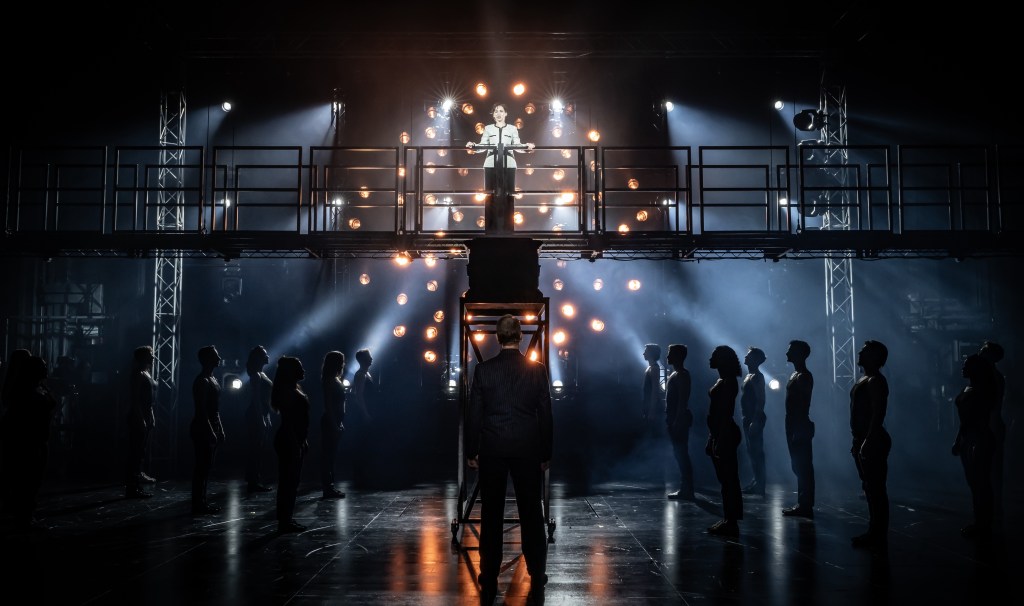
EVITA
Music by Andrew Lloyd Webber
Lyrics by Tim Rice
Directed by Nikolai Foster
The Curve, Leicester – until 13 January 2024
https://www.curveonline.co.uk/whats-on/shows/evita/
As with any classic – and Evita, first seen on stage in 1978, is surely now regarded as a classic modern musical – echoes of earlier productions inevitably hang over any new version. So it proves with Nikolai Foster’s determinedly contemporary new staging of the Rice and Lloyd Webber rock opera at Leicester’s Curve. The use of projected images sometimes recalls the iconic Harold Prince original while anybody who saw the Jamie Lloyd open air production in Regents Park is likely here to be transported back by the modern sneakers and monochrome leisurewear of the ensemble and by Adam Murray’s muscular, angular choreography.
That said, Foster’s vision, epic and frequently laser-focused, is as remarkable for the new ideas it throws at the piece as it is for its (perhaps unintended) continuation of earlier tropes. There is little, if any, attempt to contextualise the action in Argentina or in the 1940s when the real life Eva Peron was at the height of her powers as wife of the ruling dictator. The visual aesthetic here is stark, spare and majestic: a gargantuan staircase is wheeled around the vast space, a video screen wall flies in and out, batteries of lights (stunning work by Joshie Harriette) rain down on the performers or blind the front stalls, simultaneously glamourising the action while mercilessly exposing the less admirable aspects of the Peronist regime, a stage wide gantry bearing the ruling militia descends from the flies to suggest absolute power and also constant surveillance.
Staging the waltz where the narrator Che (Tyrone Huntley) directly challenges Evita over her motives and morals as a TV interview is a brilliant idea, as is the concept of having the ruling classes, the aristocracy and the aforementioned military men, as, respectively, a bunch of trashy drunks and feckless, towel-flicking frat boys. Not everything lands, but clearly a lot of original thought has gone into this reimagining. The bare metalwork of Michael Taylor’s set is often reminiscent of the Regents Park Jesus Christ Superstar, especially under Harriette’s rock stadium lighting.
In all honesty, I’m not sure how clear the storytelling would be to somebody unfamiliar with the work, and some of the concepts feel a little half-baked. Is the frequent live filming and direct address to camera intended to suggest that Eva was a latter day equivalent to a social media star? Was she the first influencer?! Having Che emerge from the front stalls to question the status quo (“who is this Santa Evita? Why all this howling, hysterical sorrow?”) is an interesting choice but isn’t fully followed through, leaving the usually wonderful Huntley as a frustratingly ambiguous figure. He sings beautifully, albeit a little too cleanly, but isn’t sardonic or edgy enough to really pose an ideological threat to the Perons, and never seems clear whether he’s applauding Eva or admonishing her.
Martha Kirby’s Eva gets better as the evening progresses. As the youngster desperate to escape her hicktown existence for the bright lights of the big city, she lacks the requisite fire, but she convinces later as a smooth operator capable of manipulating her way to the top, even if the staging doesn’t really give her many opportunities to demonstrate this. It’s a very passive interpretation of a role that can, and probably should, be a performance-driving firecracker. Still, she works the camera like a real star and meets the considerable vocal demands of the role with ease and sweetness, maybe a little too much sweetness: when she belts at the top of her range, as in the rabble rousing sections of the ‘A New Argentina’ act one closer, she’s authentically thrilling, mainly because she, for once, sounds dangerous and raw. Foster’s direction does so little foreshadowing of the illness that kills her (the real Eva Peron died of uterine cancer, aged 33) that anybody who didn’t know the story might find her very swift deterioration somewhat bewildering.
The only one of the three leads who is fully inhabiting their role at present is Gary Milner as Juan Peron. He’s dashing and charming on the surface but suggests a core of bullying, ruthless darkness and also a fundamental weakness, as though acutely aware that the lions share of his popularity is down to his charismatic wife. Since the 1996 movie version, the pleasant but hardly essential ballad ‘You Must Love Me’ has become part of the standard stage score and it works better here than ever before by turning it into a duet for the Perons, Eva in failing health and Juan attempting to comfort her but with one eye on his dwindling power.
Dan Partridge’s swaggering Magaldi, the tango singer who seduces the underage Eva and unwillingly takes her to Buenos Aires, is like a boyband reject in this modern iteration, and it’s a highly effective take. Having Peron’s Mistress appear much earlier than usual (she’s on Peron’s arm at the charity concert where he meets Eva) is another inspired idea, and makes her rejection all the more cruel, a point reinforced by Chumisa Dornford-May’s exquisite, powerfully emotional rendition of the beloved ‘Another Suitcase In Another Hall’ number.
The choral singing throughout is exciting, although Adam Fisher’s sound design would benefit from upping the volume several notches, and using teams of youth performers to swell the crowd scenes is an intelligent move, adding to the monumental feel of the production. Foster has the ensemble stationed all over the auditorium at points which adds to the general feel of us all being collusive in the Peron’s rise to power, and it’s just a shame that the musical performance is so aurally underwhelming on the whole, which is no fault of the the fine singers but rather that a nine piece band inevitably sounds a bit thin given the scale of the staging and the symphonic demands of Andrew Lloyd Webber’s galvanising, fascinating score.
Fans of a traditional Evita will mourn the period trappings and glamour (even the Jamie Lloyd version gave us the iconic white ball gown and scraped back peroxide blonde, albeit only in the final moments) and it’s a shame that the music doesn’t always sound as powerful as it should, but this is an undeniably fresh, bold look at a familiar piece. Here it’s less about Eva Peron as a historical figure and more about the corrosive, changeable nature of fame and mass manipulation. It may miss some of the notes one has come to expect but it has its own dynamism, and is frequently astonishing to look at.
 ajhlovestheatre
Leave a comment