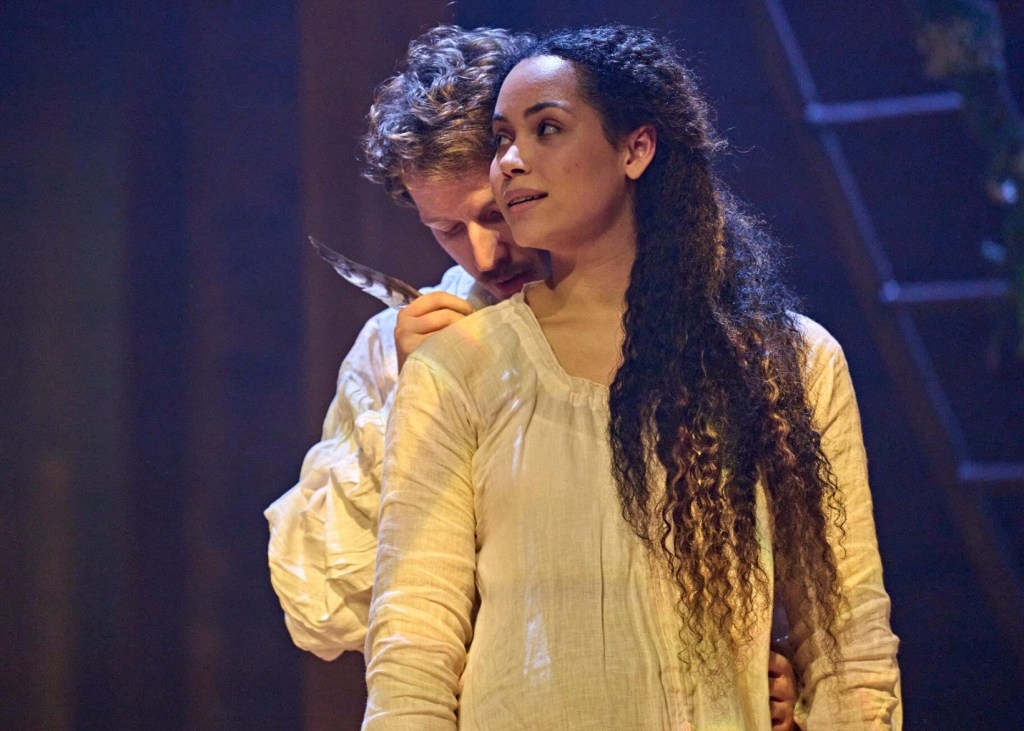
HAMNET
by Maggie O’Farrell
Adapted by Lolita Chakrabarti
Directed by Erica Whyman for Royal Shakespeare Company
Garrick Theatre, London – booking until 17 February 2024
First seen as the reopening production of the newly refurbished Swan Theatre in Stratford-Upon-Avon, Hamnet arrives in London feeling simultaneously like an old and a new play. In truth, nobody does these drama-cum-pageant historical pieces better than the RSC, and Hamnet is vintage work, with its economical but stylish production values, intelligent theatricality, and fine performances from a diverse cast. It’s not going to set the world alight maybe, but it’ll nicely warm up the winter nights for many.
Lolita Chakrabarti’s play is based on the 2020 novel by Maggie O’Farrell which imagined what happened when Hamnet, William Shakespeare and Agnes’s (after reading the will of Hathaway’s father where he refers to her as Agnes, O’Farrell is convinced that she has been misnamed for over 500 years) eleven year old son died, and the effect this would have had on his grieving parents and family.
First seen flying her pet kestrel, watched by a smitten Shakespeare (Tom Varey, excellent), Agnes is a feisty, unconventional, fascinating young woman, unfashionably (for the time) free-thinking, and in connection with otherworldly forces, a seer, a herbalist, a hearer of voices. Madeleine Mantock, in a ferociously good performance, invests her with enormous warmth, emotional directness and a compelling fearlessness. William falls for her unconventionality, and so we. Her grief after the death of her beloved son is authentically difficult to watch, and her regret and bitterness when it looks as though her marriage will be the next casualty after her child, is beautifully, painfully expressed.
One of the virtues of Chakrabarti’s script is that it seldom feels like an adaptation. So many stage versions of novels suffer from a somewhat frantic necessity to cram in beloved sections of the book so that the cumulative effect is less theatrical and more like box-ticking, but not so here. It is, by necessity, episodic as the location switches between Stratford and London, and it’s hardly dynamic. However, it has clarity, a measured theatricality, and the story and characters get full rein to breathe. It also feels relatable in this post-Covid era, as the Shakespeare household is forced to quarantine when the twins Jude and Hamnet succumb to the fever that will eventually carry the latter off.
The detail in Erica Whyman’s production is impressive: minor characters seem vivid and fully drawn, the subtle adjustments in sound and lighting evoke interior or exterior, a simple repositioning of the blocks on Tom Piper’s glorious timbered set transform the space into “this wooden o” of Shakespeare’s Globe where the final scenes take place. Prema Mehta’s lighting design is particularly effective: autumnal, evocative. Simon Baker’s sound is complex and transporting, although I could barely make out what the “voices” that haunt Agnes were saying.
In a large cast, there’s superb work from Peter Wight, doubling as Shakespeare’s abusive father and a fruity Globe actor, and Sarah Belcher and Liza Sadovy as a pair of contrasting female family members with suitably strong opinions on the relationship between William and Agnes. Ajani Cabey and Alex Jarrett are very affecting as the Shakespeare twins, as is Phoebe Campbell as their older sister. Gabriel Akuwudike is magnificently understated as Agnes’s world weary, likeable brother. The use of Midlands accents is a nice, unforced touch.
It isn’t perfect: some of the blocking feels as though it hasn’t quite been adjusted from the (quite differently shaped) Swan, which makes a few moments frustratingly unfocused. There’s not much humour, and the pace is sometimes lacking in energy. It’s a shame also that Chakrabarti’s depiction of the relationship between William and Agnes is presented in a more linear, less quirky manner than in the book, and the connection between Hamnet the boy and Hamlet the play that Shakespeare may or may not have written as a posthumous tribute to him isn’t really explored.
These cavils aside, this is a predominantly spellbinding piece of theatre, classy, intelligent and satisfying. Warmly recommended, whether or not you’ve read the book, and a solid West End hit for the RSC. I also think culturally minded foreign tourists will love it.
 ajhlovestheatre
Leave a comment