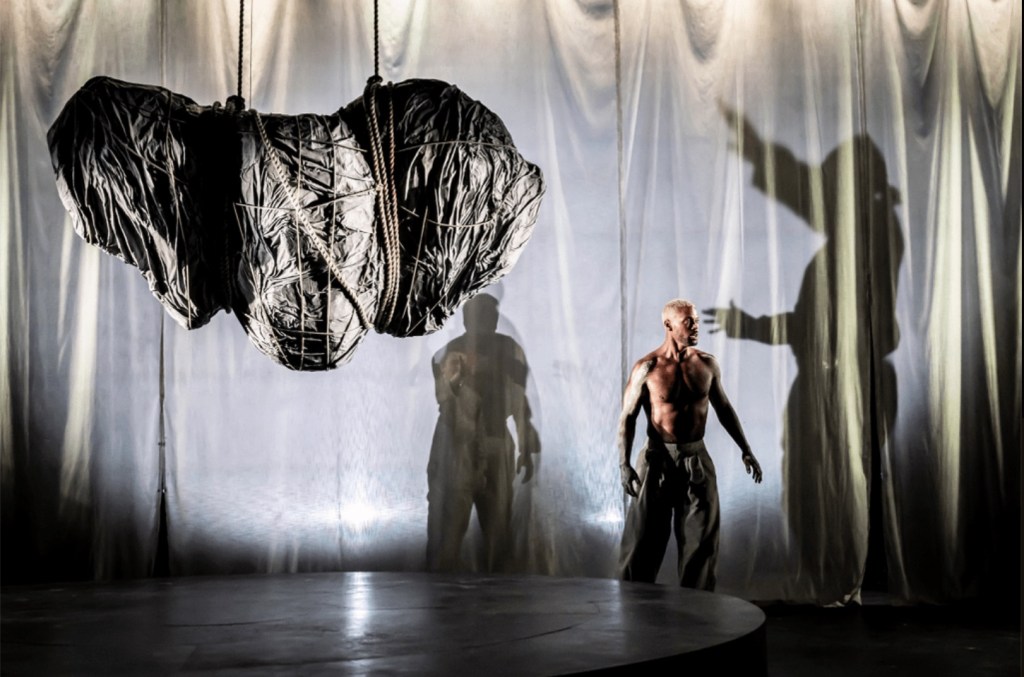
MLIMA’S TALE
by Lynn Nottage
Directed by Miranda Cromwell
Kiln Theatre, London – until 21 October 2023
https://kilntheatre.com/whats-on/mlimas-tale/
Any London theatre season that features two UK premieres by double Pulitzer winner Lynn Nottage, arguably the finest African American female playwright at work today, is cause for celebration. Nottage is a wonderful writer, an impassioned, socially aware, astonishingly versatile artist with fire in her belly and on her keyboard, a bold sense of the theatrical, and a command of language that can turn from elegant to raw as required. The Donmar will present her 2022 Tony nominated Clyde’s later in the autumn, but first up is Mlima’s Tale, first seen at New York’s Public Theater in 2018 and now here at the Kiln in a starkly effective staging by Miranda Cromwell.
In a number of ways, Mlima’s Tale forces us to evaluate what a “play” actually is. Part ritual, part docudrama, part lecture, it’s an angry, intermittently poetic examination of the black market trading in elephant ivory, that serves as a critique of human greed and selfishness and a wake-up call with regards to the dwindling elephant population. The text also revels in the spiritual afterlife of those magnificent pachyderms, and eschews linear storytelling in favour of a series of scenes, sketches almost, and dance-heavy moments that coalesce into a bigger picture longer on symbolism than on dramatic tension.
There’s little humour, but then again there’s nothing funny about humankind exploiting the natural world to the point of permanent damage, and most of the characters are little more than sketches rather than fully rounded creations. This may well be Nottage’s point -that humans are only a small part of the overall picture- but it doesn’t help that Cromwell’s production hasn’t, as yet, found the right tone for some of the sections. Despite the pithiness of the writing, it isn’t always clear just how grotesque or how sincere the trio of ensemble actors (Gabrielle Brooks, Pui Fan Lee and Brandon Grace) are supposed to be as they glide between gender and racial boundaries as a succession of people, some corrupt, some wracked with guilty, others simply indifferent, all embroiled in some way in the clandestine global ivory trade.
Natey Jones is very effective as the nearest thing the play has to a human protagonist and finds convincing layers to Geedi’s anguish and uncertainty. The production’s biggest asset is the astonishing central performance of Ira Mandela Siobhan as the titular Mlima, a fifty year old elephant prized, sought after and then murdered for his tusks, before becoming an omnipresent figure for the play’s duration (although he lingers in your mind long after that), watching, judging, bearing witness. As choreographed with sublime sensitivity and imagination by Shelley Maxwell, his supple, finely honed black body larded with more and more swathes of white emulsion like so much contamination as the performance progresses, this Mlima is a riveting, magnetic combination of grace and power. Transforming from a physically beautiful example of humanity to the dignity and gravitas of the elephant by bending his torso forward and crooking his arms just so, he is miraculous to behold, moving with a liquidity that simultaneously suggests the sheer size of the creature and an ethereal otherness. Vocally, he is commanding, whether howling in pain or bellowing in righteous indignation. This is a unique, unforgettable interpretation, and should to be a major boost to this fine actor’s rapidly ascending star.
Femi Temowo’s evocative musical score runs throughout, above and alongside Nottage’s words, and the physical production (Amelia Jane Hankin – design, Amy Mae – lighting, and Emma Laxton – sound) has a simplicity that amplifies the urgent messages of the text. This may not be a great piece of drama, but it’s heart is emphatically in the right place, and Cromwell’s production has numerous takeaway moments that stay with you long after the ninety minute duration.
 ajhlovestheatre
Leave a comment