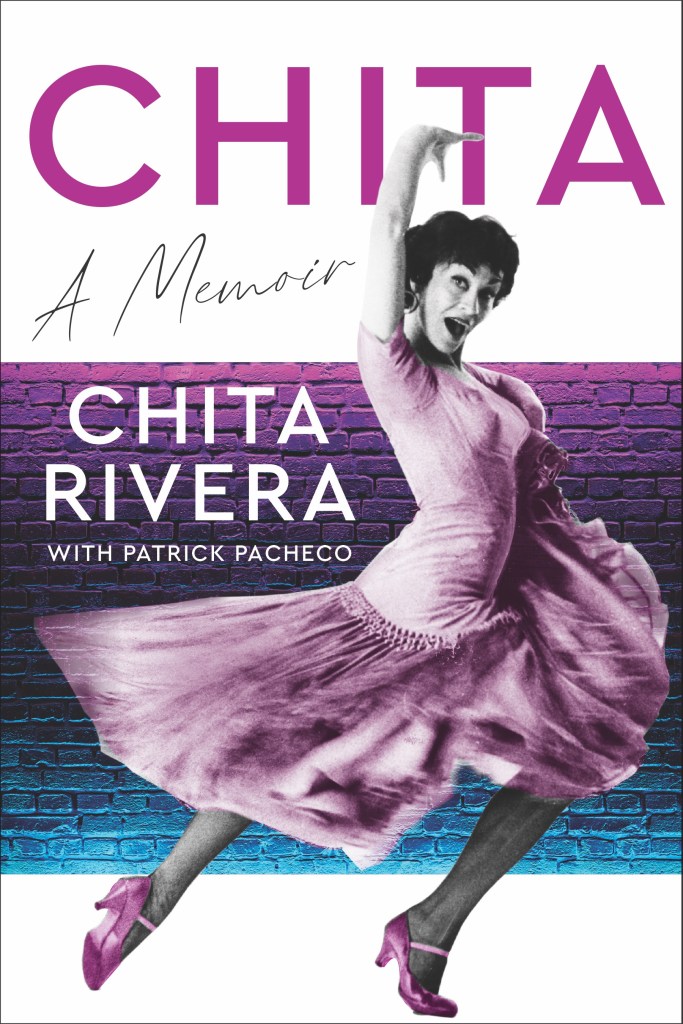
CHITA – A MEMOIR
by Chita Rivera, with Patrick Pacheco
Published by Harper One
https://www.barnesandnoble.com/w/chita-chita-rivera/1141864330?ean=9780063226791
“I’m not nearly as nice as people think I am” states Broadway icon Chita Rivera at the beginning of this delightful autobiography. It’s probably the only thing that readers won’t agree with when they complete this memoir, co-authored with Emmy-winning arts journalist and commentator Patrick Pacheco and suffused with love, humour, humanity and fascinating backstage stories. What emerges most strongly is the picture of Chita, or Dolores Conchita Figueroa del Rivero Montestuco Florentina Carnemacaral del Fuente to give her her full name, as a thoroughly decent, well-rounded human being, albeit no pushover and certainly prone to some beguiling eccentricities, as well as a consummate professional and an authentic showbiz legend. But yeah, she’s not so much “nice” as utterly irresistible.
As anybody with an interest in musicals will know, Chita Rivera was the original Anita in the Bernstein-Sondheim-Laurents-Robbins masterpiece West Side Story, so was the first person ever to perform such classics as “America” and “A Boy Like That” on any stage anywhere. She subsequently reprised her Broadway role in the West End premiere, a feat she repeated with Rosie Grant, the lead in Bye Bye Birdie. She lost out on both roles in the film versions of those shows, to Rita Moreno and Janet Leigh respectively, something she writes about sanguinely here, but was unforgettable as one of Shirley MacLaine’s hard-boiled, big-hearted sidekicks in the movie of Sweet Charity.
With remarkable equilibrium, Rivera acknowledges that her friend and colleague Gwen Verdon (who created Charity Hope Valentine onstage for Bob Fosse, and who was Roxie to Chita’s Velma in the maestro’s original 1975 Chicago…and the whole section on that is unputdownable) had similar experiences to herself when it came to transferring, or rather not transferring, a Broadway role to the silver screen. It’s commendable but also deeply lovely how Chita remains loyal to her magical stage colleague while never trashing MacLaine’s performance on celluloid. Referring to her own experience, she writes “people often ask me if I feel ownership of the roles I have created on stage….Hell, ya!” but then, in imitable Rivera style, concludes “To the actors inheriting these parts, I say ‘Blessings. More power to you!’”
Learning first hand about the creative processes and tribulations behind shows that are part of the fabric of Broadway lore from somebody who was actually there, and who recounts her memories with a beguiling combination of humility, wonder and honesty, is a rare treat for theatre enthusiasts. The book is gossipy too, but never salacious – Chita is way too classy for that – but she touches upon some of the demons that haunted Sammy Davis Jr, with whom she had a personal relationship and shared a stage in the Broadway tuner Mr Wonderful, and Liza Minnelli, her co-star in Kander and Ebb’s The Rink, the show for which Rivera won her first Tony award (she actually has three); she recounts these issues with compassion but zero sensationalism, judgement or sentimentality, and there is a sense of a certain naivety in her outlook that, alongside once-in-a-generation talent, formidable work ethic and being a human that is generally a joy to be around, may help to account for her long term survival in a brutal industry.
Strong women are a recurring theme here: there’s her beloved mother Katherine, simultaneously a cheerleader and an anchor for the budding star, then her daughter Lisa Mordente, a terrific performer in her own right and, as depicted here, a total force of nature, also her first dance teachers Miss Jones and Miss Haywood, disciplinarians who envisioned a multiracial world of ballet beyond its (at the time) entirely Caucasian constraints. Then there’s Dolores….
Dolores is, to all intents and purposes, the alter ego of Chita. Dolores is who comes out when things are not going well, productions are failing due to incompetence or carelessness, when Ms Rivera suffers a professional slight or, as Lisa Mordente so memorably puts it, “when Mom goes Puerto Rican”. In a sense, she’s a ‘get out of jail free’ card for when Chita needs to behave like a diva. It’s an intriguing prospect and Dolores is a frequent, and highly entertaining, presence throughout the narrative.
Not as entertaining as Chita herself though; her turn of phrase is idiosyncratic and frequently hilarious. Reading the text, it’s impossible to get her witty, smoke-infused purr of a voice out of your head. Anybody who can come out with lines like “Boris Karloff, the sexiest man alive. Always. When he was alive, that is” or “in Bernarda Alba, my costume was a black mourning dress and I wore clunky shoes that made me look like a truck driver” is someone I want to spend time with. There’s a keen, quirky wit but also a wild imagination at play here: for instance, when taking about Antonio Banderas, with whom she co-starred in the 2003 Roundabout revival of Nine, she writes “I imagined Antonio as a golden bird climbing into the sky with all this power coming from his tail feathers. I saw myself hopping on his back for the ride. Okay. I’m not sure what a psychiatrist would say about that. Probably plenty. I’m not one to analyze myself.” Glorious.
She’s sensitive too, as she talks about AIDS decimating the world of theatre during the 1980s (she was a true ally to the gay community long before it became fashionable, or widely accepted), and very moving when she pays to tribute to her beloved co-star, English classical actor Roger Rees, who died midway through the run of her most recent Broadway show, Kander and Ebb’s powerful, unsettling, death-fixated The Visit. As lifelong friends, as well as creators of some of Chita’s most acclaimed roles as well as her near-legendary night club act, John and Fred loom large in the book. They, along with Harold Prince, were also responsible for her memorable return to the West End stage after an absence of several decades, in Kiss of the Spider Woman, another tuner obsessed with mortality as Rivera freely admits she herself is too, in the dual role of Aurora/Spiderwoman for which she would end up winning another Tony when the show went to Broadway. The chapter on that show is particularly interesting.
All in all, this is a great read for anybody interested in theatre, but specifically Broadway musicals and their sometimes rocky road to the stage. Showbiz enthusiasts will love spotting the famous names Chita worked with and befriended (or not) and anybody starting out in the industry will get a sharp, but kindly, lesson in just how hard it can be, even when you’ve got a cv like Ms Rivera’s, and the importance of acknowledging and appreciating the people who help you. Another major takeaway I had from Chita – A Memoir is that she is living proof that it is possible to be a roaring, unassailable talent and enjoy the acclaim and rewards that brings, and a true survivor, while still being a damn good person. That’s pretty special, like Chita Rivera.
 ajhlovestheatre
Leave a comment