FAREWELL MISTER HAFFMANN
by Jean-Philippe Daguerre
translated by Jeremy Sams
directed by Lindsay Posner
Ustinov Studio at Theatre Royal Bath – until 23 September
https://www.theatreroyal.org.uk/events/farewell-mister-haffmann/
I’m not sure which is crueller: the unexpected volte face that derails the anxious but compelling supper party scene in Nazi-occupied Paris, that is the centrepiece of this riveting drama, or the play’s final moments, which provoke sniffles and gasps from a gripped audience, where the characters tell us the conclusions to their stories. It’s a moving ending, only slightly marred by the realisation that only two of the figures depicted were actually real people.
Either way, watching Lindsay Posner’s meticulous, thrillingly acted production, it makes sense that Jean-Pierre Daguerre’s 2017 piece has become a long running staple of the French theatre scene (over 1000 performances in Paris and winner of four prestigious Molière awards). Adieu Monsieur Haffmann has been translated into umpteen languages and presented internationally, and is a study text in French schools.
What’s perhaps more of a surprise is that such an engrossing and timely play has taken this long to get an English language version. It’s set during a historical period that has social and political divisions that worryingly resonate in the present day, it has tension, humour, humanity, psychological acuity, and it speaks to the idea that evil proliferates when good people are prepared to blur the edges of what’s acceptable and right. It tackles anti-Semitism head on, and rams home the uncomfortable fact that much of France already had a shameful attitude towards Jewish people even without the input of the Nazis. Jeremy Sams provides a crisp, well-turned adaptation that crucially sounds like a new play that happens to be set in 1940s Paris, rather than a translation.
Childless couple Isabelle and Pierre Vigneau (Lisa Dillon and Ciarán Owens, both heartbreakingly good) agree to hide Jewish jeweller Joseph Haffmann (Nigel Lindsay, powerfully understated and emotionally accurate) in the basement of his own house while Pierre takes over his business, at a time when the Nazis are rounding up Jews and sending them away while seizing their art works and wealth. As if that wasn’t tense enough, the price Vigneau demands from Joseph is that widower Haffmann impregnates his wife in return for his safekeeping. I’m not sure I completely bought this plot strand, although the acting is so good it went most of the way towards convincing me, but it does allow Daguerre to sensitively explore the sadness of a youngish couple unable to conceive, and the irrationality of jealousy. I suspect the trio of actors invest the characters with more inner life than was written for them; Dillon in particular imbues Isabelle with a fascinating mixture of vulnerability and steel.
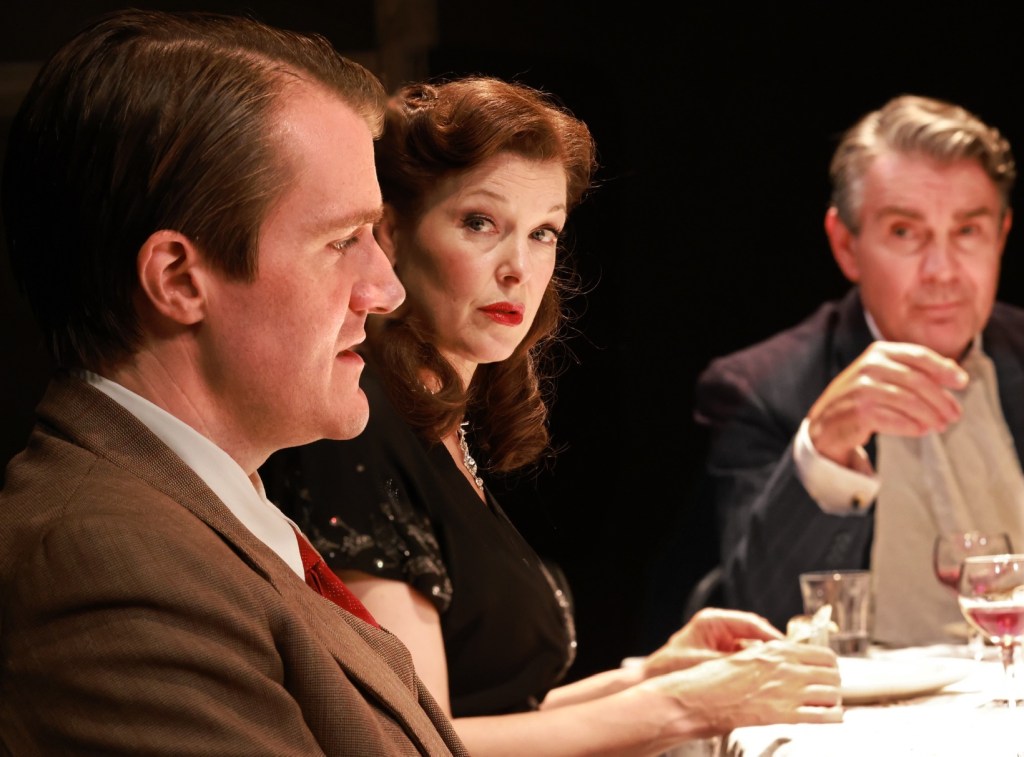
Posner’s production is full of striking moments – the sight of Lindsay’s Haffmann tentatively placing his outstretched hands then his whole body into the sliver of sunlight that reaches as far as his basement is almost unbearably moving, as is Owens’s increasingly frenetic tap dancing as he tries to keep his gnawing jealousy at bay – but really catches fire with the climactic dinner party and the arrival of German ambassador Abetz and his colourful wife. To further up the ante, and once again the performances go a long way to papering over the cracks in the play’s plausibility, Haffmann decides to attend the dinner, pretending to be Pierre’s restauranteur brother Jean (and of course the main dish is suckling pig, cue jokes about this being the best pork “Jean” has ever tasted).
In the dramatic equivalent to the devil having all the best tunes, the Abetz’s are fabulous theatrical company. Alexander Hanson plays Otto Abetz as witty, urbane, charming….until he isn’t. It’s a brilliant portrayal, all too credible, especially chilling as he makes profoundly nasty anti-Semitic sentiments sound like civilised social small talk. By contrast, Josefina Gabrielle makes his glamorous but ghastly wife Suzanne transfixingly vivid, but with an undertow of something else: she’s boozy, bracingly rude, often very funny, and almost entirely inappropriate, but Gabrielle intriguingly suggests a core of desperate sadness. It’s an outrageous, utterly satisfying performance.
These dinner scenes, with tensions threatening to boil over at any second, the discovery of Haffmann’s true identity a constant possibility, paroxysms of social awkwardness and a major revelation during dessert, play out like an elegant mash-up of Ayckbourn at his most mortified with a wartime thriller. It feels urgent, and familiar but fresh; genuinely gripping entertainment.
The spare but atmospheric design by Paul Wills, complemented by Tim Mitchell’s lighting and Giles Thomas’s haunting sound and music, adds to the suspense and sense of finely tuned melancholia. The play carries a real, and perhaps unexpected, emotional wallop in its penultimate scene that does make me wonder if the final, direct address section, where each character tells us what happened next, is really necessary. Despite that, this is a memorable, first rate piece of theatre, magnificently acted, and I hope it has a further life after this Bath season.
 ajhlovestheatre
Leave a comment