ASPECTS OF LOVE
Music by Andrew Lloyd Webber
Lyrics by Don Black and Charles Hart
Based on the novel by David Garnett
Lyric Theatre, London – until 11 November 2023
With controversy surrounding a youngster being potentially groomed by a much older man being all over the media at the moment, the timing could hardly be worse for this revival of Andrew Lloyd Webber’s 1989 musical (really a chamber opera given that almost everything is sung). Seeing Aspects Of Love in 2023 provokes the inescapable feeling that you’re watching one of the Lord’s loveliest scores unfortunately tethered to a story that seems to get more problematic with every passing year.
Based on David Garnett’s 1955 novella about bedhopping Bohemians disporting erotically and complicatedly all over Europe in the 1940s, it often felt like the poor relation in the early Lloyd Webber canon, coming as it did in the wake of Phantom, although the original London run clocked up a run of three years. Bad Cinderella and Stephen Ward would surely have been more than happy with that, and Aspects has enjoyed numerous tours, international productions and revivals since the original. It was last seen in London in 2019 at Southwark Playhouse in Jonathan O’Boyle’s exquisite bijou version from Manchester’s Hope Mill which intriguingly for a show that is sometimes tainted with accusations of misogyny put the women front and centre, with an astonishing lead performance from Kelly Price as histrionic but irresistible French actress Rose Vibert.
Jonathan Kent’s new production is less a revival than a full on revisal, switching the nationality of the central character Alex from English to American (presumably to accommodate new leading man Jamie Bogyo), changing a sizeable percentage of the lyrics, cutting, adding and repositioning scenes, altering the ages of a couple of principal characters, and reallocating Alex’s big number ‘Love Changes Everything’ to his bon viveur Uncle George.
That last alteration is one of the most successful and not just because it gives Michael Ball fans another chance to hear their idol perform his signature song (Ball was the first Alex in Trevor Nunn’s West End and Broadway premieres), which he does magnificently, albeit in a lower key. Originally a youthful declaration of the vicissitudes of love that sat slightly randomly in the score as a whole, here it is more contemplative and regretful coming from an older character. Ball still owns it though. Actually he lights up the stage whenever he is on, capturing all of George’s bonhomie, self-absorption and complicatedly conflicted emotions as the story twists and turns. It’s a charming, commanding performance, vocally winning and dramatically satisfying, that reaffirms Ball’s status as this country’s foremost musical theatre leading man.
Many of Don Black and Charles Hart’s original lyrics, always one of the weaker aspects of Aspects, have been tinkered with, mostly to positive effect, although the mind boggles that they still didn’t see fit to excise such wince-inducing horrors as “I think I know the reason you’re so keen for this to end / I saw what you were doing with your new Italian friend” or “Now tell me, do you still like omelettes?” The banality of the words contrast so jarringly with the full blown melodic lushness of Lloyd Webber’s tunes (Tom Kelly’s new orchestrations sound gorgeous as played by Cat Beveridge’s fine thirteen piece band) that I can’t help but wonder if this might be one of those rare shows best enjoyed by non-English speakers who can just experience the rapture of the music without having a clue what’s coming out of anybody’s mouth, a bit like watching an unfamiliar opera in it’s original language, without surtitles.
That said, I’m not sure the action in Kent’s pretty but ponderous staging would help anybody not listening to the words, to understand what was going on. In this rethinking, Alex is eighteen when he first meets and falls for older actress Rose (Laura Pitt-Pulford) and so is Jenny (Anna Unwin), George and Rose’s daughter (I told you it was complicated), when she in turn becomes besotted with her much older cousin. Despite the obvious talent of most of the leading players, there is zero sexual chemistry. During the idyllic first section where youthful Alex and Rose romp through the Pyrenees in the first flush of lust, you should get the overwhelming feeling that they can’t wait to rip each others clothes off, but instead this pair wander about like a couple of kids on a geography field trip. Far from adoring each other, most of the principal characters seem to barely even like each other, a problem exacerbated by some mind-bogglingly awkward blocking and misconceived musical staging.
In the original, Alex and Jenny were seventeen and fifteen respectively, so at least this new version removes paedophilia from the roll call of potentially troubling themes (incest and grooming being perhaps the two biggest no-no’s) that run through a story that seeks to be head-turningly romantic but in the wrong hands can come across as self-indulgent and not a little creepy. On paper, one would have expected a director with Jonathan Kent’s track record to be absolutely the right hands to steer this delicate but tricky ship.
Unfortunately though, in practise, he fails to make the disparate strands of melodrama, comedy and full blown romanticism coalesce, rendering an already elusive story pretty hard to follow. It all feels excessively restrained, precious and lacking in heat. Without a sense of palpable passion and the fire in their hearts and veins, the characters can come across as unlikeable, apart from Michael Ball’s George and Anna Unwin’s heartfelt, winsome Jenny.
Laura Pitt-Pulford is among this country’s finest musical theatre leading ladies, a consummate artist with heart, presence and formidable technique. Unfortunately though, her Rose feels too polite, too sensible, as though she has been directed to stay constantly at one remove from the other people on stage and from us. Pitt-Pulford sings the role terrifically but seldom finds the warmth, the earth, and the sexual magnetism to really make sense of this complex woman. I think it’s a directorial issue: for instance, during the impassioned tarantella ‘Hand Me The Wine And The Dice’ at George’s funeral, Trevor Nunn’s original Rose (the late, great Ann Crumb) danced wildly while sobbing pitifully having just scattered her husband’s ashes amongst his vineyards, it was cruel, powerful and rousing. Kent however has his Rose sit passively on a random cart on one side of the stage with her back to the audience as though waiting for the post-funeral vol au vents to be passed around. His star deserves better.
It also doesn’t help Pitt-Pulford that her leading man is so lacking in charisma that it makes nonsense of whole swathes of the story. It may be that Bogyo’s work reads brilliantly up close or in the audition and rehearsal room, but it fails to travel across the footlights; that was an issue in Moulin Rouge and it feels like an even bigger problem here where his singing is passable, but his acting is less than that. Opera star Danielle De Niese works hard and looks fabulous as George’s other great love, the Italian sculptress Giuletta, but her characterisation feels entirely too uncomplicated to convey a woman who was widowed young and suffers from waves of debilitating depression, plus the score doesn’t seem particularly well suited to her voice. There are richly enjoyable cameos from Michael Matus and Rosemary Ashe as a couple of innocent bystanders caught up in all the drama.
The staging aims for a cinematic feel but is hampered by the limited size of the Lyric’s stage (also not helped by having the musicians on a raised level at the back of the playing area, and coyly but pointlessly revealed during two orchestral sections, as though to reassure the audience that the music is in fact being played live). The use of panels with sometimes mystifying projections traversing the space during scene changes gets pretty tiresome, and a series of filmic close-ups and reveals later in act two, redolent of Michael Blakemore’s masterly original production of City of Angels or currently Sam Mendes’s vision for The Motive and the Cue over at the National, comes out of nowhere.
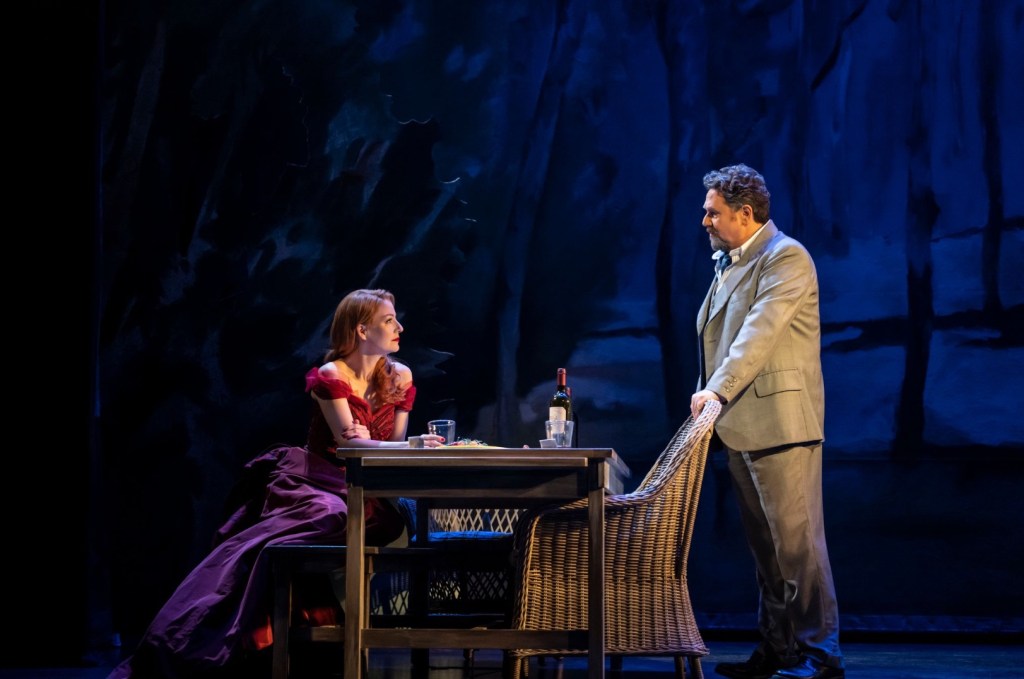
The uncertainty of tone and lack of palpable passion in the staging fatally blunts the emotional impact of the swooning swells and unexpected dissonances in Lloyd Webber’s score. Furthermore, this odd production makes a couple of the more eccentric scenes – a random act one visit to a fairground, and a circus sequence in the second half – feel even more surplus to requirements than in earlier versions. On the up side, John Macfarlane’s attractive, painterly scenery, ravishingly lit by Jon Clark, mean that even when boredom and/or bewilderment sets in, the whole thing is lovely to look at. It’s also often very beautiful to hear, but it’s a disappointingly pedestrian, inconsistent take on a sophisticated, conflicted musical.
 ajhlovestheatre
Leave a comment