SWEENEY TODD THE DEMON BARBER OF FLEET STREET
Music and lyrics by Stephen Sondheim
Book by Hugh Wheeler, from an adaptation by Christopher Bond
Directed by Thomas Kail
Lunt-Fontanne Theatre, New York City – open-ended run
https://sweeneytoddbroadway.com
Is it the greatest musical of the late twentieth century? Is it the greatest opera of the twentieth century? The question of genre has always hung over Sondheim and Wheeler’s 1979 masterpiece, further complicated by the fact that it is the only piece of music theatre of it’s time to have been presented on opera stages as well as legit stages (New York City Opera have performed it at Lincoln Center and in the UK, Sweeney has slashed throats at ENO, the Royal Opera House and Opera North). What is in no doubt though is that it is a noirish masterpiece, a soaring, seething cauldron of vivid characters, ribald humour, nasty shocks, astonishing beauty and thrilling, transporting music. The current Broadway revival, which obliquely homages Harold Prince’s extraordinary original vision at times, leaves audiences in no doubt that they are in the presence of greatness, even if several individual elements are less than ideal.
Musically it’s magnificent: Jonathan Tunick’s original orchestrations, by turns swoon-worthy then jarring, is played by a much-heralded 26 piece orchestra under Alex Lacamoire’s baton. Sondheim’s score, from the rollicking foreboding of the opening and closing ‘Ballad of Sweeney Todd’ with the entire band sawing away thrillingly, to haunting, achingly lovely balladry (‘Johanna’, ‘Pretty Women’, ‘Not While I’m Around’), witty patter songs, fiendishly clever quartets and chorales, to sheer, unbridled terror, is a thing of absolute wonder. The company singing is crisp, accurate and impassioned.
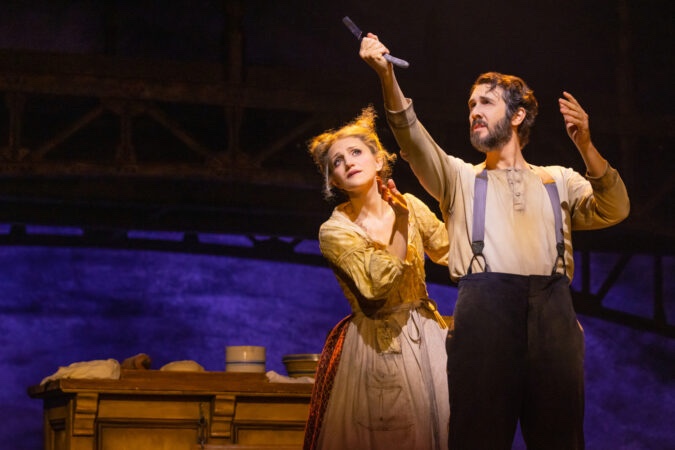
Visually, Kail’s production is restrained to the point of anaemia though. His Victorian London, as designed by Mimi Lien, is a cavernous, dark, empty space (matching Sondheim’s lyric “there’s a hole in the world like a great black pit…and it goes by the name of London”), dressed only with a stage-wide arch, a giant crane, a couple of staircases and some sticks of furniture periodically trundled on. It’s all lit in painterly fashion by Natasha Katz in great sudden washes of light thinning down to laser-like pin pricks to give added focus to specific moments. It’s striking and attractive, but it all seems a bit sanitised (there’s not nearly enough blood). There’s never the sense of roiling desperation, even filth and squalor, that permeates Sondheim’s astonishing score. The musical’s subtitle is “A Musical Thriller” but there’s precious little terror here, handsome and imposing as this production is.
That’s a problem. Few musicals set out to authentically frighten their audiences (Phantom never did, Little Shop of Horrors has its moments) but Sweeney most emphatically does. It’s right there in the music….I remember having nightmares after being obsessed with the Original Broadway Cast Recording as a child, and listening to it into the night without the lights on (what was my Mum thinking?!) I can also recall the wide-eyed discomfiture of the front couple of rows at the Cottesloe (now the Dorfman) in Declan Donnellan’s viciously brilliant National production when Alun Armstrong’s terrifying Sweeney turned on them during ‘Epiphany’ (“You sir, you sir, how about a shave? Come and visit your good friend Sweeney. You sir, too sir? Welcome to the grave….Who sir, you sir? No ones in the chair, Come on! Come on!”) as Julia McKenzie’s peerless Mrs Lovett looked on appalled yet excited.
Humanising Sweeney, or rather Benjamin Barker as is his real name, is not a bad idea, but there has to be the feeling that this is a once-good, deeply wronged man who has completely snapped the tether. Without the danger, he runs the risk of appearing bland. Opera singers such as Bryn Terfel (ENO opposite Emma Thompson) or Thomas Allen (for the Royal Opera) achieved the appropriate level of mania, even housewives’ favourite Michael Ball cast aside his chummy cuddly persona and went there magnificently in the 2011 Chichester production. It’s so well written that, in the score, Sondheim actually gives Sweeney anguished moments at the disturbing height of his homicidal passion where he reflects/laments on his situation (“I’ll never see Johanna, no I’ll never hug my girl to me – finished!….And my Lucy lies in ashes, and I’ll never see my girl again”) amplifying the tension while piercing the heart. At present, Josh Groban is a vocally glorious Sweeney, but misses the jet black fury at the heart of the man. It may come, but at the moment he reads as too uncomplicated and insufficiently driven.
The real villain of the piece is the pie maker Mrs Lovett, as she is the only person who holds all, or most of, the knowledge regarding the blighted lives of Sweeney, his lost wife and daughter, and the cruel, privileged chancers who fashioned their downfall; she it is who first has the idea to make pies out of the murderous barber’s victims, and who unscrupulously pursues Sweeney for her own romantic ends. It’s a gift of a part but fraught with pitfalls, standing as she does at the crossroads between Music Hall and Grand Guignol. She’s a grotesque, incorrigible yet irresistible, but needs to have some basis in reality to elicit that peculiar mixture of hilarity, repugnance, desperation and even sympathy to make the magic of this extraordinary role really take wing. The greatest interpreters of the role (Angela Lansbury and Sheila Hancock in the original Broadway and West End stagings respectively, the aforementioned McKenzie, Imelda Staunton, Carolee Carmello, even Patti LuPone) all got it. This production fields Annaleigh Ashford, acclaimed for her Dot/Marie opposite Jake Gyllenhaal in the pre-pandemic Sunday In The Park With George and the original Lauren in Broadway’s Kinky Boots. Anybody who saw her in the latter show, or has listened to the cast album, will have some idea of what to expect from Ms Ashford’s attempt at a British accent: it’s not just bad, it doesn’t sound like anybody you’ve ever heard anywhere, unless you’ve had the misfortune to be stuck in a pie shop with a whiny Eastern European with a very heavy cold.
Ashford has brilliant comic instincts but unfortunately they have little to do with either the historical period of the show, or the character. It’s a display of shameless, scenery-chomping focus pulling, and it’s often very funny, but it seldom feels sincere and it’s not Nellie Lovett. Watching a younger, blonder, more glamorous Mrs L did make me wonder though if, should this production make it’s way across the pond, this could be the role that gets Sheridan Smith back into musical theatre.
The supporting cast are excellent. Broadway sweetheart Ruthie Ann Miles is a saturnine, edgy presence as the Beggar Woman, although she needs to decide whether she’s Scottish or not, and Gaten Matarazzo is utter perfection as Tobias, finding the sweet spot between streetwise and cute. In short, he really makes you care. I also really liked Maria Bilbao’s manic Johanna, lovely yet damaged probably beyond repair, and her coloratura sits exquisitely on the music, pretty but with a slight air of danger. At the performance I saw understudy Nathan Salstone was on for Jordan Fisher as Anthony and gave a solid, finely sung rendition of the role. Jamie Jackson and Jamie Rapson are suitably horrible as the Judge and Beadle respectively, and sing superbly. Nicholas Christopher is a thrillingly funny and vocally dexterous Pirelli.
British choreographer Steven Hoggett has done the movement and, while some of it feels a little too self-consciously modern, the moment during the first ‘Ballad of Sweeney Todd’ where the entire ensemble seems to become one pulsating organism before vomiting forth a triumphant Sweeney, is a real spinetingler. Mrs L and Sweeney’s final descent to hell is brilliantly done as well, a real shock moment, leaving the audience with a mixture of stunned admiration and “wtf just happened?!” laughter: as closing moments go, it matches the iconic slamming of the iron foundry door with which Prince put the button on his original production.
Ultimately, there is a lot to enjoy here: at the end of the day, Sweeney Todd is a raging masterpiece, and encountering him will always be a chilling pleasure. It’s just sad that Sondheim never lived to see it become the massive commercial success it’s currently proving to be, and that this production doesn’t have more fire in its belly. If they manage to keep finding star replacements for Groban and Ashford, this Sweeney will end up being one for the ages primarily because of the amount of money it makes.
 ajhlovestheatre
Leave a comment