CAMELOT
Lyrics by Alan Jay Lerner
Music by Frederick Loewe
Book by Aaron Sorkin, based on original book by Alan Jay Lerner
Directed by Bartlett Sher
Lincoln Center Theater at the Vivian Beaumont New York City – booking until 3 September 2023
https://www.lct.org/shows/camelot/
Although billed everywhere as ‘Lerner & Loewe’s “Camelot”’, which may be the other a licensing requirement or an attempt to reassure Broadway traditionalists, this is undoubtedly actually Aaron Sorkin’s Camelot. The West Wing writer has filleted and reshaped Alan Jay Lerner’s original book to such an extent that the show as a whole feels less like an integrated musical than a play with songs. It’s intelligent, resonant and classy, and it looks austerely beautiful in Bartlett Sher’s opulent but restrained production, but it may not satisfy those in search of escapism and magic.
In fact, the magic has been completely excised, along with a number of winning songs from the original score. Nimue’s enchanting “Follow Me” soprano solo has gone, as has the character; Morgan Le Fey is now a scientist with a drink problem, and Arthur (Andrew Burnap, who could well be in line for another Tony for his magnificent work here) has no Royal or divine right to the throne, and merely pulled the sword from the stone on a passing whim, the thousands of earlier would-be Kings having probably loosened it, as Phillipa Soo’s glorious Guenevere tartly points out. Guenevere’s second act solo ‘I Loved You Once In Silence’ has been given to Jordan Donica’s Lancelot, for no very intelligible reason beyond beefing up that role (Donica is exquisite, for the record, and thrills the house with his singing, but the role still feels underwritten in comparison with the other two leads).
Burnap and Soo are probably this version’s greatest triumphs. Burnap, appreciably younger than his predecessors in the role, makes Arthur an innately kind man, acutely aware of his own shortcomings but with a keen wit and hot headedness that suggests a less priapic Shakespearean Prince Hal. He brilliantly charts the journey from cocky youngster, almost playing at being the monarch, to a deadly serious adult determined to protect who and what he loves but then horribly aware of the impact of his responsibilities. It’s a really winning performance, subtle, attractively sung, and utterly convincing.
Soo is equally fine, using an understated but successful upper crust English accent to suggest Guenevere’s difference from everybody else (most of the rest of the cast sound standard American and it doesn’t jar, and one wishes they’d taken a leaf out of this particular book over at Sweeney Todd, where the accents are by and large execrable). She makes “Jenny”, as Arthur calls her, a forward-thinking woman, every bit the king’s intellectual equal, floored by her unexpected passion for Lancelot. Dramatically and musically, Soo never hits a false note, her luscious soprano is full of character and she has never before been this magnetic on stage.
In an excellent (and large) supporting cast, Dakin Matthews’s enjoyable Merlyn/Pellinore double, Taylor Trensch’s gleefully spiteful Mordred and Marilee Talkington’s striking Jessica Chastain lookalike Morgan Le Fey, are particularly noteworthy. The choral singing is glorious but there just isn’t enough of it.
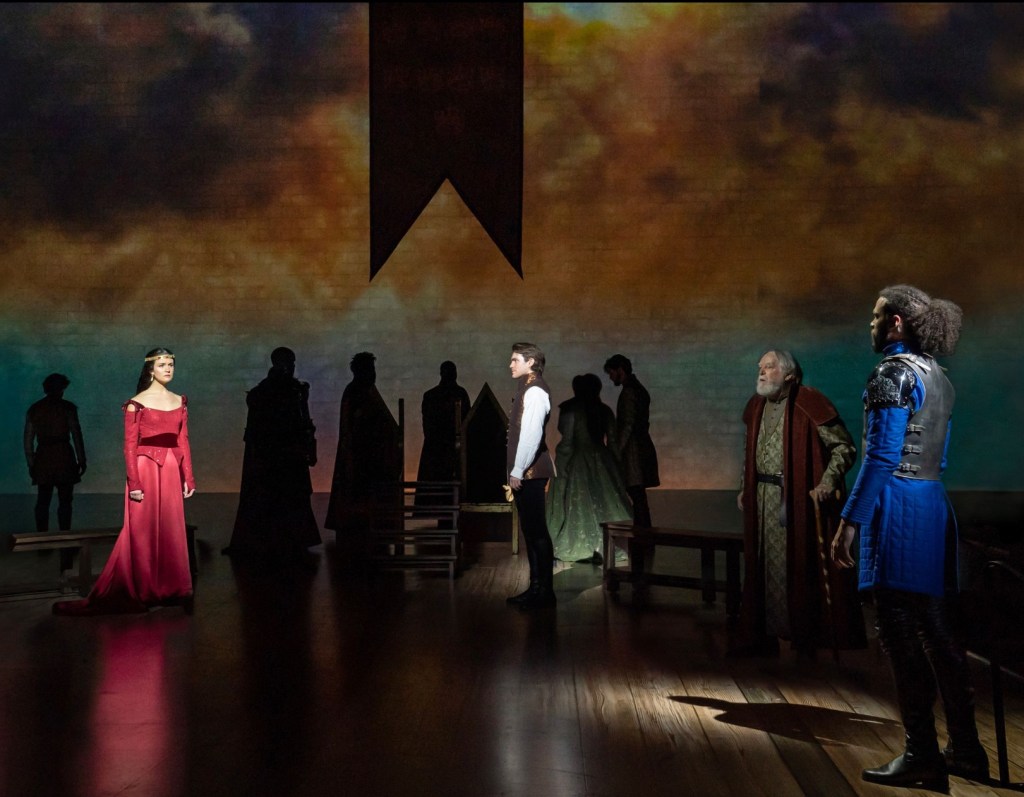
In all fairness, Camelot always was a bit of a plodder, stranded in some mythic neverland between earnest and operetta, and Sorkin’s attempts to tether it to modern relevances makes sense, but results in a show that feels resolutely earthbound. The only time, aside from the two central performances, where the show almost soars is in the fast-moving second act “Fie on Goodness” sequence where multiple storylines play themselves out and Sher uses the vast Beaumont stage almost as a giant movie set, with Lap Chi Chu’s atmospheric but terminally dim lighting helping to create new focuses and locations in the blink of an eye on Michael Yeargan’s stately set.
Ultimately, this feels like a show more to be admired than adored. Camelot in its original form was some way from the pinnacle of the revered Golden Age of Broadway, and this reimagining falls between the twin stools of respecting Lerner and Loewe’s creation and wanting to drag it (sedately) into the 21st century. It’s hardly revelatory but it’s still undoubtedly worth seeing though for those performances and the chance to hear a full sized orchestra.
 ajhlovestheatre
Leave a comment