A LITTLE LIFE
based on the novel by Hanya Yanagihara
adapted by Koen Tachelet, Hanya Yanagihara and Ivo van Hove
directed by Ivo van Hove
Harold Pinter Theatre London – until 18 June 2023
Savoy Theatre London – 4 July to 5 August 2023
https://www.atgtickets.com/search/?q=A%20Little%20Life
The thought that repeatedly struck me when reading Hanya Yanagihara’s dazzling literary masterpiece of human cruelty was “how much can one person take?”. I was reminded of that again and again watching the punishingly lengthy stage drama fashioned from it, but this time, as the playing time surged well past the three hour mark, I was thinking about the audience almost as much as poor Jude, the beaten, abused, irreparably damaged soul at the heart of this grim but compelling epic.
This is a very difficult watch: in adapting her epic opus, Yanagihara, in collaboration with Koen Tachelet and Marmite Dutch auteur Ivo van Hove (who also directs), spares us, and Jude, very little. There’s graphic self harm, rape, child abuse, violence, attempted suicide, amputation, and enough existential despair to sink a whole flotilla of ships of dreams.
Remarkably, A Little Life is also a study in enduring friendship, even though its conclusion seems to be that love is not enough to tether a person to life when their very existence means so little to them. Jude has a wonderful circle of friends – adopted father Harold (Zubin Varla), self-involved artist JB (Omari Douglas), Park Avenue trust fund beneficiary Malcolm (Zach Wyatt), and charismatic actor Willem (Luke Thompson) whose love goes above and beyond all reasonable expectations – and a privileged Manhattan lifestyle, funded by his successful legal career. None of it is enough, and as he imparts his horrifying backstory, it becomes apparent why.
Jude (known to his friends as ‘the Postman’: “post-sexual, post-racial, post-identity, post-past”) is an orphan forced into child prostitution by a predatory monk, before enduring a succession of brutalisations that leave him physically disabled and mentally disturbed, finding brief respite from the horrors in his head by regularly slashing at his forearms with a razor. He’s also a renaissance man with a delicate appreciation of the arts, the singing voice of a top chorister, and a brilliant legal mind.
Nearly as tragic as what Jude has to put with his in his young life, is the classic victims self-blame he carries around with him like an immovable boulder: he fundamentally believes that he is the engineer of his misfortunes, that he is forever tainted, and unworthy of love or even basic human consideration. This may just be the cruellest challenge Yanagihara imposes on him, and is all the more powerful because it bears the unmistakable ring of psychological truth.
Not everything else feels as authentic, at least not on stage. Upsetting as the book is, the piling on of misery and trauma across 700+ pages of often exquisite writing with a compelling narrative sweep, feels measured, plausible, compulsive, even as it’s utterly horrendous. Performed live, it starts to resemble a relentless catalogue of horrors where on more than one occasion you may find yourself wondering just what you’re getting out of watching this unfold. There’s no hope, no joy, little humour, zero redemption, apart from a genuinely beautiful final speech, delivered with exquisite restrained emotionalism by Zubin Varla, exhorting us all to find and spread compassion everywhere. Ultimately though, the message is life is shit, and then you die…horribly.
When reading the book, the implausibilities in the plot don’t seem as glaring as they do when played out on stage. Personally, I had a hard time believing that, for all his intelligence, Jude could achieve such high status within the legal profession, and nor did I buy that Willem, for all his love for Jude, would have actually become sexually attracted to him. Tellingly, in the novel, Willem continues sleeping with women, initially at least, because Jude is understandably unable to have sex. By taking that out of the script, Willem seems a bit too good to be true, despite the warmth, charm and intensity of Luke Thompson’s performance.
There are times when van Hove’s production is reminiscent of The Inheritance, another long-winded NYC-set study of gay angst and trauma across decades, but without the humour or the catharsis. Stephen Daldry’s staging of that Matthew Lopez two parter had a similar chilly-chic minimalism but also a piercing focus and intelligent theatricality somewhat lacking here, where van Hove’s blocking is often clunky, verging on the banal when it seeks to be literal.
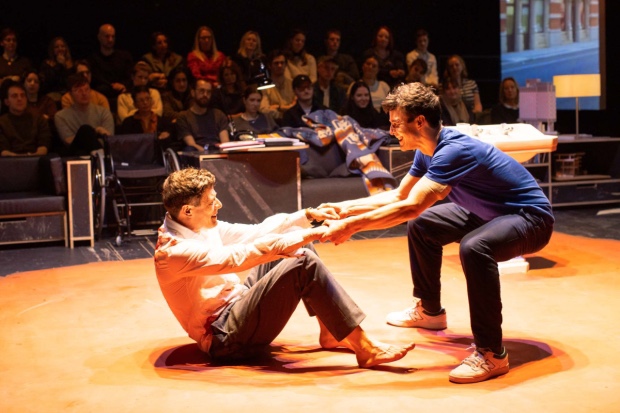
A section of the audience are on stage, which gives Jan Versweyveld’s chilly, spartan set the look of a courtroom, although what they’re there to reach a verdict on is unclear….that life sucks maybe? Either way, so much of the play is directed out front, with the view further impeded by furniture and a free standing sink, that one can’t imagine it’s a very satisfying experience, unless watching one of this country’s most bankable actors enacting self-mutilation is your particular bag.
That star is of course James Norton, best known for his screen work but here giving a performance of such utter fearlessness, craft and commitment that, even if he never sets foot on a stage again, he deserves his place in the pantheon of highly regarded theatre actors. Seldom off stage for the best part of four hours, he invests Jude with a shy, watchful dignity that makes it all the more affecting when it is ripped away from him. He’s covered in blood for much of the latter part of the show, as though the inner taints Jude is nursing are becoming manifest on his face and body. He subtly suggests the character’s different ages with breathtaking economy, just a change in gait, or a tilt of the head. When he lets us glimpse his anger, it is bleakly well done. If he can’t quite make Jude into a fully rounded character that may be because somebody who has suffered to this degree probably stopped functioning as a fully rounded human some years ago. It’s a hell of a performance.
None of the acting strikes a single wrong note, something of an achievement in a show of this ambition and sheer length. Elliot Cowan is astonishing as the trio of men who wreak such devastation on Jude, and Nathalie Armin brings such nuance and depth to the sole female role that you can almost overlook that she’s little more than a plot device. Emilio Doorgasingh is compelling as a doctor driven by a combination of exasperation, pity and fury.
Anybody who’s read the novel and goes to the play will have some idea of what to expect, but anybody who comes to this cold may be astonished at the sheer nastiness of much of it, and wonder quite what the point is. Yes, it’s gripping and yes it’s magnificently performed but ultimately the law of diminishing returns means that as the atrocities pile up, there’s a danger of some viewers becoming oddly desensitised.
Although seldom bored, I found myself becoming exhausted by the sheer nihilism of it all. Many others will disagree. I was truly moved only once: when Willem hauls his lover’s desperate, broken body up to dance, screaming heavenwards at an unforgiving God to notice what’s happening; it’s a cry of rebellion and a last ditch attempt to hold back the dark that constantly threatens to engulf Jude. It’s a heartrending moment amongst many where I found myself feeling mainly appalled.
 ajhlovestheatre
Leave a comment