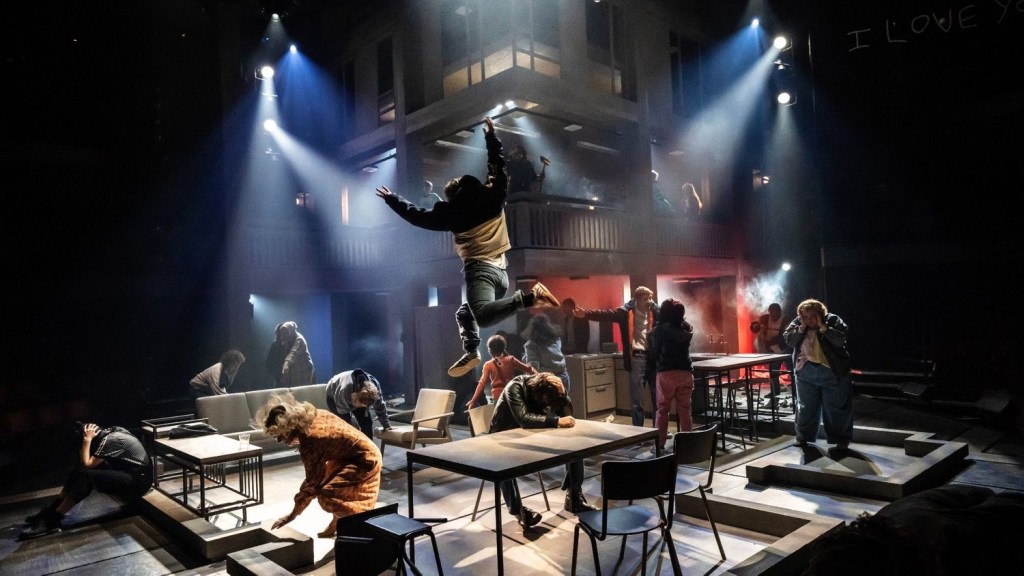
STANDING AT THE SKYS EDGE
Book by Chris Bush
Music and Lyrics by Richard Hawley
Directed by Robert Hastie
National Theatre/Olivier – until 25 March 2023
https://www.nationaltheatre.org.uk/productions/standing-at-the-skys-edge/
After rave reviews from the original run at the Crucible Theatre, and overwhelmingly positive word of mouth here in London, I assumed I was going to love Standing At The Skys Edge, but Holy Sheffield, I didn’t expect it to be THIS good. A diverse cast on stage at arguably the most prestigious theatre in the land roaring through a state-of-the-nation piece developed by one of the most well respected regional houses is exactly what we need right now. But when the results are this fine, it goes further than that: this is a cause for rapturous celebration. Once you stop sobbing, that is.
Although more sophisticated in intent and execution, Standing At The Skys Edge has the same open-hearted ebullience as audience favourite Blood Brothers and deserves to achieve a similar longevity. Chris Bush and Richard Hawley’s brilliant, heartfelt creation also recalls the inspired Conor McPherson-Bob Dylan tearfest Girl From The North Country with it’s employment of pre-existing songs to complement and comment upon a searingly effective new script.
Bush’s mastery of a trio of female-centric stories, set in the same flat on the infamous Sheffield Park Hill estate but decades apart, is enthralling. Rose and Harry (Rachael Wooding and Robert Lonsdale, both delivering career highlight work) are a young couple moving into the brand new dwelling in the 1960s, full of optimism and overjoyed at having escaped the slums. Then there’s the family of Liberian refugees who move in during the 1980s (Deborah Stanley, Baker Mukasa, both wonderful, and an astonishing Faith Omole) when the estate has become rundown and plagued with crime; the modern tranche of the story sees affluent Londoner Poppy (Alex Young) relocating to the now-redeveloped area and nursing a broken heart. In clean, intelligent strokes, with salty, realistic dialogue, refreshing humour and a brace of vivid characters, Bush’s terrific text embraces community, social change, migration and gentrification, with a bracing theatricality.
It’s ambitious but entirely successful in director Robert Hastie’s sure hands. If it’s sometimes reminiscent of soap opera, that’s only because it’s so compulsive and relatable, how much and how deeply we come to care about these characters, and the way it interweaves ongoingly relevant issues – from racism to legacy to how immigrants are treated – into personal stories of hope and despair.
There’s a running theme between the stories, which I won’t spoil here (though there is a clue from the outset in Ben Stones’s starkly imposing set design) but it carries a massive emotional wallop when the realisation dawns, and feels like the hallmark of truly great storytelling. There is a scene near the end, which refracts an exchange of dialogue from early in act one through what we have since discovered, and which is one of the most breathtakingly brutal and ingenious examples of turning a moment on its head, that I can remember, and it’s heartbreakingly played by Omole and stellar newcomer Samuel Jordan.
Hawley’s songs, some of which originated on a 2012 concept album, range from achingly lovely to real bangers. There’s a lot of light and shade, and a variety of popular music styles, but the thundering, portentous title song that opens the second half is a particularly exciting highlight.
Anybody who still subscribes to the hackneyed cliché that “real” acting seldom happens in musicals needs to see this, which features some of the finest, most truthful performances on any current stage in the capital, right across the company. Watching the sunshine drain out of Rachael Wooding’s indomitable, adorable Rose, her contended family unit decimated by the destruction of the steel industry where her husband previously flourished, is deeply painful. Wooding’s beautiful portrayal is warm, open, and, crucially, unsentimental which makes it all the more moving. The way both she and Faith Omole’s appropriately named, and equally terrific, Joy age as the story progresses is a masterclass, aided in no small measure by intelligent costume and wig design.
Alex Young is spot-on as lovelorn, conflicted Poppy, and is likeable enough to mitigate against uncharitable thoughts about “first world problems” when her story arc is juxtaposed with the others. All three women sing like absolute dreams. There isn’t a weak link in the supporting cast either, with especially invaluable, full-throated contributions from Maimuna Memon and Bobbie Little as characters whose connections to the central storylines are only revealed later in the show. Baker Mukasa carves out an unexpectedly joyous showstopper from the number he leads.
Hastie’s staging is laser sharp, negotiating the gear changes from tender family moments to rioting and much in between, with real flair. His work is augmented by Lynne Page’s hypnotic choreography, pitched halfway between dance and mime, which invests “real” people with an unusual grace and power, while remaining grounded in a gritty naturalism.
I laughed a lot, I uglycried and I couldn’t get out of my seat fast enough at the end to join in with the most spontaneous standing ovation I’ve ever seen at the National – this is captivating, vital, haunting theatre, stunningly staged and performed, and the most emotionally satisfying British musical in decades. As well as being a great show, this feels like a major mass populist cultural event and exactly the sort of thing the National Theatre was set up for. Get in there, for a genuinely life-enhancing, power-packed experience.
 ajhlovestheatre
Leave a comment