INDIAN INK
by Tom Stoppard
directed by Jonathan Kent
Hampstead Theatre, London – until 31 January 2026
running time: 2 hours 45 minutes including interval
https://www.hampsteadtheatre.com/whats-on/2025/indian-ink/
Arriving less than a month after his death, this rare revival of Tom Stoppard’s 1995 drama Indian Ink could hardly have been timed more appropriately or poignantly. Stoppard is generally regarded as one of the most intellectual and literate of modern playwrights, but pieces like this, along with The Real Thing, Arcadia (often perceived as his masterpiece and receiving a new production at the Old Vic in early 2026) and his final, emotionally charged Leopoldstadt, make a great case for the beating heart beneath the crackerjack brilliance and verbosity.
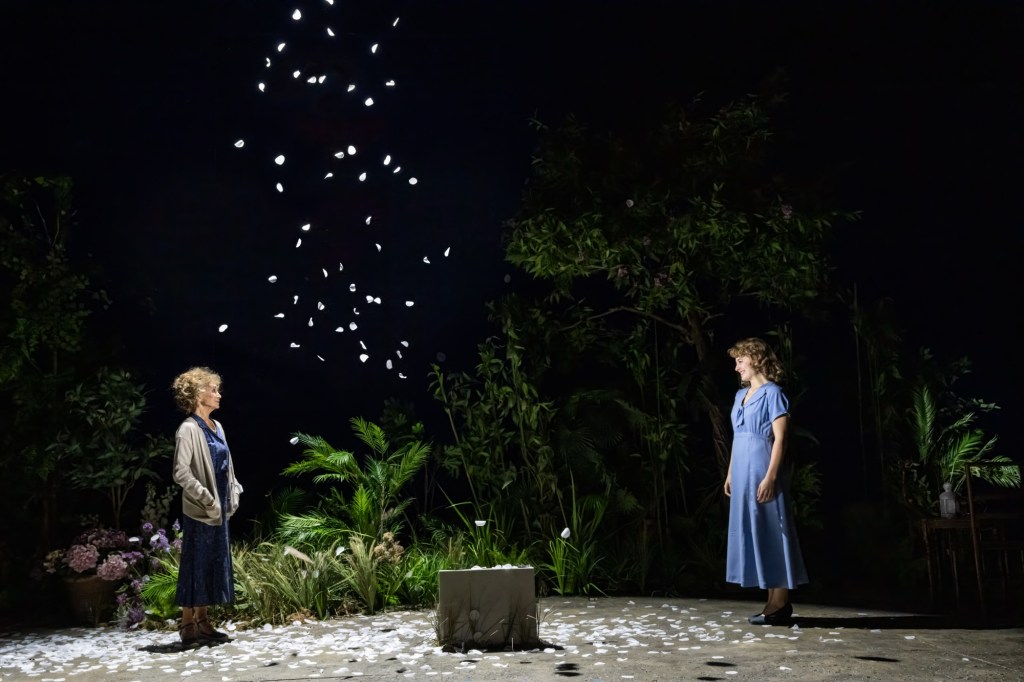
Indian Ink was originally a radio play entitled In The Native State, and the multiple changes of location and time period continue to strongly suggest that. Jonathan Kent’s visually arresting production is great at pointing Stoppard’s pithy dialogue, which is sharp and witty then suddenly surprisingly heartfelt, and just occasionally winningly crude. The bluey-black hues of the visual aesthetic are attractive and appropriate: Leslie Travers’ rising and falling flower-bedecked sets and Peter Mumford’s lighting evoke both ink and the skin colour depicted by traditional Indian painters when portraying the supreme Hindu deity Krishna, whose loric presence runs throughout the text.
This version also excels at exploring the complexities of the central characters: plucky, forward-thinking 1930s poet Flora Crewe (Ruby Ashbourne Serkis) travelling through late Colonial India for her failing health and, in the 1980s, her younger sister Eleanor (Felicity Kendal, who originated Flora in 1995), now in her dotage and reflecting back on her sister’s adventurous life. Then there’s Nirad Das (Gavi Singh Chera), the sensitive Indian artist painting Flora and whose attitude to her is complicated and ambiguous, and, fifty years later, his son Anish (Aaron Gill), also an artist, helping Eleanor to piece together their joint family histories.
The production is less successful when dealing with the duality of time frames, too often submerging half of the stage in twilight while the action of the moment unfolds on the other side of the playing area, which gets a little samey. Peter Wood’s original West End staging had a gorgeous, impressionistic sweep but Kent’s production is more prosaic, and inadvertently points up how Stoppard’s text, while mostly engrossing, tends to meander. A strong case is made for cutting some of the extraneous characters who extend the show’s playing time while adding little to the overall story.
There’s so much here to savour though. Ashbourne Serkis, reminiscent of a young Helen McCrory, is unshowy yet entirely riveting as Flora, capturing unerringly her kindness, intelligence and unconventional spirit. She’s sensual, vulnerable yet powerful, the kind of young woman you’d immediately want as a friend but with whom you wouldn’t want to mess.
Kendal is a wonder as Eleanor, spiky, charming, vain but with a rare emotional availability that genuinely touches. She’s a fascinating mix of eccentricity and laser sharp focus, dropping names like Modigliani from her sibling’s storied past to the avid excitement of Donald Sage Mackay’s loquacious American biographer. She is also entirely plausible as the surviving younger sister of the marvellous, long deceased Flora. Margaret Tyzack was also terrific in this role back in the first production but didn’t have the same sense of connection to Kendal’s original Flora as we get here. Kendal and Stoppard have long been a winning theatrical combination, and it is tremendously moving to be reminded of that with this Indian Ink.
Singh Chera beautifully delineates Das senior’s quicksilver mood changes, and Gill delivers convincing, intelligent work as his more grounded son. Tom Durant Pritchard steers a winning path between ex-pat David’s stiff-upper-lip solicitude and romantic fixation with Flora. Irvine Iqbal has a delicious cameo as a wealthy, cosmopolitan Rajah, smitten with our heroine but with a troubling hint of coercive control.
Stoppard in the last decade of the twentieth century had a penchant for juxtaposing different timelines as he considered romantic loss and the nature of nostalgia, as evidenced in Arcadia and The Invention Of Love. Indian Ink is part of the same thematic pattern, but is also about the legacy of art and the contrast in approach between Western and Indian artists. It’s also an exploration of colonialism, both sociopolitical and artistic: “you’re trying to paint me from my point of view instead of yours” observes Flora to Nirad, frustrated at his subsuming of his own culture to an all-pervasive European one.
The uneasy post-British Raj relationship between the United Kingdom and the Indian subcontinent makes for interesting subject matter: “we made you a proper country, and when we left you fell straight to pieces like Humpty Dumpty!” cries Eleanor, from a decidedly partisan viewpoint. If it isn’t presented here in a particularly dramatic way (Stoppard himself observed that Indian Ink is a play devoid of villains), it’s still absorbing enough to be worth our time, especially with such fine writing and the performances at the heart of Kent’s handsome staging.
This isn’t perhaps top-tier Stoppard, but even at less than his best, the late, great playwright is still more stimulating and impressive than many other dramatists. Although a tad overlong, and at times unfocused, Indian Ink remains a fragrant, thought-provoking pleasure, skilfully balancing poignancy and intellectual buoyancy. With its scenic challenges and large cast, it doesn’t get done often, so even if this Hampstead production wasn’t as good as it unquestionably is, it would still be worth seeing. Ruby Ashbourne Serkis is a star, and another opportunity to see Felicity Kendal drive Stoppard’s dialogue with such wit and elegant potency, makes it pretty much unmissable.
 ajhlovestheatre
Leave a comment