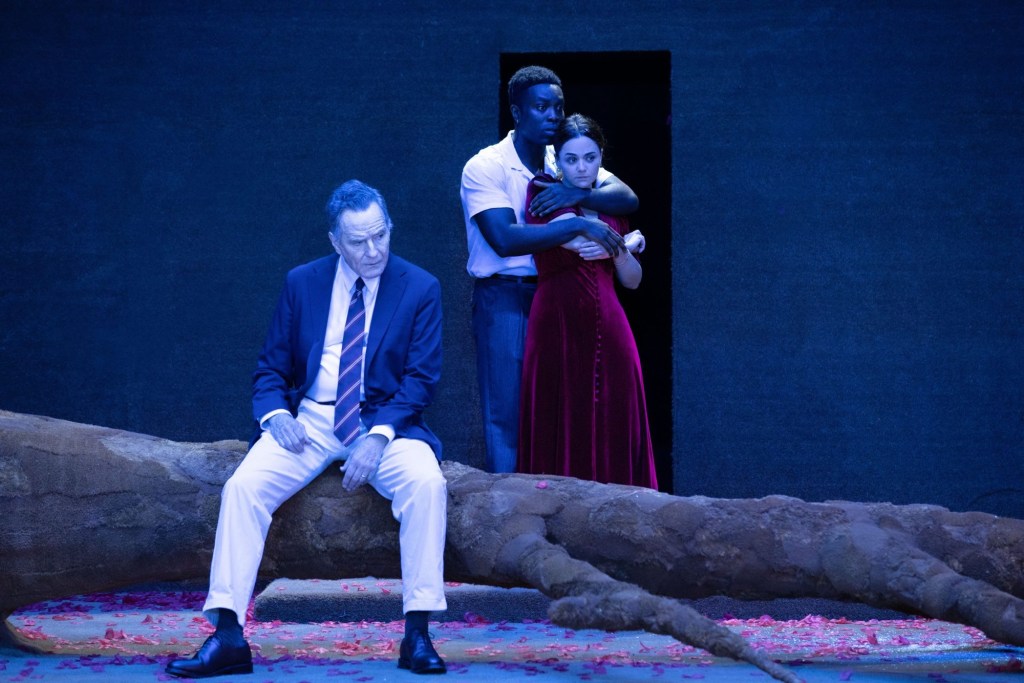
ALL MY SONS
by Arthur Miller
directed by Ivo van Hove
Wyndhams Theatre, London – until 7 March 2026
running time: 2 hours 15 minutes, no interval
So, it turns out lightning really can strike twice. I’m not just talking about the meteorological kind, symbolically hitting then tearing down the tree in the Keller family’s yard before the main action of Arthur Miller’s 1947 masterpiece (a term that gets bandied about too freely, but truly applies to All My Sons). I’m also referring to the fact that Belgian auteur director Ivo van Hove, who exploded onto the British stage in 2014 with a shattering, stark, mould-breaking A View From The Bridge, another Miller study of flawed protagonist railing at fate as the American Dream collapses in on him, has done it again. This All My Sons has its own flavour, but the sense of a classic being looked at through entirely fresh eyes, fully in tune with every nuance and beat of it but untrammelled by tradition and rich in imagination, is similarly palpable.
That earlier production transferred to Broadway, and it’s inconceivable that this coruscating revival won’t follow its sibling across the Atlantic, especially given the presence of Bryan Cranston, one of the greatest American actors of his generation. He’s delivering here the kind of work that should be required viewing for anyone studying the craft of acting but there’s not a weak link in this cast. Miller’s creation is brought roaring back to spellbinding, searing life.
With its themes of hubris, disgrace and the sins of the fathers being visited on their offspring, All My Sons is essentially Greek classical tragedy reimagined in mid twentieth century American terms. van Hove and his long-time design collaborator Jan Versweyveld seem to embrace that with a timeless aesthetic (a giant tree in front of a monumental back wall with one door and a circular aperture like a portal through which characters watch or appear like so many deux ex machina) that could equally serve a Medea or an Electra.
An D’Huys’ costumes are contemporary but not distractingly so. Versweyveld’s lighting sets out with a golden naturalistic glow as Cranston’s Joe Keller and Zach Wyatt’s affable neighbour Frank assess the damage to the fallen tree the morning after the storm, then stark and unforgiving at moments of high drama, before giving way to roiling greens, pinks and unsettling darkness as the play grinds inexorably toward its devastating climax. Music and sound (superb work by Tom Gibbons) thrums over, under and through the dialogue, at times soothing, at others like a dull ache and occasionally as a jarring shock. It sets mood and amplifies tension but, crucially, never undermines the urgency and muscularity of Miller’s text or the subtle brilliance of the performances. There’s real magic in the silences, when you can feel the audience breathe as one, totally wrapped up in the play: it also makes you realise how seldom that happens in the theatre these days.
If you’re unfamiliar with All My Sons, it plays out like a thriller, but if you’ve previously seen or read it, this remarkable rendering has moments bordering on the revelatory. As patriarch Joe, Cranston’s descent from measured bonhomie to snivelling wreck is charted with such precision and psychological truth that it barely feels like acting. You watch a man crumble before your very eyes: it’s painful to witness but the sheer bloody artistry is exhilarating.
Paapa Essiedu is every bit his equal as the son whose idealism is ripped out of him as his father’s wartime misdemeanours are uncovered, in many ways his trajectory more tragic than Keller Sr.’s as he has little idea of what’s coming to him. Essiedu invests Chris with an appealing awkwardness suggestive of a sensitivity that I’ve never seen in the character before, and when his world is shattered, his rawness takes the breath away. Observe how he stares, stricken, at his father as though he has never even seen him before.
Marianne Jean-Baptiste as Kate Keller, the mother holding it all together in a state of ongoing denial, is initially less fragile than some of her predecessors (Julie Walters’ stunning, award-winning portrayal in Howard Davies’ 2000 version at the National seemed permanently on the verge of a breakdown) but is tremendously effective. She’s savage in her aggression towards Ann (a sublime Hayley Squires, projecting a beacon of kindness and dogged determination), the daughter of Joe’s discredited business partner and girlfriend of the son Larry lost in the war, her smile stopping short of her eyes, and the look of desolation on her face as she realises what’s unfolding is utterly haunting. When she warns Joe to be smart or attempts to reassure him that he won’t be punished if he confesses to past misdemeanours, one gets the distinct impression that she doesn’t believe the words coming out of her own mouth. I’ve seen more moving Kate’s than Jean-Baptiste but few as powerful.
It’s indicative of the sheer quality of the production that every supporting performance is well nigh perfect. Tom Glynn-Carney delivers a finely tuned account of neurosis mixed with fury as Ann’s brother George, arriving from the back of the theatre like a heat-seeking missile in a hoodie, hellbent on destroying the Kellers but disarmed by his lingering affection for Kate. His brief reunion with Aliyah Odoffin’s lovely, slightly eccentric neighbour Lydia, with whom he has romantic history but who is now married to eternally nice guy Frank (a spot-on Wyatt) with young children, is heartbreaking. Odoffin has little stage time but creates a remarkably detailed picture of a sunny young woman more complicated than she initially looks. Cath Whitefield is impressive and similarly multi-layered as pragmatic, increasingly embittered nurse Sue, frustrated that Chris’ unattainable, innate goodness is having a deleterious effect on her doctor husband (Richard Hansell, also excellent).
Intense then cathartic, and shot through with unexpected but welcome laughs, All My Sons retains its ability to rouse and to provoke thought; it raises uncomfortable questions about culpability and how far to go for people one loves. Under Ivo van Hove’s guidance, it grips like a vice then explodes like a thunderclap. There’s little else on the London stage right now that achieves this level of tension or that demonstrates so potently the magic of ensemble acting. This is an All My Sons that looks nothing like its predecessors but is one for the ages.
 ajhlovestheatre
Leave a comment