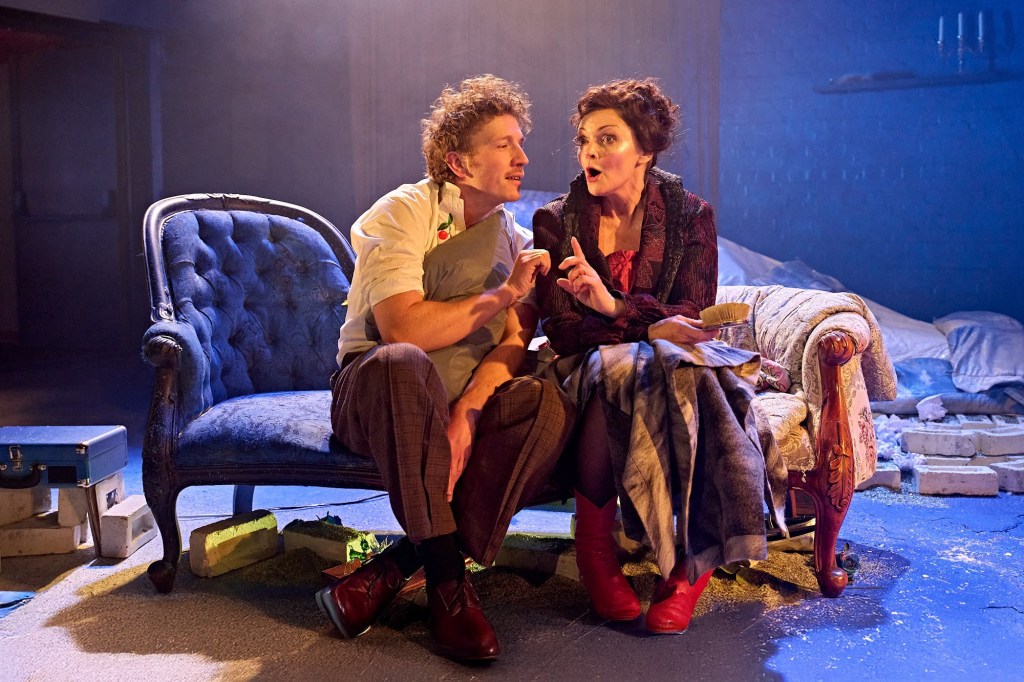
THE GLASS MENAGERIE
by Tennessee Williams
directed by Jay Miller
The Yard Theatre, London – until 10 May 2025
running time: 2 hours, 30 minutes including interval
https://www.theyardtheatre.co.uk/events/the-glass-menagerie
It’s fitting to close a theatre building (and this iteration of The Yard has joyfully occupied a canal-adjacent corner of Hackney Wick since 2011 while a larger, improved version is set to open in 2026) with Tennessee Williams’s classic memory play. The Glass Menagerie is a gorgeous piece of writing, an elegiac, poetic meditation on family ties and dependencies, etched in guilt and sorrow but with pops of faintly ridiculous humour. Crucially and appropriately, it’s a play all about commemorating and analysing the past. The Yard’s Artistic Director Jay Miller stages it as a ravishing, shabby-chic, vaguely anachronistic last dance of regret, awash with feeling and flights of imagination.
As a production this is very on-brand for The Yard: it’s wildly eccentric, achingly cool but feels as in tune with the author’s intentions as it is with the unconventional but atmospheric warehouse space it’s playing in. I laughed more than usual at this bittersweet play and marvelled at the cheekiness of some of Miller’s choices but still had the required lump in my throat during the final scenes.
The Wingfield family, Amanda and her adult children Tom and Laura, cloistered together in a tiny St Louis apartment surviving on a meagre income while the mother recalls bygone days of moneyed gentility, are a stand-in for Williams’s own (Tennessee’s real first name was actually Thomas). Tom Varey’s Tom, looking back on his fractured home, has in this version become a multidisciplinary artist: although the text refers to him as a poet, he’s first discovered here as a painter, clad in overalls and head-mounted light visor, working on the back wall of the stage as the audience files in.
Cécile Trémolière’s set looks like an art installation, with a chaise longue and (inventively used) wardrobe marooned atop scatterings of the dust we all eventually come to, while a large sand pile is studded with motifs from the text such as multiple blue roses and the telephone Amanda makes increasingly desperate sales calls on, bursting through. Meanwhile, outsize beaded curtains hang, a larger than life sized image of the absent father beams down jocularly next to a giant, unattainable moon. It’s simultaneously literal and dream-like, an impression reinforced by Josh Anio Grigg’s haunting, reverb-heavy music and sound design where single words and phrases are repeated like fragments of memory, and by the pearlescent make-up on all the other actors except Varey, rendering them as not-quite real, yet entirely plausible, as they’re caught under Sarah Readman’s effective lighting which goes from stark to sensuously colourful by the second.
This is a play that sometimes in performance can feel a little precious but under Miller’s bold guidance, one is struck by the youthfulness and energy it can muster. The exquisite language and delicate characterisations are underscored by mini-explosions of colour, light and sound, and the piece reveals itself as an altogether more muscular, vital beast than it seemed in its last two major London outings: John Tiffany’s expressionistic, dead-of-night-set Broadway transfer, and the gentle Amy Adams revival which split the role of Tom between two actors.
This production isn’t perfect. Lambdog1066’s hipsterish costumes, sometimes more redolent of the 1970s than the period of the play, are maybe trying a bit too hard (Amanda’s cotillion dress donned for the arrival of the long awaited gentleman caller is unhelpfully hideous, while Jad Sayegh as Jim, said caller, is somewhat bizarrely got up to look like Jim Carrey in The Mask) but they are certainly striking. There’s a fantasy dance sequence for Laura and Jim that doesn’t really add anything. For all Miller’s obvious understanding of, and affection for, the text, there are moments when the cast are stuck in one corner of the large stage leaving the majority of the audience staring at blank space (there’s also onstage seating for no particular reason).
Still, I’d rather sit through a take with this much guts and imagination than a more staid, conventional version, especially when the acting is so good. Sharon Small’s Amanda is a magnetic combination of sweetness and steel, and probably the most sympathetic rendering of this role I’ve ever seen. The love for her children is palpable, and her muted, brave reaction when she realises that Jim is not going to be the answer to her mother’s prayer for Laura is as heartbreaking as it is subtle. The volcanic fury that follows is grounded in real human feeling and disappointment. It’s a flawless performance.
Equally compelling is Varey who invests Tom with a throbbing vein of torment, but also a baggy, louche charm and slight air of camp. His exasperation is deeply felt but so is his affection for his now-lost mother and sister, which is as dysfunctional as it is potent (note the way he assumes the foetal position when being held by Laura).
Eva Morgan’s neurodivergent Laura is a beautiful creation (first seen wearing modern ear defenders), as delicate as the tiny glass animals she treasures, and almost convulsing with panic or staying eerily still during moments of high stress, but with a gentle self-possession and wry humour that makes it all the more gut-wrenching when things don’t pan out for her. I’ve never seen the moment when Amanda cajoles her daughter into opening the front door to the stranger coming for dinner played with so much tenderness and care, and watching Morgan blossom then deflate is quietly devastating. Sayegh brings an authentic warmth to the ambitious but kind young man who offers a brief glimpse of normality and romance.
On a fun note, the production makes much use of the tinkling piano and doomy bombast of Shakespear’s Sister’s 1992 hit ‘Stay’ (an instrumental version plays during the pre-show then returns at the end as in increasingly desperate Tom tries to outrun his memories, in an inspired bit of staging). The melancholic tone of the song suits the script but is doubly appropriate as Jim’s nickname for Tom is Shakespeare, and The Glass Menagerie centres on his sister.
The sense of America on the brink of something seismic (in the time frame of the play as written, it’s WW2), with unhappy souls burying their misery in liquor and casual encounters, feels shudderingly persuasive at the present time, but Miller and team don’t belabour this, investing the text with magic realism and an infinite amount of care. The ending is galvanising and emotionally affecting, befitting a production that thinks outside the box but never loses sight of the riches contained in that box. It’s a hell of a way to say goodbye to a space that has presented some of the most interesting, shape shifting fringe theatre London has seen in the last fourteen years. Even Williams purists may find themselves stirred and surprised by this Glass Menagerie. I loved it.
 ajhlovestheatre
Leave a comment