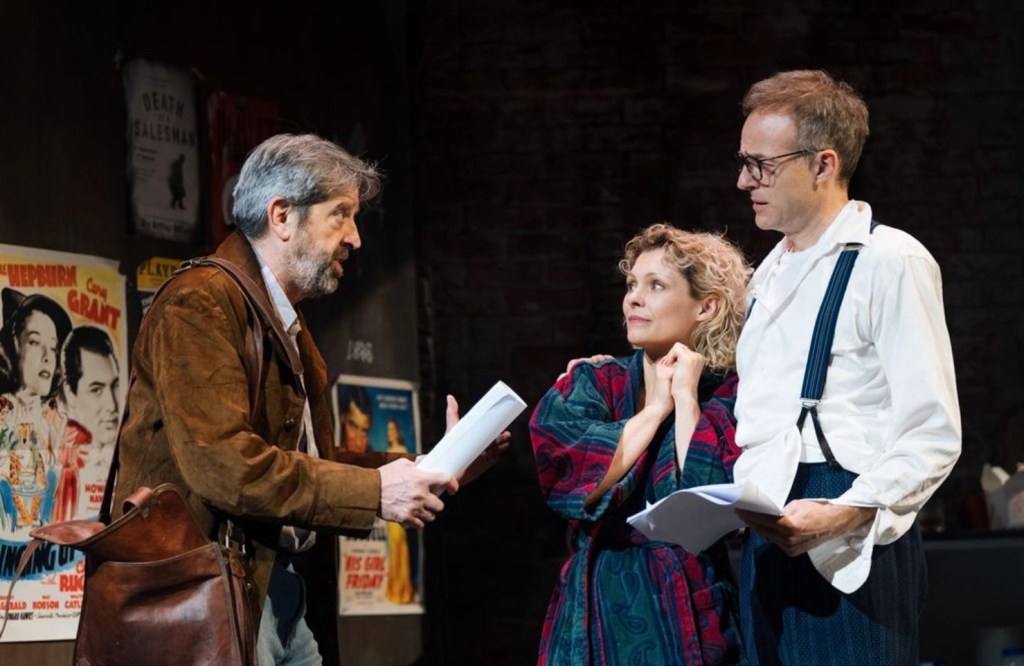
Abject terror isn’t the easiest thing to convey in the theatre. There’s something about the artificiality of the medium that tends to keep audiences at arms length, as opposed to the screen where close-ups and jump cuts can draw viewers into the heart of an unfolding nightmare. First seen in Leeds last year and now on a major USA tour, Paranormal Activity, this creepy-as-hell stage cousin to the seven popular horror movies, is the genuine article though. Forget 2:22 A Ghost Story, and even, to a lesser extent, The Woman in Black, this really is frightening.
Punchdrunk’s Felix Barrett, directing Levi Holloway’s terse, tense script, transcends traditional play-making to create a bone-chilling piece of ‘total theatre’ where the sections sat in total darkness listening to Gareth Fry’s deeply unsettling sound scape are just as important as the onstage scenes. There are similarities to Andy Nyman and Jeremy Dyson’s frequently revived Ghost Stories in that it’s the build-up of tension to all hell breaking loose that really gets the audience on edge, but whereas in that earlier show the pay-off was sometimes a let down, here the action just gets nastier and more imaginative. Yes, it’s essentially preposterous but good luck with telling yourself that when you’re sitting there in the gloom with your sphincter clenched and listening to the rest of the audience cry out in panic and fear.
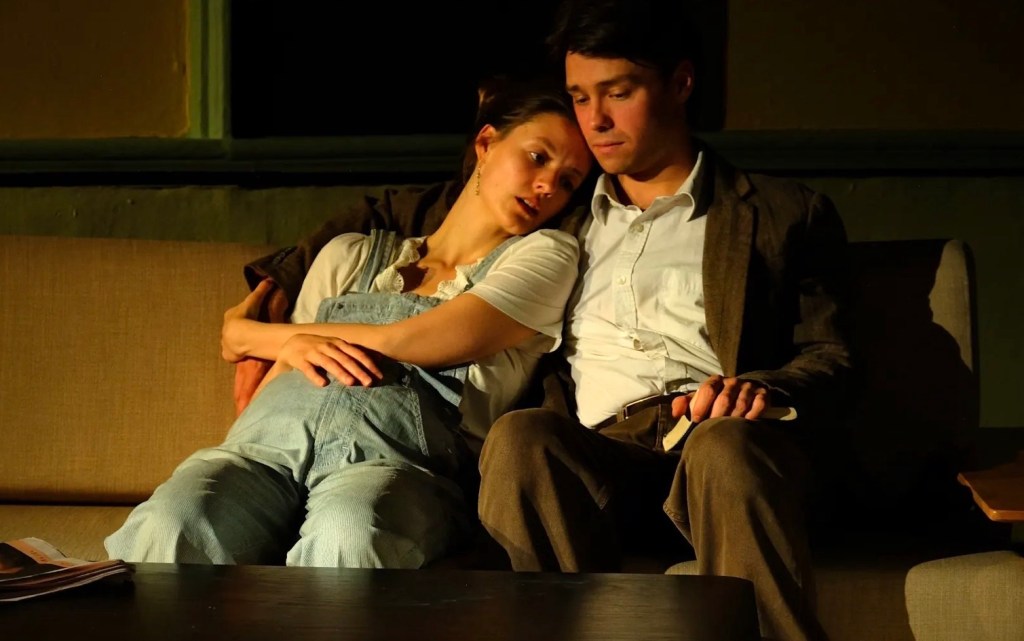
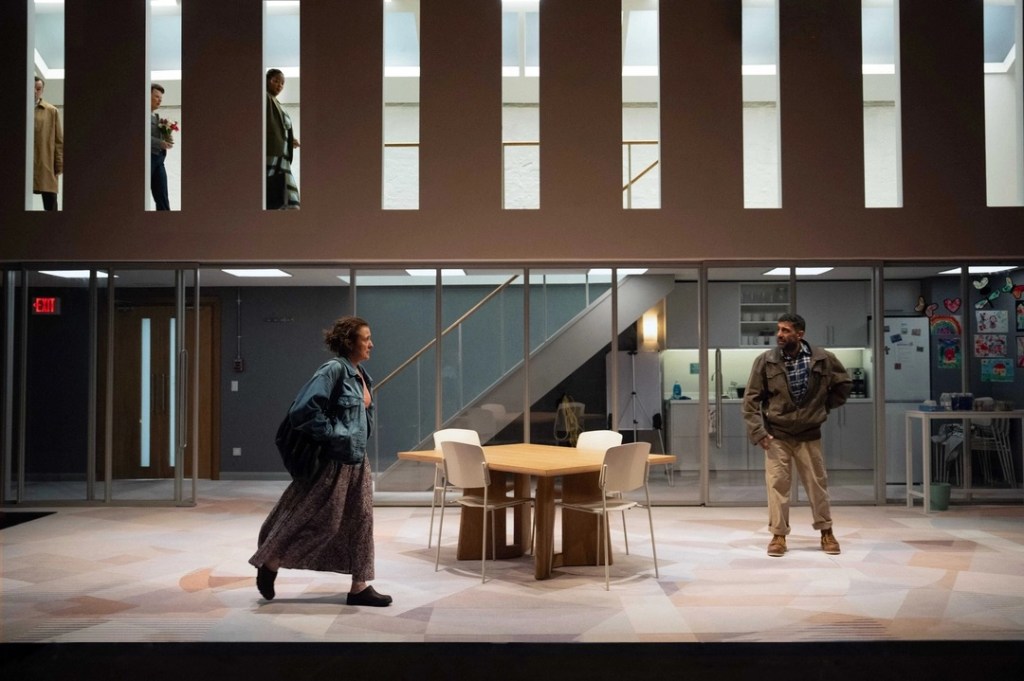
The basics of the plot will be familiar to fans of the films. Young American couple James (Patrick Heusinger) and Lou (Melissa James) have relocated from Chicago to London partly because of his career but also because she was having issues back home that were attributed to her mental health, although any horror aficionado will know full well that there’s gonna be more to it than that. They’re living in a house (grungy, impressive split level set by Fly Davis) that on first impression appears charmingly ramshackle but which becomes less and less cosy and appealing with every (frequent) blackout.
Heusinger’s disintegration from masculine self assurance to terrified self-abasement is superbly managed. The writing for Lou isn’t as nuanced but James has genuine presence and an ambiguous, aching intensity that is tremendously effective. Although the characters are essentially created to further the plot, Jackie Morrison as a benignly efficient psychic and Pippa Winslow as James’ God-fearing mom make potent contributions.
Technically, the show is, to put it inelegantly, stonkingly good. Chris Fisher’s illusions and Luke Halls’ video designs make you doubt the evidence of your own eyes, and Anna Watson’s lighting transforms and tantalises. If Holloway’s script is more efficient than inspired as writing and drags a bit in act one, it does an excellent job of planting the seeds of demonic mayhem and using repeated motifs that seem innocuous at first but end up loaded with chilling significance. It’s not always clear what should be funny and what is intended to be deadly serious, but that duality is part of the fun in a show where an overstimulated audience occasionally make more noise than anybody on stage.
Overall, this is a huge success in terms of achieving exactly what it sets out to do, and is likely to be a major West End hit. I can’t remember the last time a piece of theatre made all the hairs on the back of my neck stand up through sheer fear, but this one did. Twisted good fun.
World class clowning, exhilarating beatboxing, killer vocals, cheesy but beloved rock and pop standards, groan worthy jokes….and vampirism: welcome to Dracapella, probably one of the most unusual festive theatrical offerings in the capital this Christmas, and certainly one of the most fun. Imagine, if you dare, a benignly deranged mash-up of nutty comedy that revels in its own preposterousness (think Mischief on stage, the Naked Gun and Airplane movie franchises on screen, with a dash of improvisation à la TV’s Whose Line Is It Anyway thrown in), swoonworthy vocals and gothic horror, and you’ll have some idea of what’s sending Park Theatre audiences home on a mirth-induced high, their faces aching from laughter.
If the slapstick comedy and heinous puns of Jez Bond and Dan Patterson’s script, which still manages to do a decent job of retelling the Dracula legend, are the calling card of Bond’s whip-smart production, the singing is the secret weapon. Ian Oakley’s vocal arrangements are exquisite and matched by septet of world class vocal talents including Olivier award winners Stephen Ashfield and Lorna Want, and stage and screen star Keala Settle. There’s no band, just ABH Beatbox (full name: Alexander Bulgarian Hackett), a one man treasure trove of beats, foley effects and sheer charm, but the sound threatens to blow the roof off the theatre. Standards like Queen’s ‘Find Me Somebody To Love’ and Bonnie Tyler’s ‘Holding Out For A Hero’ come over with breathtaking vitality and assurance.
The whole thing is infused with a sort of lunatic magic that keeps the audience on side, even when you can see the jokes coming from a mile off, and it surely helps every member of the supremely talented cast seems to be on the exact same page. Ashfield displays a fabulous gift for physical comedy as a squeamish, neurotic Jonathan Harker, prone to frequent debilitating injuries, alongside a wonderfully rangy, versatile voice. Opposite him, Lorna Want is a sparkling delight as a knowing heroine Mina, whose resemblance to Dracula’s deceased lover drives the plot, tinged with a smattering of modern day feminist awareness.
Ako Mitchell’s all-American Dracula strikes exactly the right balance between sinister and suave, and is particularly hilarious when his dignity is abandoned. Settle has a stupendous voice but also an unexpected skill at deadpan comedy as Mina’s best friend, the surprisingly voracious Lucy. Philip Pope excels in a variety of roles, and Monique Ashe-Palmer and Ciarán Dowd are gloriously gross as Dracula’s tormented domestic servants doomed to mutual celibacy until their master is set free. Dowd all but walks off with the second half as a vowel-mangling, Dutch accented Van Helsing, whose ineptitude is matched only by his penchant for coming out with impenetrable aphorisms and adages that apparently lose everything in translation to English. He’s terrific, but then, they all are.
This is exhilarating, laugh-out-loud stuff, performed and presented with imagination and technical brilliance. It is a little too long, and the interval saps some of the energy briefly, but these are minor quibbles. The low comedy works because it’s put over with so much skill and if you don’t find one moment funny, there’ll be another one along in a moment which will slay you, and there’s always the next thrilling musical interlude to look forward to. Everything gets hurled at the wall and the vast majority of it actually sticks, silliness is raised to an art form. Literally bloody marvellous.
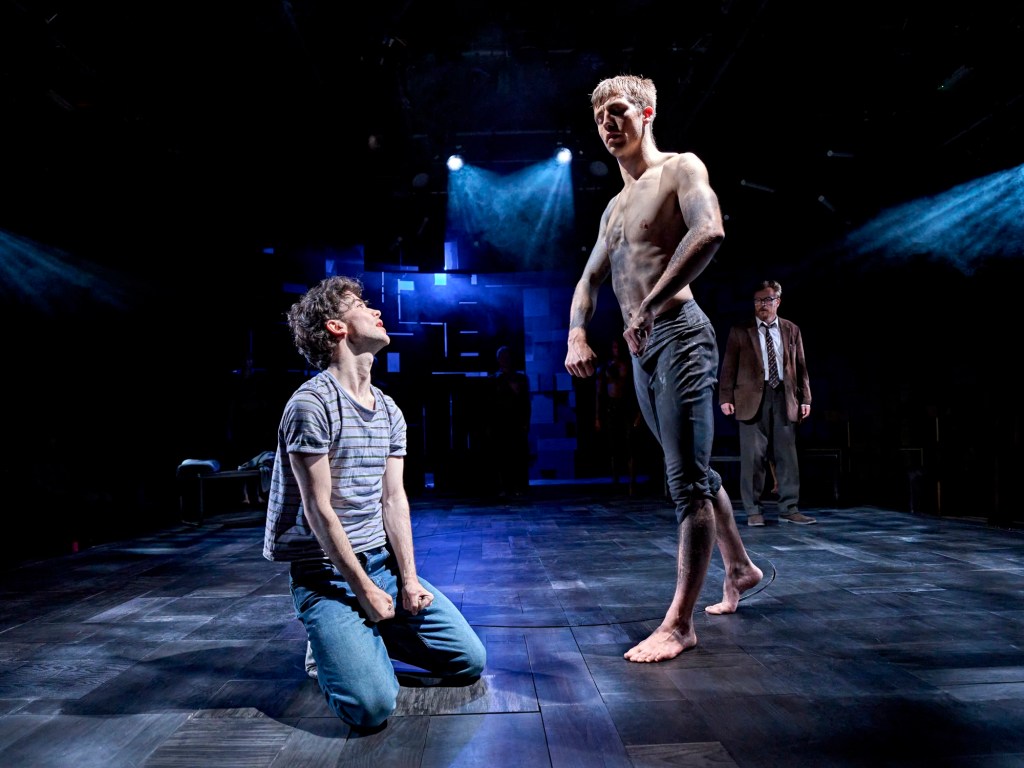
So, it turns out lightning really can strike twice. I’m not just talking about the meteorological kind, symbolically hitting then tearing down the tree in the Keller family’s yard before the main action of Arthur Miller’s 1947 masterpiece (a term that gets bandied about too freely, but truly applies to All My Sons). I’m also referring to the fact that Belgian auteur director Ivo van Hove, who exploded onto the British stage in 2014 with a shattering, stark, mould-breaking A View From The Bridge, another Miller study of flawed protagonist railing at fate as the American Dream collapses in on him, has done it again. This All My Sons has its own flavour, but the sense of a classic being looked at through entirely fresh eyes, fully in tune with every nuance and beat of it but untrammelled by tradition and rich in imagination, is similarly palpable.
That earlier production transferred to Broadway, and it’s inconceivable that this coruscating revival won’t follow its sibling across the Atlantic, especially given the presence of Bryan Cranston, one of the greatest American actors of his generation. He’s delivering here the kind of work that should be required viewing for anyone studying the craft of acting but there’s not a weak link in this cast. Miller’s creation is brought roaring back to spellbinding, searing life.
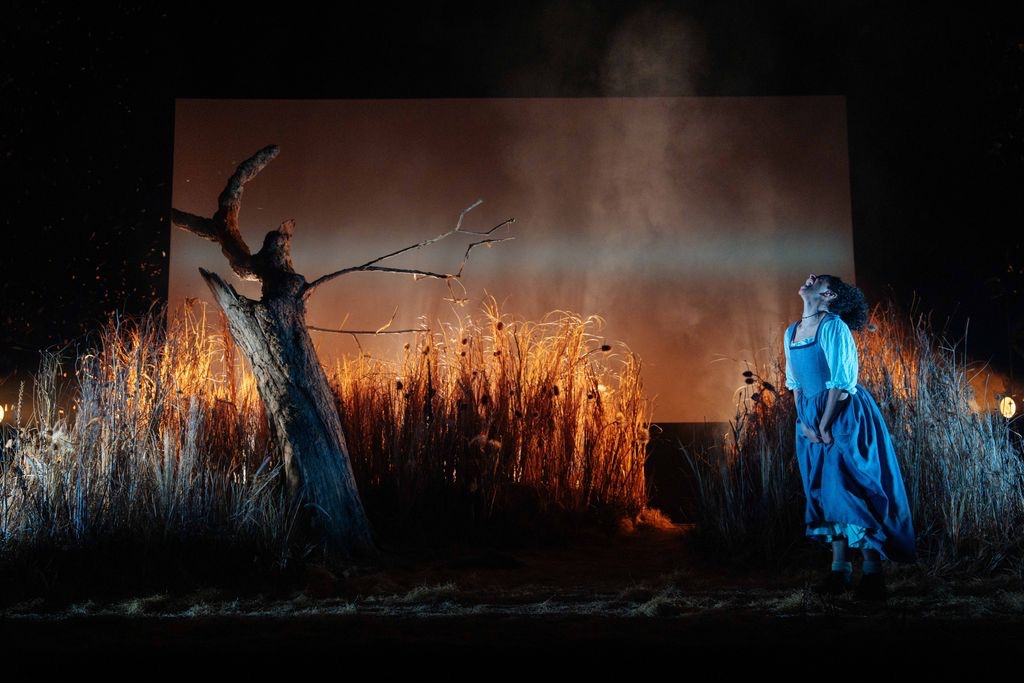
With its themes of hubris, disgrace and the sins of the fathers being visited on their offspring, All My Sons is essentially Greek classical tragedy reimagined in mid twentieth century American terms. van Hove and his long-time design collaborator Jan Versweyveld seem to embrace that with a timeless aesthetic (a giant tree in front of a monumental back wall with one door and a circular aperture like a portal through which characters watch or appear like so many deux ex machina) that could equally serve a Medea or an Electra.
An D’Huys’ costumes are contemporary but not distractingly so. Versweyveld’s lighting sets out with a golden naturalistic glow as Cranston’s Joe Keller and Zach Wyatt’s affable neighbour Frank assess the damage to the fallen tree the morning after the storm, then stark and unforgiving at moments of high drama, before giving way to roiling greens, pinks and unsettling darkness as the play grinds inexorably toward its devastating climax. Music and sound (superb work by Tom Gibbons) thrums over, under and through the dialogue, at times soothing, at others like a dull ache and occasionally as a jarring shock. It sets mood and amplifies tension but, crucially, never undermines the urgency and muscularity of Miller’s text or the subtle brilliance of the performances. There’s real magic in the silences, when you can feel the audience breathe as one, totally wrapped up in the play: it also makes you realise how seldom that happens in the theatre these days.
If you’re unfamiliar with All My Sons, it plays out like a thriller, but if you’ve previously seen or read it, this remarkable rendering has moments bordering on the revelatory. As patriarch Joe, Cranston’s descent from measured bonhomie to snivelling wreck is charted with such precision and psychological truth that it barely feels like acting. You watch a man crumble before your very eyes: it’s painful to witness but the sheer bloody artistry is exhilarating.
Paapa Essiedu is every bit his equal as the son whose idealism is ripped out of him as his father’s wartime misdemeanours are uncovered, in many ways his trajectory more tragic than Keller Sr.’s as he has little idea of what’s coming to him. Essiedu invests Chris with an appealing awkwardness suggestive of a sensitivity that I’ve never seen in the character before, and when his world is shattered, his rawness takes the breath away. Observe how he stares, stricken, at his father as though he has never even seen him before.
Marianne Jean-Baptiste as Kate Keller, the mother holding it all together in a state of ongoing denial, is initially less fragile than some of her predecessors (Julie Walters’ stunning, award-winning portrayal in Howard Davies’ 2000 version at the National seemed permanently on the verge of a breakdown) but is tremendously effective. She’s savage in her aggression towards Ann (a sublime Hayley Squires, projecting a beacon of kindness and dogged determination), the daughter of Joe’s discredited business partner and girlfriend of the son Larry lost in the war, her smile stopping short of her eyes, and the look of desolation on her face as she realises what’s unfolding is utterly haunting. When she warns Joe to be smart or attempts to reassure him that he won’t be punished if he confesses to past misdemeanours, one gets the distinct impression that she doesn’t believe the words coming out of her own mouth. I’ve seen more moving Kate’s than Jean-Baptiste but few as powerful.
It’s indicative of the sheer quality of the production that every supporting performance is well nigh perfect. Tom Glynn-Carney delivers a finely tuned account of neurosis mixed with fury as Ann’s brother George, arriving from the back of the theatre like a heat-seeking missile in a hoodie, hellbent on destroying the Kellers but disarmed by his lingering affection for Kate. His brief reunion with Aliyah Odoffin’s lovely, slightly eccentric neighbour Lydia, with whom he has romantic history but who is now married to eternally nice guy Frank (a spot-on Wyatt) with young children, is heartbreaking. Odoffin has little stage time but creates a remarkably detailed picture of a sunny young woman more complicated than she initially looks. Cath Whitefield is impressive and similarly multi-layered as pragmatic, increasingly embittered nurse Sue, frustrated that Chris’ unattainable, innate goodness is having a deleterious effect on her doctor husband (Richard Hansell, also excellent).
Intense then cathartic, and shot through with unexpected but welcome laughs, All My Sons retains its ability to rouse and to provoke thought; it raises uncomfortable questions about culpability and how far to go for people one loves. Under Ivo van Hove’s guidance, it grips like a vice then explodes like a thunderclap. There’s little else on the London stage right now that achieves this level of tension or that demonstrates so potently the magic of ensemble acting. This is an All My Sons that looks nothing like its predecessors but is one for the ages.
Entertainment juggernauts seldom come as cuddly and adorable as this. With Paddington, Jessica Swale (book) and Tom Fletcher (songs), in bringing Michael Bond’s most beloved Peruvian bear to the stage, have created the musical we probably all need right now. That’s not just because the diminutive ursine charmer is a fur-covered emblem of kindness and tenacity, or even that Luke Sheppard’s barnstorming production feels like a love letter to the polyglot vitality of London at a time when tolerance and diversity are increasingly coming under fire. Not since the criminally underrated Madness tuner Our House has a new musical trumpeted so persuasively the capital’s unique combination of tradition, freedom of expression and joyful strangeness, and celebrated its visual iconography (there’s glimpses of various landmarks from St Paul’s and Buckingham Palace to the Shard and the London Eye).
It’s also because 2025 has been a pretty ropey year for new West End musicals (Evita, thrilling as it was, counts as a revival): Clueless was a lot of fun but The Great Gatsby, Hercules and Burlesque were mediocre at best, Shucked lost something in its transatlantic crossing and the final Sondheim, the incomplete Here We Are, was a triumph at the National but was too esoteric for some. My favourite musicals of the last twelve months – Lovestuck, Sing Street and the current Southwark Playhouse smash Ride The Cyclone – were/are all off-West End, but now finally commercial mainstream London theatre has an outright winner…and Paddington is the absolute bear’s whiskers.
Following more or less the plot of the 2014 movie, where an evil taxidermist (Nicole Kidman on film, here on stage a gloriously scenery-chewing Victoria Hamilton-Barritt) entices Paddington away from his adopted London family in order to do the unspeakable, the musical works exquisitely on multiple levels. Sheppard’s production is grand enough to feel like the big, lavish extravaganza West End ticket prices demand. But it’s also intimate enough that the delicious eccentricities, quirks and running jokes register, as do the finesses in expression of Paddington himself, as split between an offstage voice and an onstage actor in a gorgeous bear costume (brilliant work by Tahra Zafar, also responsible for puppet design), played respectively by James Hameed and, on the night I attended, Abbie Purvis (alternate to Arti Shah). You will fall in love with this bear, and it’s impossible to overstate just how right the team here have got the onstage representation of this most adored of anthropomorphic characters.
There is generally a lot here to love though. Ellen Kane’s choreography is sharp and propulsive, unerringly successful in building numbers to their fizzy showbiz climaxes. Tom Pye’s magical scenic creations, Gabrielle Slade’s vivid costumes, Neil Austin’s lighting and Ash J Woodward’s entrancing video designs all combine to create a world at once comfortingly familiar yet exciting. It’s a fabulous eyeful and, thanks to Gareth Owen’s full-on sound design and Fletcher’s ear-worm tunes, a satisfyingly loud earful.
Then there’s the uniformly fine casting. Amy Ellen Richardson’s Mrs Brown, as sensitive and artistic as she’s kookie, and Paddington’s most prominent advocate, is the gorgeous beating heart of the piece apart from the bear himself. Adrian der Gregorian convincingly charts Mr Brown’s journey from self-protective scepticism to full on embrace of Paddington’s uncynical world view. The writing and acting of their tricky relationship has beautiful, convincing detail where a lesser adaptation would make them more generalised malcontents. Bonnie Langford is a show-stopping delight as the housekeeper with a backstory as rich as any encyclopaedia, and West End veteran Teddy Kempner scores a joyful bullseye as shopkeeper Mr Gruber.
Tom Edden and Amy Booth-Steel come close to stealing every scene they’re in as, respectively, an uptight cab driver impervious to Paddington’s cuteness, at least initially, and a hysterically plummy aristocrat who jealously guards an elite society for geographers. Seasoned musical goers may feel they’ve seen Hamilton-Barritt’s uber-camp, statuesque ‘baddie’ performance before, and they wouldn’t be wrong, but previous iterations of this flamboyant characterisation were generally in infinitely inferior shows, and she is terrific here. So too is Tarinn Callender as her reluctant henchman.
Sheppard’s staging and Swale’s writing feel wonderfully fresh, balancing the cute, the sinister and the flat-out hilarious with wonderfully sure hands. For all the showbiz brio on display, there’s something unmistakably British in the nods to panto and old time music hall. If there’s a tiny flaw, it’s that it occasionally feels a little over-stuffed with themes and ideas all pulling focus at once: a tentative romance between eldest Brown daughter and the son of Brenda Edwards’ life-embracing next door neighbour is well played by Delilah Bennett-Cardy and Timi Akinyosade but doesn’t add much to a slightly overlong show. Neither does a second act full kick-line number for a tribe of geographers, despite being brilliantly staged and led with hilarious verve by Booth-Steel.
Fletcher’s songs sound a bit generic modern musical theatre from time to time, but at its best the score is rousing and fiendishly catchy. The Calypso-tinged anthem ‘The Rhythm of London’ is a bona fide classic, and Hamilton-Barritt’s swaggeringly nasty ‘Pretty Little Dead Things’ brings the house down and will be stuck in your head for weeks.
Crucially, Paddington deftly achieves the almost impossible in that it entrances the children while also winking knowingly over their head at the adults, generally giving everyone a fabulous night or afternoon out. Apart from the ingenuity of how Paddington himself is created, this is a pretty traditional musical, but one crafted with huge love and care by people who really know what they’re doing. If the Savoy Theatre is looking for a new tenant within at least the next five years, I’ll be astonished.
Do we choose to engage with an increasingly difficult world or do we hide away from it? What is the cost of being there for other people even in extremely tricky circumstances, even when they claim not to need help, and at what point does one close the door to protect one’s own interests? These are some of the questions running through Samuel D Hunter’s deceptively simple but altogether engrossing new play, Little Bear Ridge Road, now on Broadway in a Joe Mantello-helmed production that originated at Chicago’s powerhouse of stage excellence, Steppenwolf Theatre.
This is Hunter’s Broadway debut (his Clarkston, a tenderly written but inferior work, is just completing a West End run) and it’s an unqualified triumph. This is one of those plays that American writers seem to excel at: terse, pared down, spiky but complex, a beating, bruised heart under a harsh, unadorned exterior, the only thing maximalist about Mantello’s exquisite staging is the craft and talent on display.
Set in rural Idaho in the immediate aftermath of the pandemic, the play sees thirty-something Ethan (Micah Stock, raising gruff awkwardness to an art form) arriving in the remote farmhouse of his tough, bemused aunt Sarah (Laurie Metcalf, re-staking her claim as America’s greatest living stage actress), ostensibly to sell the nearby house of his newly deceased drug addict father. It becomes clear pretty quickly that there’s more to Ethan’s intentions than that, and also that Sarah is less invulnerable than she first appears.
Two stones rubbed together can create fire, and so it proves when Stock’s mercurial dreamer clashes with Metcalf’s flinty Sarah. Ethan is a mass of contradictions and resentments while Sarah, who is being callously managed out of her job in a local hospital, just wants to be left alone. She’s perhaps naive about how dreadful life for her nephew had been as a kid, and he never forgave her for not responding the way he expected when his ten year old self reached out, and their uneasy co-existence, full of barely expressed feelings and fuelled by shared critiques of trash television, is realised with a rare truth and economy.
It’s grimly funny too: after a fruitless phone conversation with a medical insurance company, Ethan moans “I hate this country!” and Sarah comes right back with “trust me, it hates you more”. Ethan looks like having a real chance of happiness with good-hearted rich kid James (Steppenwolf regular John Drea, in a sublime Broadway bow) who he met online, and the first meeting between James and Sarah – he has stayed the night which she is unaware of – is a little masterpiece of comic social awkwardness and blind panic.
It’s the sadder, darker territories that the play enters which really linger in the mind though. Metcalf charts Sarah’s physical decline due to cancer with a detail and honesty that’s simultaneously riveting and hard to watch. Stock never overplays Ethan’s essential unhappiness and past trauma but when it all boils up in a howl of despair (“I DON’T KNOW HOW TO BE A PERSON IN THIS TERRIBLE FUCKING NIGHTMARISH WORLD”) he is utterly devastating. Not a single line, gesture or movement is wasted, everything counts.
Metcalf is thrilling, an artist at the very top of her game, entirely without vanity or artifice. She conveys every layer of this difficult but not unkind woman, and disappears so completely into her it’s almost hard to fathom that one is watching acting. The queen of the withering stare, Metcalf also invests Sarah with some choice comic physical touches: note the way she wryly genuflects when taking leave of the two boyfriends. Hunter has written Sarah to possess a defensive dry wit which Metcalf attacks with laconic aplomb; the whole performance really is the most flawless marriage between actor and material.
A lesser talent might pale into insignificance next to Metcalf’s brilliance but Stock matches her. He makes no attempt to ingratiate Ethan to us but allows his tricky nature and hypersensitivity to speak for themselves, creating a figure that is at once sympathetic and frustrating; it’s a quirky but endlessly interesting interpretation, rooted in truth and real human frailties, and there are strong indications that Ethan’s writing talent is a genuine one. Drea is an understated wonder, and it’s a sign of the quality of the production that even Meghan Gerachis, another Steppenwolf alumna, who only has one brief scene as a nurse, is utter perfection.
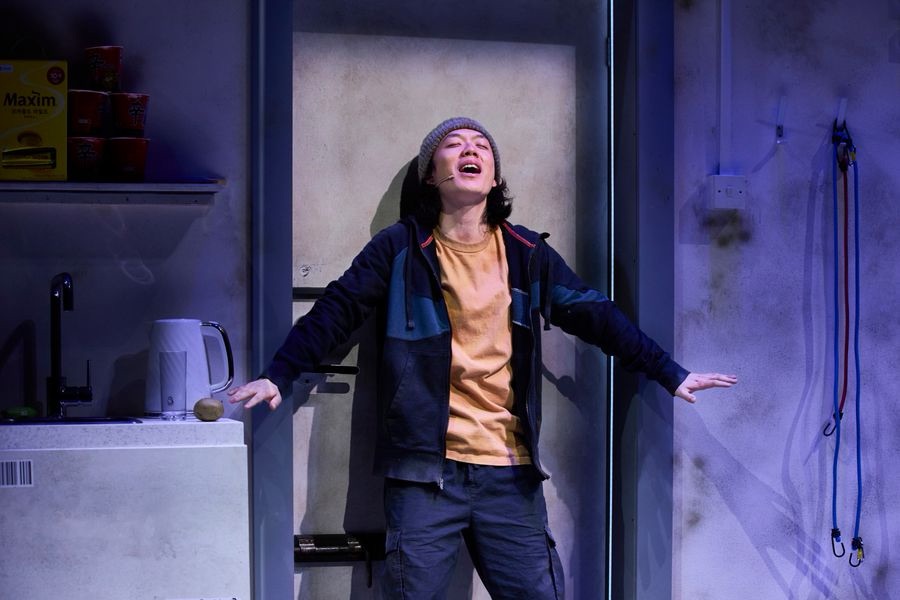
Scott Pask’s solitary sofa atop a slate-grey disc with a fan whirling overhead is the only set but, as lit by Heather Gilbert against a black backdrop that occasionally softens into a wall of pale stone, it gives a striking sense of lonely figures adrift in an endless nightscape. Jessica Pabst’s naturalistic costumes are spot-on as is the sound design by Mikhaïl Fiksel which is so unobtrusive as to be unnoticeable, except that we hear every mutter and throwaway retort.
This is surely one of the finest American plays in decades. Tiny in stature but massive in emotional impact, it sears and haunts. I left the theatre in a state of drained rapture, fighting back tears. Little Bear Ridge Road received one of the most heartfelt standing ovations I’ve ever seen in a Broadway theatre: it absolutely deserved it.
This isn’t the ending I was expecting, but then I guess that’s life, or indeed death. I’d naively supposed that End, the concluding part of David Eldridge’s masterful trilogy of standalone but connected plays about stages of relationships, comprising Beginning (2017) and Middle (2022), would just be about a marriage or long-standing partnership breaking down. But Essex’s answer to Ibsen is actually on about something even deeper and darker here – the end of actual life – and the result is pretty harrowing, albeit leavened with moments of genuine joy.
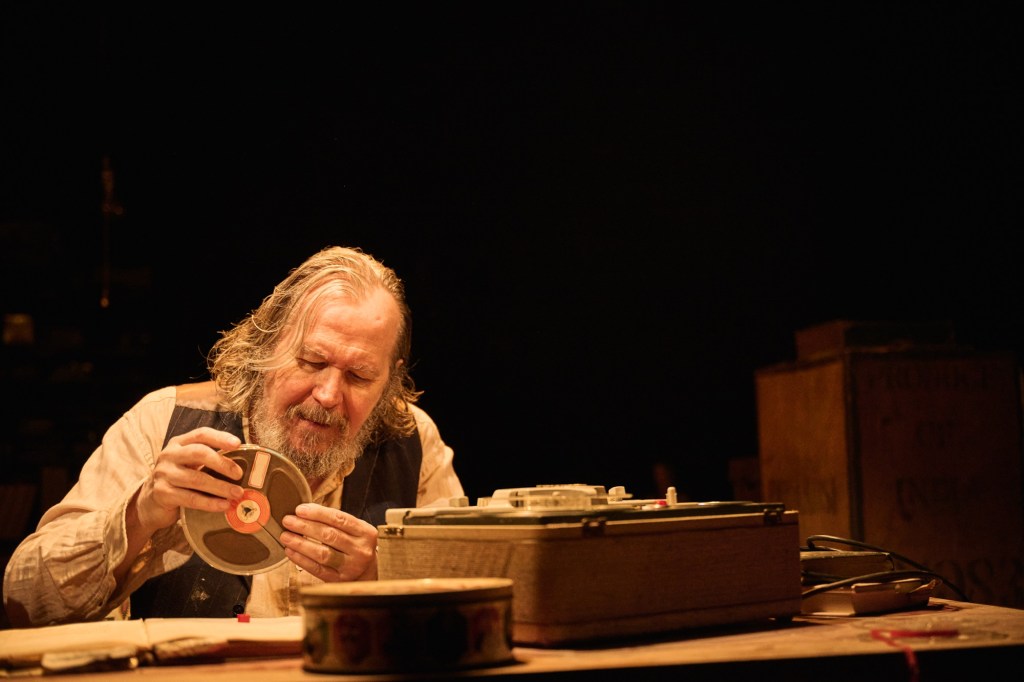
Like its predecessors, End is a two hander centred on a straight couple (but neither of the pairings featured in the first two plays), as each faces moving forward without the other. Alfie (Clive Owen) has a terminal cancer that means he won’t see his sixtieth birthday and floors Julie (Saskia Reeves) his partner of twenty plus years – they’ve never married – by announcing that once he is moved into a hospice for his very final stages he wants to be completely alone. This quietly shocking premise plays out in their pleasantly cluttered North London kitchen (beautifully detailed set design by Gary McCann) filled with the detritus of full, settled lives, a variety of objects giving essential clues to who these people are: there’s a framed football shirt, a giant clock the face of which is the round yellow smile emblematic of the Acid House movement, rows upon row of vinyl records and CDs, shelves of books (Alfie is a club DJ, Julie is a writer).
Also, it’s the eve of the Brexit vote in 2016, which for many of us was another catastrophic ‘end’ of sorts. Eldridge’s deftness at weaving together multiple thematic threads in a domestic setting and in real time is a marvel, as is his unerring instinct for capturing how real people speak to each other. As in the earlier plays, the minutiae of ordinary lives are elevated to something charged and riveting, and there is magic in the silences as much as in the salty, sometimes very funny dialogue.
Rachel O’Riordan’s understated but perfectly modulated staging is saturated with dance music, and one is reminded of the Noël Coward Private Lives line “extraordinary how potent cheap music is”. The euphoria of the beats and synths are a conduit and focus for the emotions and memories of this couple who met in the clubbing heyday of the late 80s and early 90s and clearly enjoyed the hedonistic aspects of it, Alfie even making an apparently notorious career on the rave scene. Watching these late middle age figures swaying to the music, remembering a shared past and trying to beat back the oncoming darkness, is profoundly affecting, nowhere more so than when Owen’s Alfie’s smile gets overtaken and he helplessly yelps “I just feel so young”.
So, End is also a lament for a time now lost, an examination of what happened to the rave generation, and Eldridge distils, generously but not too neatly, a collective experience down into these two figures. There’s a slight clumsiness to the way a former affair is introduced to up the dramatic ante, and a couple of lines are clearly present only to clue the audience in on backstory, but elsewhere the writing is coruscating and true. Eldridge understands crucially that many humans are at their funniest when staring into the abyss.
That’s certainly true of Alfie, who Clive Owen inhabits so fully that it almost doesn’t feel like acting. An all too human combination of brutality, tenderness and massive, kind spirit, he’s entirely convincing as somebody who, for a time, adopted debauchery as a way of life, and who, one suspects, is never as hard on other people as he is on himself. Saskia Reeves matches him with a luminous, clear-eyed portrayal of the rock that is tethering Alfie to this earth; an intelligent woman, pragmatic and massive of heart, trying desperately to accommodate her partners needs and keep him from the brink while tending to herself and their grown-up daughter. Reeves’ Julie screaming silently into a cushion in a brief moment of respite says more about the pressure on carers and loved ones than a page of dialogue and is one of the most moving things on any current London stage.
Not always an easy watch, End is nonetheless an emotionally resonant one, humane, witty and strangely haunting. Yet again Eldridge emerges as the chronicler supreme of ‘ordinary’ people’s lives, while understanding of course that, really, we are all extraordinary. Let the music play.
Aside from the questionable timing of producing a musical about revelling in excess when many ordinary Americans are trying to make do with less and less, this must have looked like such a good idea on paper. The first stage score in decades from Stephen Schwartz, the man who gave us Godspell, Pippin and Wicked, reuniting with one of his leading ladies from the latter show, Tony winner Kristin Chenoweth, supported by Oscar winner F Murray Abraham, with a script by acclaimed playwright Lindsey Ferrentino. On top of all that, director Michael Arden is a double Tony winner for Parade and the still-running Maybe Happy Ending, and his work on the Once On This Island revival of 2018 was little short of visionary.
So, The Queen of Versailles arrives on Broadway following a developmental run in Boston with a pedigree many other shows would envy. The track records of all involved makes it even more unfathomable how it could have arrived in NYC in this wan state, and if this is the improved version then the mind boggles at what it must have been like in Massachusetts last year. One wonders if the participation of the ‘Queen of Versailles’ herself, Jackie Siegel, the subject of the documentary on which this musical is based, has scuppered any chance of any critical thinking about the central figure.
Siegel and her husband David, a timeshare tycoon, were in the midst of building their dream home – the largest private residence in the USA, inspired by the Palace of Versailles which the Siegels visited on their honeymoon, according to Ferrentino’s book – when the stock market crash of 2017 caused them to run out of money….temporarily. We see Jackie (Chenoweth, whose relentless sunniness tends to bely any sense of trauma on the character’s part at least until the last fifteen minutes of the show) ascend from humble working class upbringing via an engineering degree then the sexism of corporate America to an abusive first marriage and single motherhood before she meets her ageing knight in shining leisurewear, the ridiculously minted David.
Improving ones lot in life is surely part of the great American Dream, and Jackie’s ambition and acquisition of riches is presented in flavourless dialogue and scenes that lack any real punch, enlivened only by Chenoweth’s trademark comic chutzpah and general cuteness. The whole show would probably play better in a much smaller house: the St James is a barn, presumably selected only for the reveal of Dane Laffrey’s soullessly opulent ballroom set (complete with sweeping staircase) very late in act two. The venue dwarfs the figures on stage and renders borderline unsympathetic characters even more remote and inaccessible than they initially appear.
If we root for Jackie, it’s because it’s Kristin, but her cheeky charm and ear-splitting vocals only take her so far, and her chirpy unwillingness to be bound by financial and social constraints starts to look less and less credible or appealing as a very long evening draws on. Although the role was built around her, Chenoweth’s shortcomings as an actress are exposed: when her teenage daughter (Nina West, who gets the best song with the rock-lite ‘Pretty Wins’ decrying the shallowness of the lifestyle) dies and the Siegels launch a charity in her name, she registers vague regret but little real pain, and a sudden outburst seems like a flash in the pan required by the script rather than anything organic.
The wearisome framing device of the French court of Versailles featuring Marie Antoinette herself (Cassondra James) is more ponderous than inspired, although the frocks (by Christian Cowan) are gorgeous. To be fair, the whole show looks as though it has had cash thrown at it (Kristin-Jackie’s garish wardrobe brings to mind Dolly Parton’s comment about it costing a lot of money to look this cheap), but without any clear point-of-view or anything distinguished in terms of book and score, it just doesn’t matter.
Almost as overused as the historical French stuff is the use of cameras and live footage (none of which is as technically slick as it could be, especially when compared with the work in Sunset Blvd, the last tenant at this theatre) as we are constantly reminded that they’re making a documentary. These people are just not that interesting or sympathetic, with the exception of Melody Butiu’s rather lovely Sofia, the faithful family retainer whose assimilation into the Siegel clan doesn’t erase her anguish at being separated from her own family overseas. Butiu is wrenching in her pain but the subject gets dropped pretty quickly, maybe because it casts Jackie in an insensitive light.
Schwartz’s score is surprisingly undistinguished, often sounding like snippets of his earlier work, while unfortunately reminding one of how much better they were. ‘Caviar Dreams’, Jackie’s first “I want” song, bears a disconcerting initial resemblance to the opening of Shrek The Musical and frankly I know which misunderstood monster I would rather spend an evening with. A bizarre duet about a dead pet lizard for the stoner daughter and her cousin, and a bewildering Country and Western production number for an at-sea F Murray Abraham, both seem the kind of things that should have been cut out-of-town but nope, here they are. The audience looks on, incredulous and/or indifferent. It’s hard to work out if the lyrics are any good because the sound is appalling, rendering at least sixty per cent of the show unintelligible.
The final section – the house is almost complete and Jackie tries to throw a celebration party that nobody wants to attend – reminds us, heavy handedly, that this is a cautionary tale. But cautioning who and about what? By this stage, Kristin-Jackie is giving it the full Norma Desmond (the original, not the Scherzinger/Lloyd version) going bonkers on a massive staircase with only a light ring for company. She’s working her tush off up there for so little payoff. I was just glad to get out of the theatre.
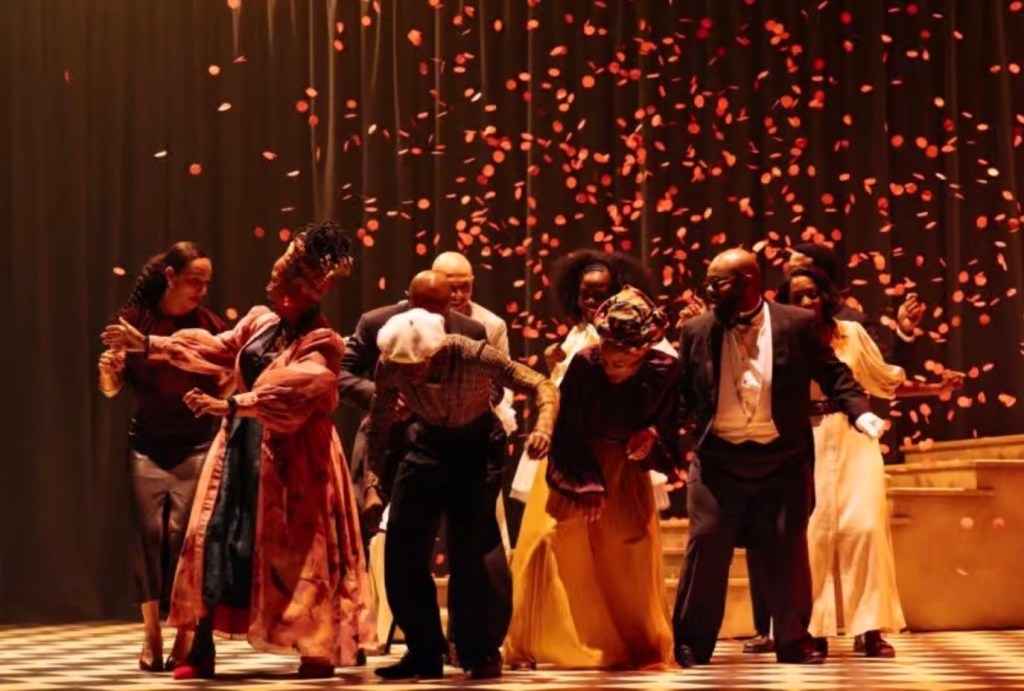
Ask any musical theatre aficionado for their top ten modern scores, chances are this tuneful epic will be on most lists. In adapting E L Doctorow’s sprawling tale of social consciousnesses awakening and the necessity but challenges of immigration as America takes shape at the dawn of the twentieth century, Lynn Ahrens and Stephen Flaherty created something operatic in ambition and scope, aided by the late Terrence McNally’s sweeping, fleet but emotionally alive book.
A masterpiece has been reminted by a bunch of creatives and craftspeople at the top of their games at Lincoln Center and this Ragtime will restore your faith in the power of the arts to speak urgently to issues that are happening right now, and bathe you in the warm, golden light of musical theatre at its most enthralling. It is specifically about the birth of America, or at least America as it could and should be rather than the way it is for many people at the present time, but the messages of tolerance, hope and legacy are resonant and necessary for the world at large.
This makes it sound a bit worthy but the joy and exhilaration of Lear DeBessonet’s roof-raising production – her first as new artistic director of Lincoln Center Theater – is that it’s not only a brilliant example of illuminating the relevances of a modern masterpiece, it’s also wondrously fresh and vital, and an altogether glorious three hours in the theatre. Take hankies, you’ll need them.
It’s hard to fathom a better cast than the one assembled here. Joshua Henry’s womanising rebel Coalhouse Walker Jr perfectly balances the moments of light-on-his-feet charm with something brooding and darker; he’s a complete, flawed but admirable human being, and when he sings it’s the kind of deep, rich clarion call that makes you hold onto your seat and gasp. Brandon Uranowitz as Tateh, the Eastern European Jewish immigrant who will do whatever it takes to give his daughter (Tabitha Lawing, heartcatching) a comfortable life in the New World, is equally fine, with a wiry energy and an edge of manic desperation borne of genuine hardship. It’s a wonderfully detailed portrayal, funnier but also grittier than anyone else I’ve seen in the role.
Few singing actresses can make good and nice so utterly riveting as Caissie Levy does and this unique ability, first seen in her luminescent Sheila in the last Broadway and West End Hair revivals and superbly honed across multiple roles since, works a treat for Mother. Levy charts her spiritual and social awakening with precision and extraordinary emotional intelligence. Watch her as she waits for traumatised shut-in Sarah to decide whether to meet with Coalhouse, or her reaction to Father’s bigoted response to the fact that a Black baby is being raised in his house….this is magnificent acting, potent and true. Vocally she brings power and sweetness that culminates in a rapturous but rueful ‘Back To Before’ that stands equally alongside the late, great Marin Mazzie’s more operatic original version, that sends the audience into ecstatic overdrive.
Nichelle Lewis reconfirms the promise she showed last year in her professional debut as The Wiz’s Dorothy, and gives us a Sarah of devastating emotional intensity. She doesn’t have the classical sound of the role’s originator Audra McDonald but instead produces a voice that seems to be ripped from the guts. She’s sensational. Colin Donnell impresses as Father, giving him an air of troubled reflection more complex than anybody else I’ve seen in a role that can often seem a bit one-note.
In another quiet revelation typical of this production, Anna Grace Barlow makes something tangier, more interesting out of scandalous soubrette Evelyn Nesbitt, while Shaina Taub as rabble rousing Emma Goldman, Nicholas Barrón (understudying Ben Levi Ross) as Mother’s politically rebellious Younger Brother and Nick Barrington as the little boy who predicts the onset of World War One to Rodd Cyrus’ captivating Houdini, are all impeccable. The ensemble singing and the playing of James Moore’s satisfyingly huge orchestra thrills the blood and makes the hairs on the back of your neck stands out.
DeBessonet and her choreographer Ellenore Scott, not to mention the exemplary central design team of David Korins (set), Linda Cho (costumes) and Adam Honorë (lighting), completely master the Beaumont’s vast space. Moment after moment lingers in the memory (the entire company rising through the floor at the beginning, the staircases floating in the darkness to represent ships, the way an entire factory floor materialises in seconds), and the rapid changes of focus from epic to intimate are achieved with assured sleight of hand. The visual storytelling in the lengthy opening section – splitting the company into three discrete groups: the affluent whites, the Black community, and the immigrants – takes the breath away.
Kai Harada’s sound design is crystal clear so we get every word and nuance, and the music – an unsurpassed mixture of jazz syncopation, good old fashioned showtune, bombastic neo-classical intensity and of course ragtime – utterly transports and thrills. William David Brohn’s original orchestrations remain stunning.
This Ragtime comes at us like a roar and a hug, and a wake-up call. It’s the most politically relevant show on Broadway, except perhaps for Liberation, but also one of the most richly enjoyable. This is theatre that nourishes you, it grips and it soars: go see, wallow and weep. They may as well start engraving those Tonys now. Essential.
Understandably acclaimed by critics and audiences alike on its off-Broadway premiere earlier this year for Roundabout Theatre, Bess Wohl’s Liberation has now arrived on the Main Stem and is a significant enrichment to this Broadway season. It’s that rare and wonderful thing, an intelligent, politically and emotionally charged play about an important and essential subject, that is also terrific entertainment.
Inspired by her own mother’s involvement in the Women’s Liberation movement in the 1970s, Wohl filters her feminist agenda through a set of relatable but never stereotypical characters, spiky and gloriously quirky, placing them in a situation (regular Consciousness Raising meetings in an Ohio school gym) where the verbal and emotional fireworks are primed to explode. It’s infused with love, some anger and a degree of theatrical invention and fourth wall breaking that sets it apart from some other plays where people come together for discussion and reflection.
Whitney White’s almost note-perfect staging has transferred with its entire original cast intact and it’s impossible to imagine another team of women inhabiting these roles so fully and vividly. That said, the writing is so nuanced and rich in humour and the eccentricities and attitudes that make humans human, that there are probably several ways to portray these characters. No doubt other actors will get pleasure and praise from mining them in due course, as this feels like a play that will receive a multitude of productions in years to come. A modern American classic? It just might be.
A warm, luminous Susannah Flood plays journalist Lizzie deep-diving into her mothers past (“My devoted, dutiful mom who sewed the costumes for every school play and cooked every family dinner and did all the dishes and took me to every piano lesson… she was actually… a radical?”) and specifically the Women’s Group she founded in 1970. She also doubles as her Mum and out of her memory come the women who became such friends, allies and, occasionally, antagonists.
And what a bunch they are: there’s garrulous, boisterously self-aware aspiring film-maker Isidora (Irene Sofia Lucio, outrageous and irresistible) from Italy (“I have the husband but really only for the Green card”), and vinegary, older housewife Margie (Betsy Aidem) who claims to be in attendance so as to avoid stabbing her husband (“I realize that sounds like a joke. It’s not a joke”). Then there’s nomadic, rebellious lesbian Susan (Adina Verson, ultimately as touching as she’s hilarious) who’s currently living in her car, Kristolyn Lloyd’s elegantly fierce Celeste, a Black book editor temporarily back from New York to look after her ailing mother, and Dora, a people-pleasing fugitive from the epically sexist corporate world who has wandered in thinking it’s the knitting circle (lovely Broadway debut by Audrey Corsa). Costume designer Qween Jean dresses them in attire that looks authentically 1970s but also gives valuable clues as to who these women are, aided by Nikita Mathis’ eye-catching, slightly heightened wigs and hair designs.
Lizzie’s opening speech directly addresses that we’re watching a play as she welcomes and reassures the audience (“surely you’ve noticed all of those six hour, eight hour, ten hour plays are by men with no children? A woman with children would never. Could never”) and Flood’s delivery of it is so chummy and lowkey that some of the other performances feel comparatively over-emphatic, but only at first. What’s refreshing though is that Wohl, White and team give these women so much detail and definition that, as in real life, they constantly surprise but never at the expense of credibility.
They evolve too. Three years elapsed between acts one and two, and the way their relationships with each other and with themselves change is beautifully done, quietly fascinating in a show that is frequently anything but quiet. Corsa’s initially delicate Audrey transforms the most perhaps but it’s done with subtlety and precision. There’s a lot to love in all the performances but what Aidem is doing as wise-cracking but decent Margie is remarkable and has the audience eating out of the palm of her hand: her comic timing is stellar but the moments where she digs deep, bemoaning the speed of times passage and suggesting resigned amazement that all her significant life moments featured her husband or her kids and grandkids, pierces the heart. Even more astonishingly, there is a brief, deeply moving, scene where she has to portray Lizzie’s mother so that Flood’s character can have a conversation with her, and it’s done with little more than a change in posture and vocal timbre plus the removal of a pair of spectacles, but it’s a transformation. This is acting of the very highest order, and there was barely a dry eye in the house.
With Liberation, Wohl celebrates the Women’s Lib movement and the pioneers who went on strike and protested but also interrogates if they went far enough, given how much work there still is to do. It examines through these relatable, lovable women where the wheels sometimes came off. It’s intelligently but playfully critical: “no normal woman with school-age children can join a group that meets consistently at six p.m. on a school night” observes Joanne (played wonderfully on the night I attended by understudy Kedren Spencer), a local woman who popped by to retrieve her son’s sports bag and ends up arguing with Celeste, “you make a women’s group that women can’t come to…..this is exactly the kind of liberal bullshit that drives me bananas.”
Although written with spice and passion, that contretemps is one of a few moments where the play strays into contrivance. The sole male character, Lizzie’s Dad as a young man, feels necessarily like an intrusion into David Zinn’s hyper-realistic yet oddly dreamlike setting, nicely lit by Cha See, but probably gets a little too much stage time, though touchingly played by Charlie Thurston.
Ultimately, Liberation is a grand achievement, a play to be embraced and cherished by women but that also educates the men that love them, while also giving everyone a rollicking good time in the theatre. It celebrates the extraordinary resilience of women but it’s also about healing and giving ourselves and other people a second chance. Very special indeed.
Your perception of Chess probably depends which side of the Atlantic you’re from. The first Broadway version was a notorious flop garnering rotten reviews, but the London premiere, which had opened five months ahead of the original Phantom in 1986, was much more successful, filling the sizeable Prince Edward for over three years. Both productions were helmed by Trevor Nunn but were very different in look, feel and even script, the New York iteration having a completely new book by acclaimed American playwright Richard Nelson. The overall impression was that the score by ABBA’s Benny Andersson and Björn Ulvaeus with lyrics by Tim Rice in his first large scale departure from working with Andrew Lloyd Webber, was magnificent but the story and script, not so much.
By the time Chess hit Broadway in 1988, out was Elaine Paige plus the gigantic electronic chessboard stage that elevated and rotated, and the banks of TV screens showing Cold War news events and the moves in the all-important chess games, all inherited by Nunn from the original concept of Michael (A Chorus Line, Dreamgirls) Bennett who had become too sick from AIDS to continue working. In instead was Judy Kuhn and a less spectacular but still complicated staging featuring a series of beige towers that moved about to suggest multiple locations. The general consensus among New York theatre folk was that the “British Invasion” started by Cats and Les Mis had come to a shuddering halt with this tale of romance and betrayal amongst fractious East-West relations, and Chess Broadway shuttered after a mere two months.
But now it’s back, in an eagerly awaited revisal led by Tony-winning director Michael Mayer, with a starry trio of central players and yet another new book, this time by Danny Strong, known more for his TV than theatre work. It would be lovely to report that this is the definitive Chess, that Strong, who in more than one press interview has proclaimed that he’s “fixed” the problematic musical, has finally cracked it and turned the show into the beloved blockbuster that diehard fans of this undeniably thrilling score always felt it should be.
Well, it certainly seems to be making a lot of money, mainly one suspects due to the presence of Lea Michele as lovelorn, power-belting Chess analyst Florence, evacuated to the USA as a child from her native Hungary when the Soviets invaded. She’s alongside Broadway darling Aaron Tveit and rising star Nicholas Christopher as the (respectively) American and Russian Grandmasters competing with each other and squabbling over her. These bare bones of plot seem to be the only constant between each variation of the show.
Unfortunately though, what’s currently doing phenomenal box office business at the Imperial (the same theatre where the original production played) is nearer to a particularly ballad-heavy episode of American Idol with a bit of politics and witless narration thrown in, than a coherent, fully realised musical. Essentially, it’s a semi-staged concert with Ian Weinberger and Brian Usifer’s band (excellent by the way, but less satisfying than the symphony sized orchestras on some recordings of the score) on platforms at rear and fully visible at all times, and the suited (women as well as men) ensemble sat around on couches throughout like a less decadent version of the cast over at Chicago.
They don’t just sit there, to be fair: they also execute choreography by the usually terrific Lorin Latarro that occasionally finds a natural dynamism but mostly feels like a confused distraction from all the park-and-bark singing. Why the bizarre sat-down interpretive dance when Christopher’s Anatoly is delivering his first crie de cœur solo ‘Where I Want To Be’? They strip to their underwear for ‘One Night In Bangkok’ but it feels more desperate than sexy, and a bit odd since they don’t change clothes at any other time (no Tyrolean costumes for Merano!) Much is made at the beginning of them donning a blue or red kerchief to denote American or Russian, but that concept is abandoned for the rest of the show.
Worse is Strong’s misguided book which sets up Bryce Pinkham’s Arbiter (“from square one, he’ll be watching all sixty four”) as a narrator-cum-MC, commenting on scenes as they unfold. There was a not-fully-realised antescendent to this with the late, fabulous Tom Jobe in the original London version, but Pinkham, working very hard, seldom shuts up. Strong has him rabbiting on incessantly, re-describing dialogue sequences we either just witnessed or are about to watch but are really not that complex, as though to an audience of halfwits. Then there’s the contemporary “jokes” and allusions he’s saddled with: Chess is set at the height of Soviet vs West tensions in the 1980s but we get gags about Robert F Kennedy Jr’s brain worm, Biden and Trump, constant references to “our Cold War musical” and fatigued digs at the show and characters we’re watching (“see I told you he was a dick” he winks at us over the head of a villainous American agent; “that was HOT!” after Bangkok…like ok we get it, we’re right here).
It’s as though Strong doesn’t trust the piece to speak for itself, and his approach keeps us at a constant emotional remove from a show that, while soaringly effective as a collection of bombastic theatre songs, suffers from a certain chilliness that I doubt even its most passionate advocates would deny. Mayer’s staging, glossy but soulless, doesn’t help, favouring the prosaic over the inspired, and giving two of his three leads little to make their dramatic mark with. Michele and Christopher are authentically great singers and have moments of vocal power here (‘Nobody’s Side’, ‘Anthem’, ‘Endgame’) that make the hairs on the back of your neck stand up, but neither registers much in the way of personality beyond a general air of discontent. Comparisons may be odious but anyone who saw Elaine Paige and Tommy Körberg in these roles will likely miss the edge, warmth and humour these two performers brought (and Florence as a leading lady role that barely passes the Bechdel test needs as much help as she can get).
Tveit, on the other hand, nails American player Freddie’s mix of swagger, instability and vulnerability, plus has the perfect stratospheric rock tenor to really do justice to the role’s extraordinary vocal demands. He’s superb and his breakdown number ‘Pity The Child’ has never sounded better. Strong ups the ante by making explicit the character’s mental health issues but then turns us off Florence by having her snatch away the meds that keep him on an even-ish keel, just as she’s leaving him for Anatoly.
The other improvement in this new Chess is the depiction of Anatoly’s abandoned wife Svetlana, forced to come to Bangkok by the KGB to plead for his flunking of the international championship game and return to Moscow. No longer the dowdy drudge of old, here she’s a manipulative, ambiguous vamp, tough, sexy as hell but with an edge of real desperation (one of Strong’s more inspired modifications is suggesting the mortal danger Russians found themselves in if perceived as having shamed the motherland in some way). Hannah Cruz invests her with a powerful presence and fascinating, focused unknowability, plus a steely, enthralling vocal belt (has this woman ever played Evita?!) She is stunning but when the most complex and satisfying performance is from a secondary character who only appears in act two, you know the show has issues.
Bradley Dean and Sean Allan Krill are enjoyably nasty as a pair of men from opposing sides of the political divide with more interest in furthering their national interests than fair play, and the ensemble singing is consistently potent. A pivotal character shows up in the very final moments but in a way that comes across as more eye-rollingly risible than the deeply moving that was presumably intended.
In eschewing the black and white colour palette, redolent of an actual chessboard, employed by original designers Robin Wagner and Theoni T Aldredge and many of their successors on later revivals of the show, this Chess is a retina-bruising mishmash of colours and styles that don’t add up, the visual storytelling being virtually non-existent. David Rockwell’s set, static but gleaming and surrounded by giant chess pieces with the occasional nuclear warhead thrown in to unsettle, is dressed up with garish lighting by Kevin Adams and video designs by Peter Nigrini that only really register properly if you’re sitting centrally. The stage is mostly empty (well, apart from the omnipresent orchestra that encroaches on everything) but then, ponderously, a bed will elevate through the floor for Michele to deliver a power ballad from, while chandeliers that look like they’ve been borrowed from the Met Opera twinkle overhead: it just doesn’t feel very well thought through. Tom Broecker’s costumes are dismayingly drab, with little sense of the 1980s.
One of the finest, most moving songs in the show, Florence’s rueful admission of romantic defeat, ‘Someone Else’s Story’ premiered by Judy Kuhn in the original Broadway version, is placed now at the very end, making no sense beyond giving Michele an eleven o’clock number (although it feels well past midnight by this point). John Shivers’ sound design is impressive though, balancing the neo-operatic overwhelm with the pop/rock elements of the score and (mostly) letting us hear Rice’s wittily incisive then heartfelt lyrics.
Tveit and Cruz apart, the principal pleasure of seeing Chess is to hear this score again. Cleverer and more complex than Saigon and Les Mis, more urgently grandiose than Phantom, with a Puccini-esque richness offset by bracing Scandinavian steel, it’s gorgeous, and apparently indestructible. Anders Eljas’ orchestrations, in collaboration here with Usifer, remain distinctive and exciting.
The perfect Chess though? We are all still waiting for that. Maybe, like world peace, it can’t exist. This glittering Frankenstein’s monster of a makeover, only intermittently stirring, isn’t it, but the cast album will be a cracker.