Extraordinary what a difference venue size can make. When I saw this highly unconventional Best Musical Tony winner in a 1000+ seat Broadway house a number of years ago, I admired it but didn’t particularly enjoy it: it was beautifully done but felt too esoteric, indistinct and (whispers) a bit boring. In Michael Longhurst’s dreamy new London production however, in a 250 seat theatre where everyone is close to the stage, it’s enchanting and quietly riveting. It also features, in the work of leading lady Miri Mesika, in the role that won Katrina Lenk the 2018 Outstanding Actress Tony, one of the most remarkable British stage debuts in living memory.
The UK premiere of The Bands Visit actually feels like a return to it’s roots. The Donmar is far closer in stature to the off-Broadway Atlantic Theatre’s intimate Linda Gross space where David Yazbek and Itamar Moses’s chamber musical premiered in 2016 rather than the comparatively cavernous Barrymore that it transferred to, and the various theatrical barns it toured to across America. The material is so much better served by being experienced at close quarters.
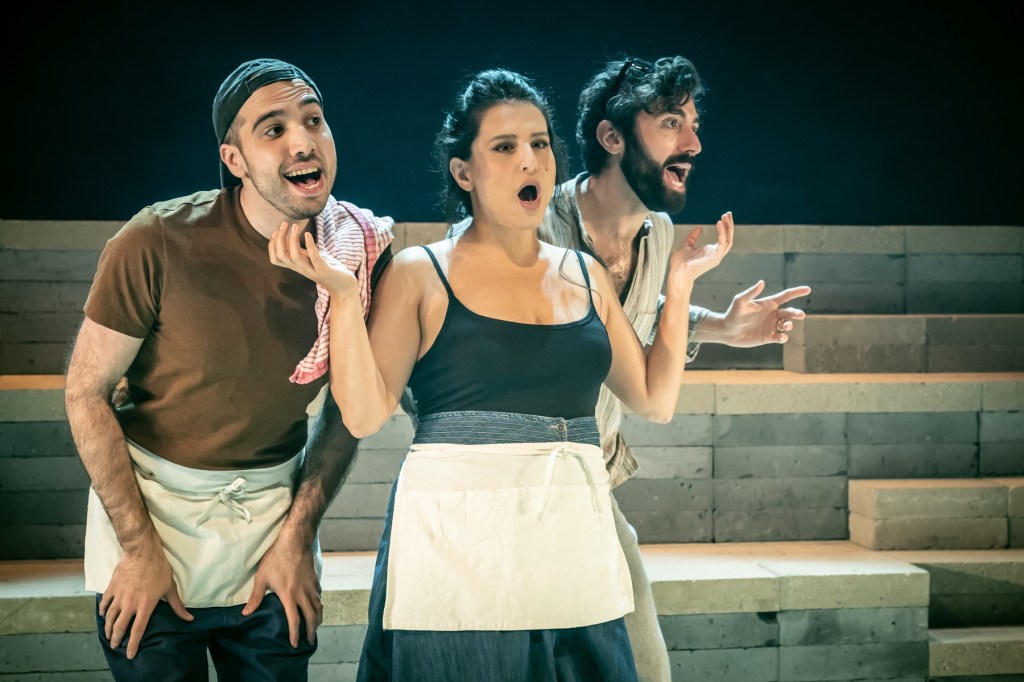
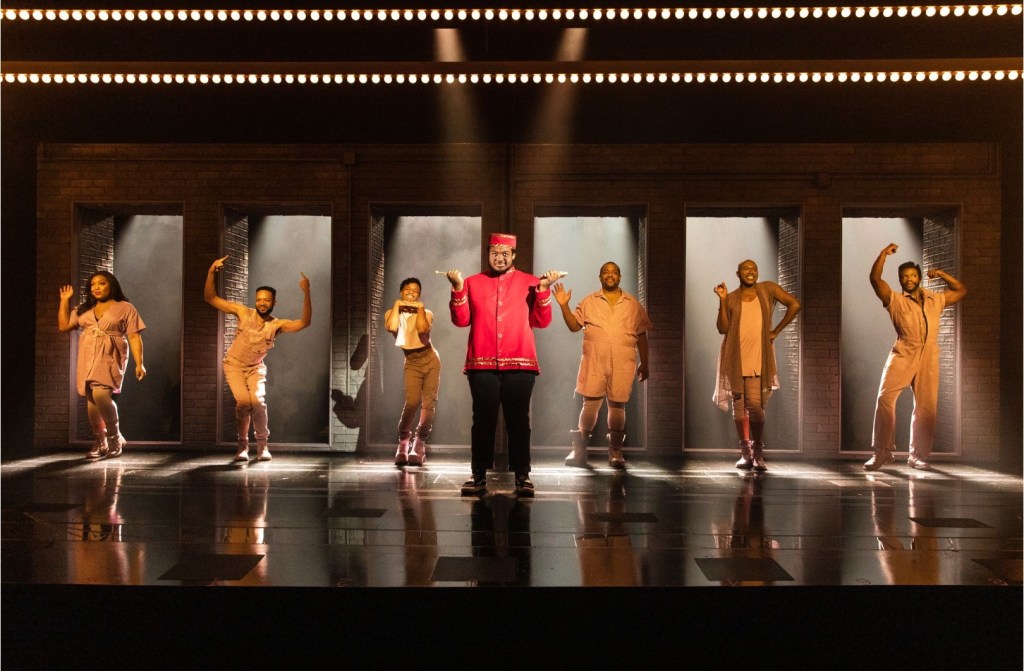
Based on a multi-award winning Israeli movie, the premise of the show is very simple: the Alexandria Ceremonial Police Orchestra travel from Egypt into Israel to play at the opening of an Arabic cultural centre in the city of Petah Tikva but, due to misunderstandings and mispronunciation, end up in the desert town of Beit Hatikva. “Welcome To Nowhere” is a ruefully funny early number as a trio of amused but not unkind Beit Hatikvans explain the mistake to the band of powder blue suited musicians, sweating beneath their formal hats and epaulettes. Due to the town’s remoteness, the men are forced to stay overnight and interact with the locals, and that, on the surface at least, is pretty much it.
The plot of Itamar Moses’s book is that gossamer thin, but the detail, humour and humanity in the characters and their relationships is rich and satisfying. They’re a quirky but relatable bunch, from the character simply known as Telephone Guy (Ashley Margolis, oddly haunting) endlessly waiting at the town’s sole public phone for a call from his beloved, to the gawky, chronically shy sweetheart who’s never had a girlfriend (an adorable Harel Glazer) to the hilarious and all-too-real uneasy rivalry of a pair of band members billeted together overnight (sublime work from Carlos Mendoza de Hevia and Sargon Yelda). Then there’s the young couple (Marc Antolin and Michal Horowicz, both heartbreakingly good) whose relationship teeters on the verge of collapse. Moses’s nuanced script presents these people without comment but crucially never judges them: it all manages, under Longhurst’s perfectly pitched direction, to be utterly truthful yet intriguingly odd.
A tapestry of life and community is created before our eyes on Soutra Gilmour’s deliberately downbeat breezeblock, chipboard and fairy lights set. It’s almost palpably atmospheric. Kindness and resignation trump drama here and the lack of dynamism and dramatic focus may prove frustrating to many (it certainly did for me on Broadway!) but this is a piece that, elusive as it is, repays the effort you put in…eventually. The onstage musicianship is also a thing of joy and wonder to encounter at close quarters.
Once again, David Yazbek proves himself a musical chameleon: his scores for The Full Monty, Dirty Rotten Scoundrels, Women on the Verge of a Nervous Breakdown, even the slightly inferior Tootsie, bear so little relation to each other that it’s hard to believe they’re all the work of the same person, so completely does he align his craft each time with the specific style and milieu of the show he’s creating. Here he has come up with an authentic-sounding score unlike anything in the musical theatre canon. It eschews Broadway-style emoting and grandstanding for the evocative dissonance, rhythms and cadences of Middle Eastern music and instrumentation. It often washes over the audience like a warm breeze, but thrills the blood when it has to. There’s a bona fide stand-out number in ‘Omar Sharif’, a gorgeous reverie where café owner Dina sensuously recalls a childhood watching Sharif and listening to Egyptian chanteuse Umm Kulthum (“dark and thrilling, strange and sweet…we dance with them in a jasmine scented wind”) to an understandably entranced band leader (the Israeli film star Alon Moni Aboutboul in an understated but deeply touching performance.)
Dina is played in London by Miri Mesika, a massive star in her native Israel….and it’s not hard to see why: she’s magical. With a singing voice like warm molasses and the kind of magnetic stage presence that can’t be learnt, she is the lynchpin of this wayward but affecting musical. She lends Dina a very particular authority and authenticity, making her the kind of woman you’d want as your friend but who you definitely wouldn’t mess with, conveying every iota of her warmth, strength, humour and innate kindness. She compellingly hints at frustrations and roiling passions beneath her bemused surface, and captures with heartbreaking honesty the sense of an urbane, curious soul trapped in a stultifying small town. Mesika is ravishingly beautiful yet earthy, magnetic and mesmerising…. this is a glorious performance, one that elevates a classy, accomplished production into a must-see event.
That old adage about madness and genius being closely aligned has seldom been better demonstrated, at least in the theatre, than by this beauteous bitchslap of a show, already an acclaimed sell out in New York and, if there’s any justice, about to follow suit here. The atmospheric, slightly seedy grandeur of Wilton’s feels like an appropriate setting for these two wildly contrasting yet surprisingly complementary, and entirely unique, world class talents and their gloriously offbeat mini-extravaganza.
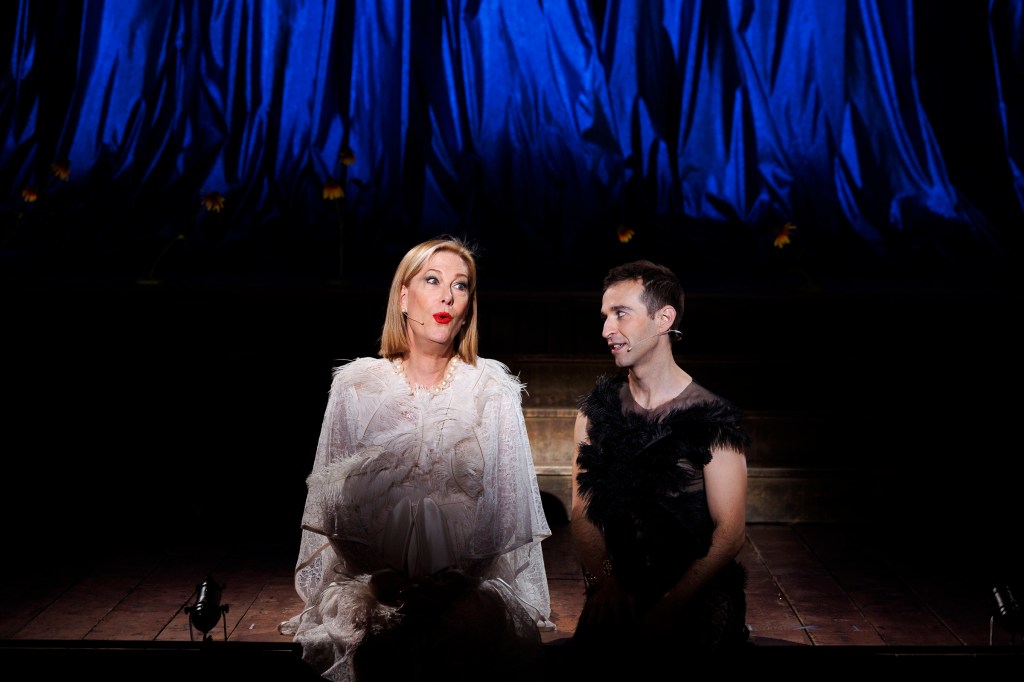
Pitched somewhere between cabaret and recital, but most definitely a piece of true theatre, Only An Octave Apart (the title refers to the fact that Anthony Roth Costanzo is a classical counter tenor while Justin Vivian Bond possesses a resonant deep baritone at home singing everything from torch songs to disco…so they literally do sing an octave apart) is a strange and compelling melange of the screamingly funny and just (exquisitely controlled) screaming. It’s glamorous and outrageous but, such is the mood-shifting brilliance of the performers and Zack Winokur’s deceptively clever staging, the tone can, and does, turn on a dime from dirty-minded camp joy to breath-holding, tear-jerking poignancy. This is audience control of the highest order.
Other than the unlikely but exhilarating pairing of Costanzo’s ravishing, bell-like sound with the smoke and slate of Bond’s vocal tone, it’s the contrast and chemistry between the two stars as talents and humans that fascinates most perhaps. As Bond (who, from a distance and with every passing year, more and more resembles Cybill Shepherd or the much missed Broadway diva Marin Mazzie) gleefully points out, they’re a star of the sometimes rough and ready downtown cabaret circuit while Costanzo has graced the stages of everywhere from the Metropolitan Opera in New York to ENO and Glyndebourne. If Costanzo’s stage persona is irrepressibly good humoured and boyish, albeit capable of real emotional depth when required (astonishingly, he’s 40 but reads on stage as at least a dozen years younger), Bond is, to quote Harvey Fierstein’s Torch Song Trilogy, “mountain beautiful”, a statuesque, louchely glamorous figure with a mega-watt smile, a killer side-eye and zero filter. Costanzo is an adorable Peter Pan, if J M Barrie’s ageless boy had a voice to make angels weep, to Bond’s slightly demented society hostess doling out cocktails while telling cock tales. He’s warm and engaging, they’re magnetic, elegantly naughty and a little dangerous, and together these boutique superstars create some crazy magic.
In between droll, delightful banter, the musical choices are nothing if not eclectic. Costanzo treats us to several pieces from his classical repertoire, including some Schubert, Purcell, Gluck and a breathlessly brilliant (breathless for us that is, not him) version of the Crudel! Perchè finora duet from Mozart’s The Marriage of Figaro in which he fearlessly and successfully takes on soprano and baritone parts. He also joins his co-star in a rip roaring Sylvester disco number and thrilling reinventions of Queen’s Under Pressure and the Bangles’s Walk Like an Egyptian (yes really). Nico Muhly’s terrific arrangements and Daniel Schlosberg’s nine piece band soar throughout.
Bond’s voice, a distinctive fusion of screech and guttural growl, is no less remarkable an instrument than Costanzo’s in it’s own way, emphasising phrasing over tonal loveliness: it’s by no means a beautiful sound but it’s an expressive one that compels you to listen, especially in tandem with it’s owner’s innate charisma. Bond sashays through a weirdly sexy appropriation of Me And My Shadow that bewitches, and delivers a raw, affecting version of Dido’s wistful White Flag that troubles and aches. The programme runs even deeper and more haunting when the stars reinvent the Peter Gabriel-Kate Bush duet Don’t Give Up as a meditative response to the ongoing battle for trans rights, gay rights and basic human decency: it’s tender, profoundly affecting and lifts an already exceptional evening into a rapturous stratosphere.
There’s an authenticity about Bond and Costanzo, both separately and collectively, that goes beyond the glitter, the outlandish almost-matching outfits, the sometimes groan-worthy jokes, the bizarre but inspired musical choices, and Bond’s repeated mantra of “keep it shallow, keep it pretty, keep it moving”… these are two true artists at the very top of their game, and you should do whatever it takes to see them. Fabulous, in the most authentic sense of the word, and, perhaps surprisingly, moving (and not necessarily in the way Mx Bond meant). A must-see.
The scene that closes act one of Eureka Day is probably the funniest couple of minutes on any current London stage. Throughout it, the actors, playing school board members in a meeting live-streamed to dozens of concerned parents as they contemplate quarantine following a mumps outbreak, are barely audible however. The dialogue for these smugly well-meaning educational custodians is drowned out by the screams of delight and recognition from the Old Vic audience, reacting to the escalating online parental slanging match in the comments section of the live stream, which is beamed all up the back wall of Rob Howells’s set, to scintillating comic effect. One parent responds solely in emojis, which becomes funnier and funnier as it goes along, and what starts out as a couple of innocent questions rapidly descends into a barrage of abuse and discord as grievances, intolerances and misunderstandings are aired. Not only is it hilarious, it’s supremely relatable, especially after the last couple of years where everyone is a keyboard warrior and a seemingly innocuous comment can prove inflammatory when taken out of context. Perhaps not since the infamous internet seduction scene in Patrick Marber’s Closer has live performance and online communication been this outrageously and inventively intertwined. Eureka Day may be set in California but it feels universal.
It says much for the rest of Jonathan Spector’s richly entertaining satire and the excellence of the acting in Katy Rudd’s engaging production that the second half doesn’t prove an anticlimax, even as it travels in a slightly different direction from the glorious mockery of the first. Interestingly, Spector wrote the play in 2017 (it was first performed on the West Coast then off-Broadway shortly after that) yet it has acquired a striking resonance in the aftermath of the global pandemic, as it considers the boundaries of personal responsibility in the midst of a health crisis, and how a community responds to such circumstances.
Spector gets a lot of comic mileage out of sending up the benignly dictatorial “woke” brigade who control the school and who are so determined to do, say and think the “right” thing that their own privilege and unconscious biases never occur to them, even as they steamroller over the any opposing voices with the cheery, empty slogan “there are no villains here!” A major thrust of the piece, in the second half in particular, is a debate around vaccinations, their efficacy, and whether the risks outweigh the advantages. Spector doesn’t entirely abandon the humour here but is an intelligent enough writer to ensure that both sides are expressed with some persuasion.
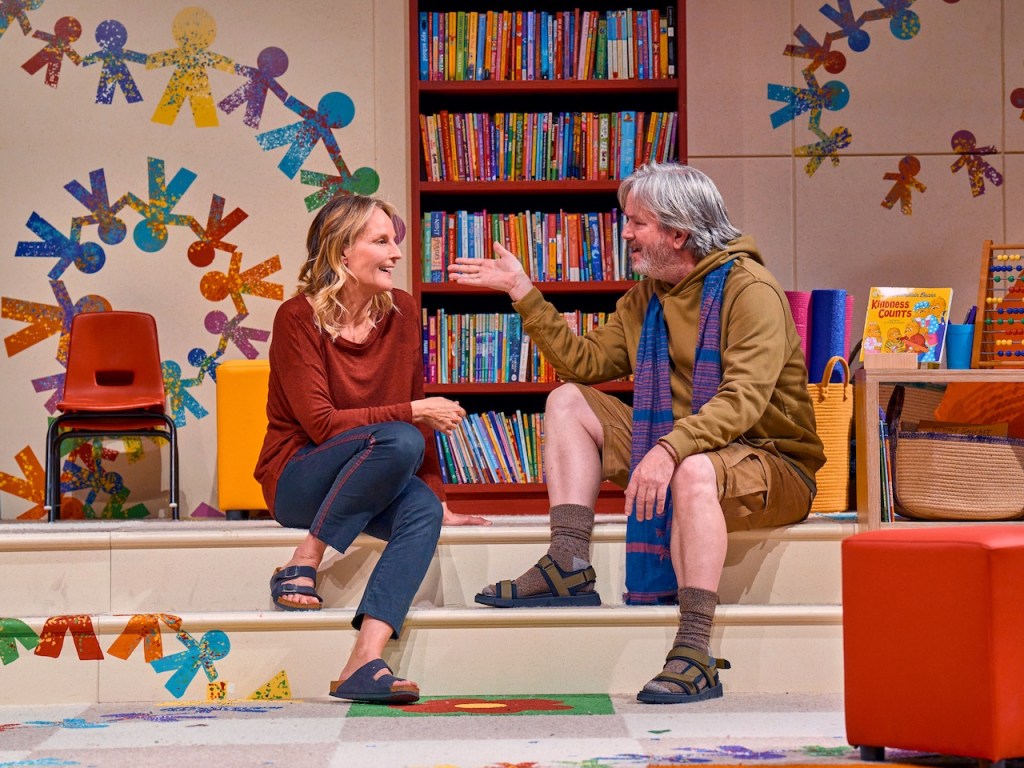
The acting is delicious. The production marks the UK stage debut of Oscar and Emmy winner Helen Hunt, and she is magnificent – understated and precise – as Suzanne, a high level board member who has raised passive aggression to an art form while masking a searing emotional pain, revealed in an exquisitely delivered monologue that grounds and illuminates the second half.
Superb as she is, this is very much an ensemble piece rather than a star vehicle, and nobody drops the ball in this cracking company. Susan Kelechi Watson is subtly, lethally funny as her arch nemesis, a newly arrived Black parent who both wittingly and unwittingly uncovers some of group’s unconscious biases. If she can’t quite make work the character’s unexpected about-face at the play’s conclusion, that is a flaw in the writing, and one of the few things in Spector’s otherwise admirable text that doesn’t ring true.
Mark McKinney is a total delight as the clueless but well-meaning ageing hippie who insists on concluding each meeting with an esoteric Rumi poem and petrifies at the first sign of conflict. Ben Schnetzer and Kirsten Foster unravel spectacularly as a smugly right-on pair indulging in an extramarital affair only to be riven apart when the realities of a health crisis intrude in their illicit union.
Plays that are simultaneously this provocative and entertaining are pretty rare. The forensic observations and trenchant humour are sometimes reminiscent of Alan Ayckbourn in his heyday (if Ayckbourn had been an American writing about Californian yummy mummies, gender pronouns and faddy trendiness) but the attitudes and terminology are bang up to date. Dazzling and uproarious.
Watching Tanya Barfield’s bittersweet two hander, receiving it’s UK premiere here following an off-Broadway run and a couple of American regional productions, it reminded me that last year’s critically lauded West End revival of Nick Payne’s Constellations never gave us a lesbian version. In it’s Olivier award-winning last outing, that time-twisting love story was done by a duo of gay men, two older actors, an early middle aged pair, and a glamorous Black couple… but never two women. Barfield’s play may not be as ambitious or intellectually rigorous as Constellations but shares a similar dramatic DNA and gives an idea of what a female-led iteration of Payne’s modern masterpiece might have been like.
As it is, Bright Half Life has much to recommend it, especially the nimble, inventive direction of Steven Kunis which plays out under a rather beautiful kite shaped neon lighting grid (kite flying is a recurring motif in the text) and the exquisite, detailed performances of Eva Fontaine and Susie McKenna as the women who fall in and out of love across decades but never in a chronological order. Fontaine and McKenna’s weighty stage presences, emotional dexterity and ability to switch in the blink of an eye from playful to grave and back again, are required to do quite a bit of the heavy lifting for a text that, for all it’s intelligence and originality, is sometimes frustratingly short on flavour and specificity when sketching it’s two central, and only, characters.
Both actresses brilliantly fill in the blanks by sheer force of personality, formidable stage technique and the fact that, despite being very different from each other, they are each so damn lovable. Erica is messy and unfocused but McKenna invests her with such charm that it’s not hard to see why Fontaine’s tough but kind go-getter Vicky falls for her. Despite the contrasts between the women, Barfield makes a convincing case for why they got together but also, sadly, why despite having children together as well as a raft of other life experiences, their union wasn’t built to last. There is a romanticism here as well that is sweet without ever cloying.
As with Constellations, scenes are replayed from different perspectives, and the storytelling is determinedly non-linear. A regular preoccupation of Barfield’s writing is a fascination with the tension between air and earth. As well as the aforementioned kite-flying, we see the women skydiving and suspended high on a Ferris wheel, and tellingly it’s the controlled, more “sensible” Vicky who is unphased while the freer spirited Erica is terrified. By contrast, we also eavesdrop on the women in bed, and then displaying a humorous delight in mattress shopping and testing out the product by bouncing on it like a pair of cackling children.
The tragic aspects of the story, such as terminal illness and the breakdown of the relationship, are represented with a commendable lack of sentimentality. If the dialogue is unremarkable, the subtext and chemistry the leading ladies imbue it with, is something to treasure. So too is the exquisitely subtle ways they age up and down scene by scene without changing an iota of their appearance. Alex Lewer’s lighting design is a subtle but powerful aspect of the production as a whole.
Ultimately, this is a highly watchable comedy drama that challenges enough and is spiced up by a novel approach to dramaturgy then further elevated by a pair of superb performances and a spare but energised staging. It isn’t revelatory, but it’s emotional clarity filtered through a clever structure means it’s not hard to see why it made the journey across the Atlantic.
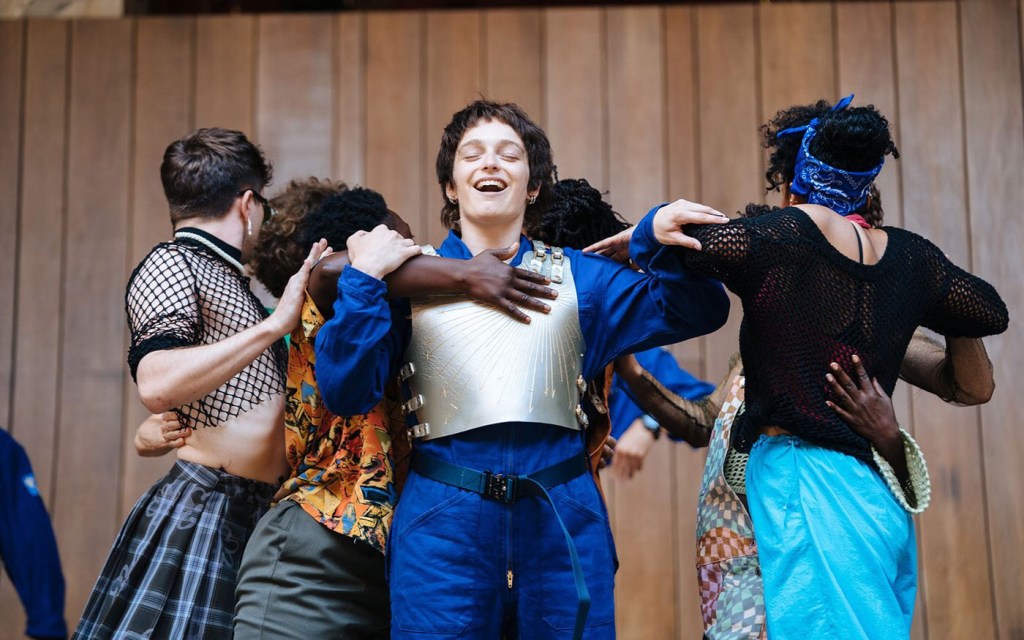
As professional debuts go, Isobel Thom’s central role in Charlie Josephine’s rambunctious, surprising distillation of the fabled life of the Maid of Orléans for Shakespeare’s Globe, takes some beating. Thom gives a beguiling, persuasive performance that humanises Joan of Arc while still preserving the magic surrounding this divisive figure.
What Josephine has created is less a coherent historical drama (and, to be fair, Bernard Shaw and Anouilh already have this story covered in that respect with Saint Joan and The Lark respectively) and more a genderqueer pageant pitched somewhere between Brecht and Black Adder, that reframes Joan as a non-binary poster child for tolerance and rebellion. It’s very much a Globe play too in that it paints in broad brushstrokes (essential when you’ve got noise seepage from the skies above and the Thames just outside), and it’s bold, mouthy, engaging, urgent….
Some eyebrows were raised at the prospect of a gender fluid Joan but it’s hard to see why: it’s impossible to think of another historical figure so well suited to this sort of creative treatment than a person who eschewed every aspect of their traditional gender identifications, and furthermore I’m pretty sure that most of Shakespeare’s history plays were no more factually accurate than what we currently have at the Globe. If this theatre had a roof, Joan would have torn it off by now.
Josephine’s writing is salty, anachronistic, vivid. You may not expect a play about Joan of Arc to have as many belly laughs as you get here, but both Jolyon Coy’s preposterously swaggering Dauphin and Adam Gillen’s dithering, self-effacing sidekick are sublime comic creations made all the funnier by being rooted in a certain reality, however crazy. I also adored Jonah Russell’s rugged Dunois who takes his time to come round to approving of Joan, and Debbie Korley’s comically imperious, Thatcherite regent Queen.
The play is touching as well though: the collective sigh of recognition and acceptance that goes through the crowd when Gillen’s inspired Thomas first suggests the “they” pronoun to a confused Joan is deeply moving, and, throughout, the central character is a figure that, for all their bravery and outward toughness, it’s impossible not to root and care for, especially as embodied by the magnetic, lovable Thom.
The battle sections are particularly exhilarating with stomping, combative choreography, by Jennifer Jackson, that sits low in the body, feels refreshingly spontaneous, and builds to an enthralling climax as more and more company members join Joan’s crusade. The effect is simultaneously joyful and slightly threatening. The audience went nuts for it, and also for the fabulous cast entrances via an enormous slide that takes up almost the entire height of the performing space. Ilinca Radulian’s energetic production consistently succeeds in striking the right balance between raucous, playful and lofty.
Joan’s death, when it comes, is cancelled, or at least postponed, by a Groundling led chant of “change the play!” not dissimilar to the traditional audience participation cries of “I believe in fairies!” in the annual Peter Pan play at Christmas. Josephine gives Thom a rousing, marvellous speech of defiance dismantling the patriarchy and putting two fingers up to gender expectations and limitations. It’s terrifically delivered and whips an already hugely engaged audience up into a further frenzy of enraptured indignation.
Exciting as the writing and the performance is, it does by this point feel slightly grafted on to the legend of the French peasant girl who liberated France only to be betrayed and burnt at the stake for her pains. That won’t matter to many: Josephine’s script relentlessly pushes it’s agenda and is very much preaching to the choir in terms of matching the expectations of the audience coming to see this unique piece of theatre.
Forget subtlety and embrace the big beautiful, messy heart of it: what we have here is a flamboyantly queer-accented slice of uplifting mass populist entertainment. It feels like this season’s Nell Gwynn or Emilia, and I suspect we will see more of it after this brief late summer season. And in Isobel Thom, the theatre has a glittering new star.
Here’s something you don’t get to experience too often: a gritty piece of contemporary writing that gives theatrical voice to people largely unrepresented on stage, and does so with compassion and comedy; a new play that is at once delicately intimate yet epic in scope, and a cracking piece of storytelling that manages to indict it’s audience without ever feeling preachy or worthy. Waleed Akhtar’s The P Word is a plea for tolerance, a study of the power of friendship, a sort-of love story and ultimately a potent political act that grips like a thriller.
Akhtar’s script kicks off by juxtaposing two men directly addressing the audience: both are in their early thirties, gay, living in present day London and of Pakistani heritage. That’s where the superficial similarities end though: Bilal, or Billy as he prefers to be known, (Akhtar himself, and as fine an actor as he is a writer) is a confidently promiscuous city dweller, working in the fashion industry, getting lots of sex via the apps and leading a fairly hedonistic existence, only occasionally troubled by the realisation that he has no one to rely on but himself, and happy to pander to racial stereotypes if it means he’ll get his end away more frequently. Then there’s Zafar (the equally brilliant Esh Alladi) seeking asylum in the UK having been run out of Pakistan by his own father who had already organised the murder of his boyfriend and was aiming to mete out the same fate to his own offspring. The script makes wry and explicit the contrast between a life where looking good to get laid is of the utmost importance, and one where your very nature could get you killed.
One of the most impressive things about Akhtar’s writing is the utter conviction with which he creates these two discrete voices: Billy’s cocksure arrogance and selfishness contrasts so vividly with Zafar’s haunted timidity and understandable paranoia that it’s hard to credit that they both came from the same pen. Every line, every nuance rings absolutely true and succeed in feeling simultaneously naturalistic yet rivetingly theatrical. Even more impressive perhaps is the way that, as the play progresses through it’s eighty five minutes power-packed playing time and these men reveal more and more about themselves, our perception of each of them changes considerably, yet never once does it feel less than credible.
At first it looks as though we are in for an evening of intertwined monologues à la Brian Friel, but Akhtar throws a curveball by setting up a chance meeting between Bilal and Zafar on a late night Soho street, and sends them careening off into a friendship that initially looks a little unlikely but gradually makes sense as you realise that Bilal is less assured than one had first thought, that Zafar is a whole lot more fun than he initially appears, and that both are in fact desperately lonely. Tellingly, despite the homophobia that forced him to flee his native land, it is Zafar who has pride in his Pakistani origins while to Bilal it seems little more than an inconvenience. Both performers inhabit their roles so completely – Akhtar is all laid back laconicism with an undertow of aggression, while Alladi has a wired, neurotic energy – that it barely feels like acting, but actually what beautiful work it is.
The interest in the will-they won’t they nature of the relationship pales into insignificance beside the bigger picture of what will happen to Zafar if he is forced to return to Pakistan and, without giving too much away, the whole tone and nature of the story alters drastically and devastatingly in the last fifteen minutes or so. Anthony Simpson-Pike’s engrossing production is staged in the round and it’s truly remarkable to see so many people on the edge of their seats, holding their collective breath and, in many cases, fighting back tears.
In the closing moments, the play changes tack yet again as Akhtar abandons the characters and their story, and directly addresses the audience on the subject of asylum seekers and their fate when the UK rejects their plea to stay…it’s like a sheet of ice splitting across the stage, and it’s thought-provoking and maddening, elevating this thumping good story, magnificently produced, into a thing of importance and carefully pointed simmering rage.
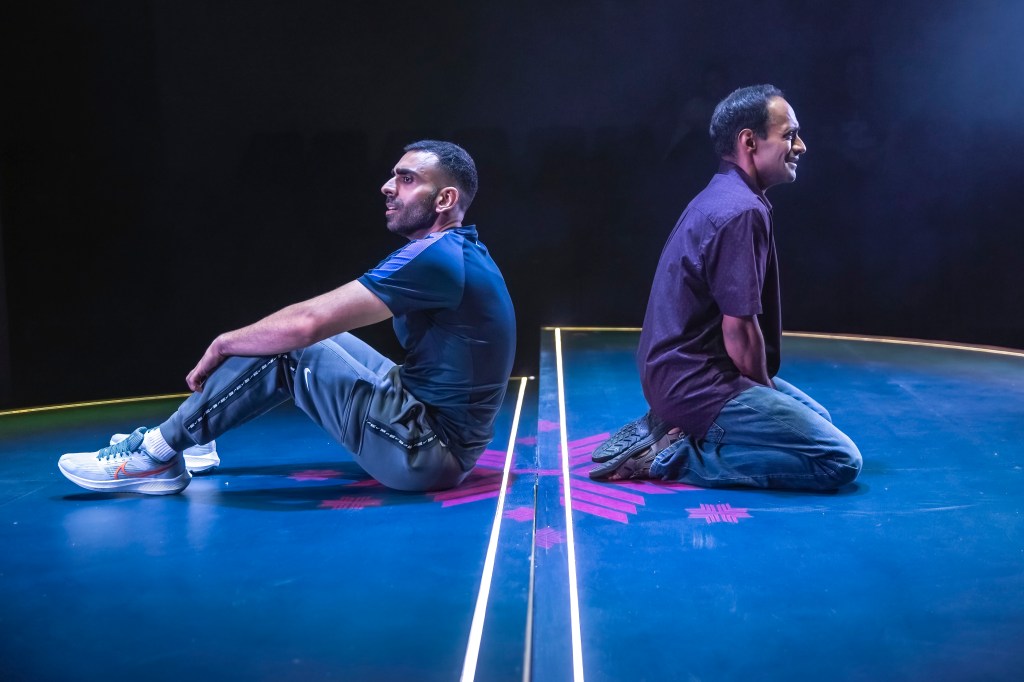
Technically, the show is flawless, from Max Johns’s revolving broken disc set to Elliot Griggs’s scene-controlling lighting and an exciting, omnipresent soundscape by Xana and composer Niraj Chag which mixes Pakistani tradition with jagged urbanity and just a hint of camp disco. The pace never flags, the humour truly lands, and the performances are sublime, while the text hammers home it’s points with potency but finds subtlety when it needs to.
Regardless of your sexual orientation or nationality, if you don’t respond to this extraordinary piece of theatre on some visceral level, you may want to check your humanity. Do not miss this terrific play.
The Finborough has a rich and noble history of rediscovering lost dramatic gems, alongside their programme of new work (this year’s Bacon and Pennyroyal remain two of my favourite new plays since theatres re-opened post-pandemic), and Kate O’Brien’s family tragicomedy, seldom seen since it’s 1926 premiere, continues that line of programming. In all honesty, Distinguished Villa is a little clunky and unlikely to be turning up in the West End or at the National any time soon, but it offers a stimulating, emotionally engaging couple of hours in the theatre that has a surprisingly contemporary spin on subjects such as mental health and the limits imposed on women’s lives, which is remarkable considering that it is nearly a century old.
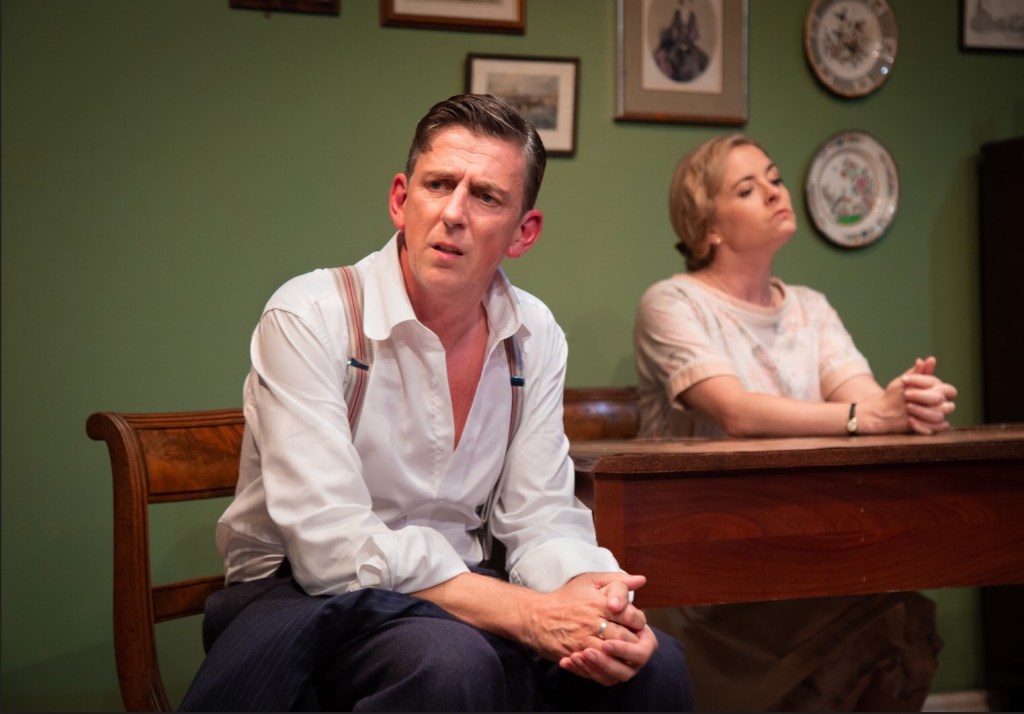
O’Brien’s play is set in the living room of the Hemworth family’s Brixton home (dubbed “Distinguished Villa” by approving neighbours) and is populated by a dramatis personae of satisfyingly vivid figures. Matriarch Mabel, in Mia Austen’s witty performance, is a socially mobile monster in a pinny, obsessed with keeping up appearances, endlessly bemoaning her fragile health -although she’s probably the most robust character on stage- and blithely unaware of the anguish of husband Natty (Matthew Ashforde, impressive in a complex role) who is clearly suffering from some sort of advanced but undiagnosed form of depression. Then there’s Gwendolyn, Mabel’s not-as-innocent-as-she-looks sister, a tantalisingly mysterious female lodger and a pair of contrasting gentlemen callers.
The somewhat meandering first half takes it’s time setting all this up: it’s perfectly watchable, thanks in no small part to the generally superb performances, but feels a little static, something which Hugh Fraser’s otherwise accomplished direction can’t do much about. The second act is more plot-driven and considerably more dynamic. An illicit affair, an unwanted pregnancy, a shocking tragedy and men behaving (very) badly: all these crop up, and if the transitions between themes and tones are sometimes ponderous, that’s a flaw in a play feels like a precursor to Noel Coward’s rather more disciplined This Happy Breed: O’Brien gives us beautifully crafted dialogue and especially compelling female characters, but can’t seem to make up it’s her mind if she wants Distinguished Villa to be a domestic comedy or an old fashioned melodrama.
Holly Sumpton is magnetic but unknowable as the elusive Frances, and Tessa Bonham Jones finds real emotional heft in younger sister Gwendolyn’s conflict and terror. Brian Martin is winningly ardent and skilfully negotiates some pretty clumsy writing as the young man torn between them. Simon Haines is hugely impressive as the urbane upper class gent who turns out to be a lot less charming and honourable when the mask slips. Ashforde handles Natty’s existential crisis with real compassion, and Austen is a spiky, nervy joy as his unloving Mrs. Mim Houghton’s gorgeously detailed set and Carla Evans’s costumes help root these figures in an entirely convincing historical period.
Ultimately, Distinguished Villa is no world beater but still has a certain resonance; whatever it’s flaws, it never prompts the thought, as some disinterred scripts tend to do, that there is a myriad of obvious reasons why it hasn’t been produced in decades. It’s certainly hard to imagine a better production of it than this one.
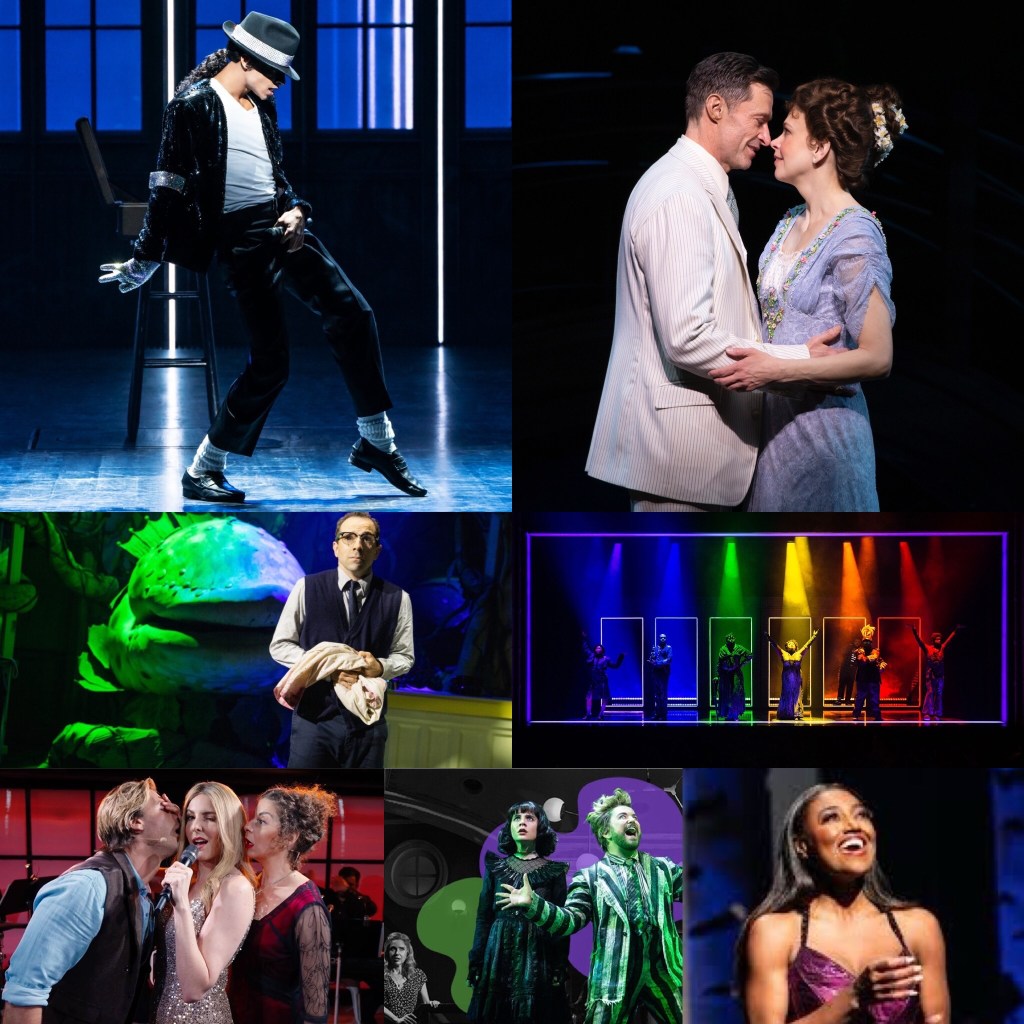
Photo credits: Myles Frost in MJ by Matthew Murphy; Hugh Jackman and Sutton Foster in The Music Man by Julieta Cervantes; Audrey Two and Rob McClure in Little Shop of Horrors by Evan Zimmerman; company of A Strange Loop by Marc J Franklin; Constantine Rousouli, Marla Mindelle and Alex Ellis in Titanique by Emilio Madrid; Kerry Butler, Elizabeth Teeter and Alex Brightman in Beetlejuice by Matthew Murphy; Patina Miller in Into The Woods by Matthew Murphy and Ethan Zimmerman
This being the first full summer post-shutdown when theatre on both sides of the Atlantic is back to something approaching normality, it’s interesting to look, from a UK perspective, at a couple of the New York musicals that we can hope to be hitting the London stage before too long. A small caveat to begin with though: while the West End is doing reasonably well (every theatre is occupied and with future tenants lined up, even though disappointingly few productions are regularly selling out), it should be noted that, at the height of the tourist season of 2022, Broadway has only twenty one shows playing. There are exciting things announced for the autumn/fall for sure, but it’s still remarkable to consider that, at time of writing, exactly half of the houses that constitute Broadway are sitting dark, and that, of those with shows, only two of them are hosting straight plays (both of which are London imports: The Kite Runner and the blockbuster Harry Potter & The Cursed Child, here streamlined into a briefer but equally magical single epic play, as opposed to the expensive two parter still on offer at the Palace).
Everything else on Broadway is a musical, ranging from the long running usual suspects (Wicked, Phantom, The Lion King) through classic revivals to a soaringly original new work that genuinely prescribes hope for the future of the genre. The biggest hit, but only likely to cross the Atlantic if it’s above-the-title star elects to come with it, is Hugh Jackman in The Music Man, a Jerry Zaks-directed revival of Meredith Wilson’s Broadway classic. Critics have been divided on the merits of both the production (attempts to water down the more unreconstructed aspects of this 1957 musical have met with some derision) and Jackman’s athletic central turn as confidence trickster Harold Hill, although generally everyone adored the leading lady (Sutton Foster, seen here to great acclaim in last summer’s Anything Goes at the Barbican). With star power like this, The Music Man will likely prove similarly critic-proof should it hit London: the piece itself may not be held in the same affection here as it is in the US, but, concerts aside, Jackman hasn’t appeared on the London stage since he starred in the National’s Oklahoma! back in 1998-9, and he has a massive fan base.
With Terry Gilliam and Leah Hausman’s opulently imaginative Into The Woods from Theatre Royal Bath allegedly eyeing a West End transfer, I guess the chances are little to zero of London audiences getting to see the other high profile revival this season, a semi-staged version of Sondheim and Lapine’s masterpiece featuring a full onstage orchestra and lightning-in-a-bottle casting, mixing Broadway veterans and debutants, all delivering career-highlight work. Some of the leads have just changed but Philippa Soo (Cinderella), Brian D’Arcy James and Sara Bareilles (Baker and Wife), Julia Lester (Little Red Riding Hood) and Patina Miller’s Witch, amongst others, found colours and nuances in the lyrics and characters that I had never encountered before in the half dozen other productions I’ve seen. The absence of decor and elaborate costuming in Lear deBessonet’s production only serves to highlight the sheer brilliance of the material. The Bath production is great fun, but this one is perfection.
Plans are already underway for a London transfer for MJ, the bona fide blockbuster that attempts to simultaneously eulogise, mythologise and humanise Michael Jackson, and ends up being a flashy Vegas-style spectacle with jawdropping production values and, of course, banging tunes. Double Pulitzer Prize winner Lynn Nottage (Sweat, Ruined) has provided a serviceable script, centring on a documentary team filming Jackson in rehearsal for his 1992 World Tour amid unsavoury rumours. It’s her blandest work to date (one suspects that the fact that the whole extravaganza is presented “by arrangement with the Estate of Michael Jackson” means that her hands were tied when it comes to exploring the more controversial aspects of the MJ legend) but never plumbs the depths of Katori Hall’s clunky book for Tina The Tina Turner Musical.
On the plus side, and why London theatregoers will flock to MJ in the same way their NYC cousins are doing, there are THOSE songs (‘Beat It’, ‘Billie Jean’, a thrilling first act finale mash-up of ‘Earth Song’ and ‘They Don’t Care About Us’, and ‘Thriller’ have seldom sounded so exciting or vital) and the most dynamic theatre choreography since Cats. Choreographer-director Christopher Wheeldon (An American In Paris) has ingeniously added just enough ‘Jackson-isms’ to satisfy the fans, to the rigour and craft of his classical background: the result is both an homage and, at times, an improvement on the original work. The exhilarating ensemble of dancer/athletes/human dynamos fair take the breath away, as does Natasha Katz’s endlessly inventive and transformative lighting design.
Wheeldon’s work is as eclectic as it is electric, as evidenced by a spinetingling second act exploration of Jackson’s dance influences, from jazz age hoofers the Nicholas Brothers to Astaire to Fosse, before culminating in a roof-raising version of ‘Smooth Criminal’. Tony winner Myles Frost, in an authentically sensational Broadway debut leads from the front but the performance of the night for me, apart from the dance ensemble, is that of Quentin Earl Darrington who doubles Jackson’s Tour Manager and his tyrannical father with a dazzling sleight of hand. MJ is about as far removed from the UK’s long-running Thriller Live as Les Mis is from a school play and will be a massive West End hit when it’s time comes.
It lost out on winning the Tony for Best Musical, as did our beloved Six, to A Strange Loop, a show that will be a much harder sell to UK audiences but is such an epoch-making leap forward in terms of form, content, structure and representation in musical theatre, that it is required viewing for anybody who cares about the art form. Not since Sondheim and Lapine unleashed the poisoned romanticism of Passion in 1994 has such an unconventional and daring piece taken home the big prize (also winning the 2020 Drama Pulitzer, one of only ten musicals to achieve that in over 100 years of the award being given). The fact that Michael R Jackson’s “big, Black and queer ass American” -to quote the rollicking opening number- musical, a massive critical success off-Broadway pre-pandemic, is even on the Great White (!) Way is cause for rejoicing.
A triumphant, sometimes painful, breathtakingly inventive interrogation of racial and sexual identity, filtered through a stunning score that shimmers, soars and screams, taking in influences from jazz and gospel to pop and showtunes, and the authentic life experiences of a young Black gay creative trying to write a musical masterpiece while also negotiating the toxic NYC dating scene, straitened finances and regular guilt trips from his stridently God-fearing mother, it’s a mould-breaking beauty. One of the many fascinating things about this power-packed show, equal parts fun and anguish, and never less than riveting, is how something so specific and current, can also feel so timeless and so universal, if you’re only willing to open your heart and mind.
Brilliance doesn’t automatically convert to ticket sales of course and this would be a tricky proposition were it to open cold in the West End without a massive star (in an ideal world, UK and American Equity would strike a deal whereby we get this terrific original Broadway cast for a limited London season, before passing the baton to British talent). It would be a great fit for somewhere like the Young Vic, Stratford East or the Lyric Hammersmith, and although the National generally produces it’s own work, it does have form with bringing over Broadway successes that are not obviously commercial to UK audiences (Fela! and the original Caroline, Or Change spring to mind). This would play well in the Dorfman, although it’s also sufficiently vivid to ignite the larger Lyttelton.
I’m fervently hoping that A Strange Loop does make that Transatlantic crossing. The precedents are strong: in the last twenty one years only three Tony Best Musical winners weren’t later seen in London, and of those, Hadestown (2019) had already played at the National Theatre prior to conquering Broadway and The Bands Visit (2018) gets it’s belated UK premiere at the Donmar this autumn. That leaves only 2014’s A Gentleman’s Guide to Love and Murder, which was very much an American view of English Victoriana, something that never seems to go down very well over here (The Mystery of Edwin Drood anyone?). A Strange Loop’s unique mix of rage, sweetness, insight and freshness will be a shot of pure adrenaline to the London theatre scene.
Another unusual NYC treat that I really hope we get over here -although it’s not a Broadway show, or at least not yet- is the fantastically bonkers Titanique, the über-camp Celine Dion jukebox disaster musical we didn’t know we needed. Performed in a basement comedy club in Chelsea but stuffed to the gills with Broadway level talent (co-creators and stars Marla Mindelle and Constantine Rousouli have umpteen Main Stem credits between them, as do several of the fabulous supporting cast), it’s premise is that Dion didn’t just sing My Heart Will Go On for the epic movie, but that she is also a survivor of the sunken ship, and is here hell bent on inserting herself, however inappropriately, into every single scene of a re-enactment of the film. Mindelle’s Celine is a thing of wonder, capturing precisely Dion’s bizarre and specific mix of diva and innate niceness. And blimey can she sing. The voices and musicianship throughout are astonishingly good, and raise the chaotic but frequently hilarious proceedings into something truly special.
You haven’t lived until you’ve seen the iceberg that sunk the Titanic reimagined as a bitchy drag version of Tina Turner (wrecking the ship to River Deep Mountain High) or characters lip syncing for their lives (literally) à la Drag Race to get places on the lifeboats or an entire cast berating a cardboard cut-out of Patti LuPone for not wearing a mask. Not every joke lands but you’ll be having far too good a time to care, and there’s real magic in the way Mindelle can put over a genuinely moving A New Day Has Come, complete with breathtakingly gorgeous backing vocals from the rest of the cast, in amongst all the screaming laughter, pulling the audience up short. This irresistible smash-up of Saturday Night Live, karaoke (if you can imagine a singalong where the singers and band are world class) and James Cameron’s bloated film has just extended until the end of the year and could, in the right venue, totally repeat it’s success over here.
Another gem is the long-running revival of Little Shop of Horrors, which takes Alan Menken and Howard Ashman’s musical comedy masterpiece back to it’s modest off-Broadway roots, a far cry from the excesses of the movie and the richly imaginative apocalyptic vision at Regents Park in 2018. Having already featured a succession of high profile performers as good hearted, nebbish horticulturist Seymour (Jonathan Groff, Jeremy Jordan, Skylar Astin…and the role’s current incumbent, Rob McClure, is utterly, heartcatchingly wonderful), Michael Mayer’s production, modest of scale but mighty of heart, humour and impact, displays an admirable trust in the material without treating it like a museum piece (Audrey is conceived quite differently from the Judy Holliday-inspired breathless blonde immortalised by the original’s Ellen Greene.) It may be too soon after the Open Air Theatre’s mind blowing version for London to welcome this glorious piece back, but a show this fine is always worth seeing.
A surer bet is Beetlejuice, which has the unique distinction of being a musical that announced it’s intended closure for summer 2020 (although the pandemic interfered with all that anyway) then saw such an upswing in business, as well as the vociferous support of online fans, that it roared back to life (ironically, for “a show about death”, as the giddily sick opening number has it) at a new venue when Broadway reopened. A gaudy, rambunctious distillation of the Tim Burton comedy horror, it features outlandish design and puppetry, a bouncy score by Australian Eddie Perfect, and a barnstorming central turn -equal parts cute, camp and utter revulsion- from Alex Brightman as everybody’s favourite undead bio-exorcist.
The musical positions grieving Goth teenager Lydia (Winona Ryder in the film, Elizabeth Teeter on stage) at the centre of the story to satisfying emotional effect. The whole thing is about as subtle as a sledgehammer, and a tumultuously good first half gives way to a sloppier second that loses momentum, but it’s undeniably a hell of a lot of fun and, as with Moulin Rouge, which opened on Broadway in the same season, you can see wherever every cent of your high ticket price has gone. When the inevitable London transfer is announced, expect a considerable degree of hysteria.
Traffic going in the opposite direction, from the UK to the US, has been comparatively sparse. Although Stoppard’s exquisite Leopoldstadt and the Wendell Pierce-Sharon D Clarke Death of a Salesman are soon to start Broadway previews, and Jodie Comer in Prima Facie is slated for later in the season, the only musical confirmed to transfer is the glorious & Juliet arriving at the end of next month following a phenomenally successful Toronto run. One would imagine that it’s “only a matter of time” (and yes that is a quote from the show’s lyrics!) before Back To The Future announces a Broadway bow (the West End show has predominantly American creatives anyway), but no concrete news of the Andrew Lloyd Webber Cinderella getting to NYC as yet, and Everybody’s Talking About Jamie so far hasn’t progressed beyond it’s limited run LA premiere at the beginning of the year. However, the state of American musicals on Broadway this coming season has seldom looked healthier with Some Like It Hot, Kimberley Akimbo, Almost Famous, the Neil Diamond A Beautiful Noise, K-Pop (technically Korean, I guess), plus sumptuous revivals of Camelot and Sondheim’s Sweeney Todd, and a boldly reimagined 1776, all confirmed, plus Sing Street and Lin-Manuel Miranda’s New York New York all in the pipeline.
Meanwhile, on THIS side of the Atlantic, we’ve also got a lot to look forward to. Fingers crossed.
Following the death last year of inarguably the greatest musical theatre artist of his generation, Stephen Sondheim, Into The Woods seems to be cropping up with the most regularity in terms of revivals. Not surprising really: it’s more immediately accessible than Sunday or Pacific Overtures, more fun than Passion, less terrifying than Sweeney, less precious than Night Music and more family friendly than Company, Merrily or Follies. With it’s depiction of a bunch of beloved fairy tale characters (albeit given a decidedly Manhattanite slant) such as Cinderella, Little Red Riding Hood and Jack heading off “into the woods” to sort out their respective stories, it has, on the surface at least, a cosy familiarity coupled with the tart ingenuity that characterises much of Sondheim’s work, and this is the only one of his oeuvre in decades to receive a big screen adaptation, unless you count the recent Spielberg West Side Story.
Into The Woods is a cracking piece of entertainment, emotionally and comedically satisfying, wildly clever but not intimidatingly so, full of vivid, relatable characters and with a sprinkling of unique magic that is equal parts Broadway and the Brothers Grimm (Jonathan Tunick’s peerless orchestrations – beautifully pared down for this production – undoubtedly help with this). It’s also subversive and unsettling: killing off probably the most relatable character half way through act two remains one of the most audacious things I’ve ever seen in a musical.
Terry Gilliam and Leah Hausman’s production at Theatre Royal Bath certainly embraces those aspects of the piece, despite being pretty as a picture. That this staging is one of two high profile productions currently on either side of the Atlantic is testament to the durability and timelessness of Sondheim and book writer James Lapine’s creation.
The two versions could not be more different, and the British one is by far the most opulent and visually imaginative. Lear deBessonet’s Broadway show is essentially a transfer of the City Center concert that got the kind of reviews artists and publicists can usually only dream about, featuring a cast of Broadway veterans and debutants, all utter perfection, and a career-redefining performance by Sara Bareilles as the Baker’s Wife. The magnificent orchestra in NYC is onstage, the set is stripped right back, the costumes are basic and there are barely any wigs used…and yet the relationships are explored on such detail, the characterisations are so rich and the acting is so damn good that there is no way this life-enhancing, transporting experience can be described as “just” concert, proving that with material and casting this good you don’t really need all the bells and whistles.
By contrast, Gilliam and Housman and their team (set by Jon Bausor, costumes by Antony McDonald, lighting by Mark Henderson) hurl everything at the wall. It hasn’t quite found it’s footing yet (it’s a beast of a show at the best of times, before one even starts putting special effects, puppetry and huge set pieces into it, and some of the book scenes lack focus) but when it does iron out the creases, this will be an Into The Woods for the ages. It’s already wildly exciting visually and contains moments of rare delight. The invention, sheer theatrical verve and sometimes sick humour are something to savour.
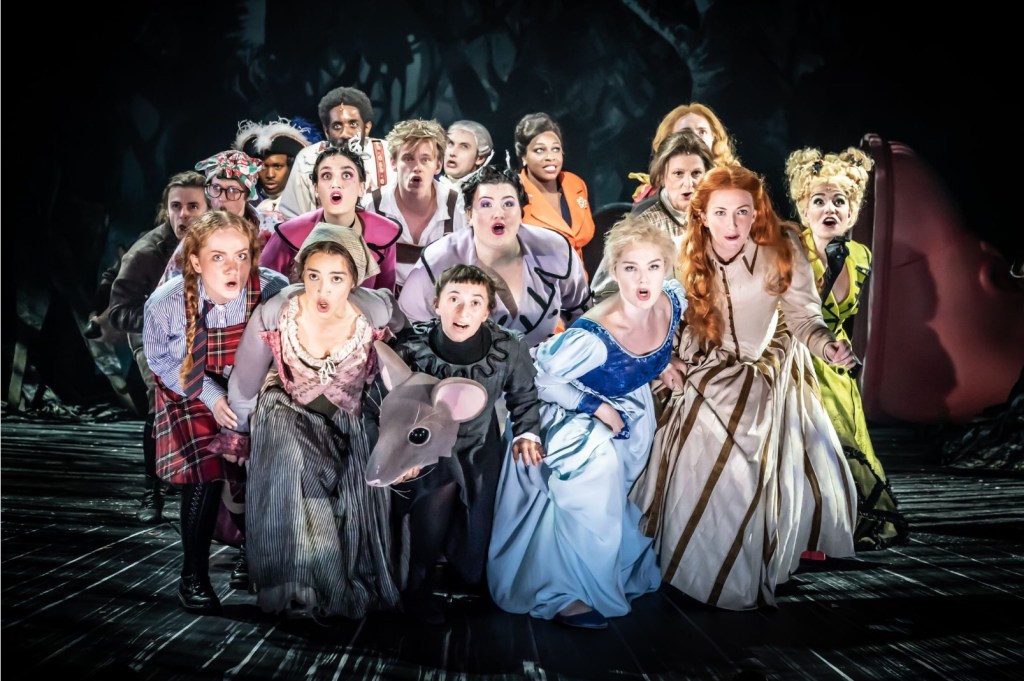
The framing device of having a child playing with her Pollock’s Toy Theatre is an inspired one: Jon Bausor’s eye-popping set turns the entire proscenium arch and stage into the toy theatre. The black and white nursery aesthetic punctuated with riots of stunning colour topped off with a giant cuckoo clock marking each midnight, looks at times like an homage to Richard Jones’s original 1990 London production. Other USPs include the reinstatement of ‘Our Little World’, the cosy/creepy duet for the Witch and Rapunzel (soaring voiced Maria Conneely) added to the score for the first London staging, but seldom heard since (neither the current Broadway revival nor the Northern Ireland Opera production earlier this year in Belfast included it), and a shockingly funny collapsing house moment that recalls Buster Keaton silent movies at their most precise and dangerous.
There are issues however: some of the delicious comedy that is right there in the script goes for surprisingly little; Julian Bleach, giving basically the same performance as he delivered in The Grinning Man and Shockheaded Peter, seems so much a part of the fairy tale milieu that his protestations that he is commenting on the story not part of it, make little sense; by contrast, when the gloriously disagreeable Witch of Nicola Hughes (who’s first entrance is a total coup de theatre, and who sings like a dream) transforms, it’s into a modern power suit with handbag, thereby making her look like she’s in a completely different world from the other characters, with their elaborate wigs and gorgeously fanciful costumes. It’s confusing and does little to help this fine singing actress, or us, to find the beautiful version of the Witch, and she could also afford to punch up the bleak humour and the sadness once transformed.
No reservations at all about the terrific pairing of Rhashan Stone and Alex Young as the Baker and his wife, he a lovely everyman with a sweet innocence that makes him ill-prepared for what the stories throw at him, she a clear-eyed pragmatist with zero sentimentality and oodles of warmth. Young’s phrasing and ability to find new colours in the lyrics and character demonstrate why she is fast becoming one of the foremost British Sondheim interpreters of her generation.
Another Sondheim expert is Gillian Bevan, here tremendously affecting as a more melancholy than usual Jack’s mother, and Audrey Brisson is a lovable, athletic Cinderella even if her voice isn’t quite the lush soprano ideal for this role. Equally athletic and lovable is Barney Wilkinson’s Jack, who delivers his signature ‘Giants In The Sky’ number perched atop a gigantic clock face suspended in mid air. It’s one of a series of stunning stage pictures, all watched over by a Greek chorus of woodland creatures that look like something out of Beatrix Potter.
Nathanael Campbell and Henry Jenkinson are great fun as a pair of campy, self-absorbed Princes, forever pursuing maidens that are just out of reach. Lauren Conroy’s grave Glaswegian Little Red Riding Hood looks fragile but has a cool detachment that shades into considerable ferocity. I also loved Alexandra Waite Roberts’s venomous Stepmother. In both the New York and UK productions, Jack’s cow Milky White (here, Faith Prendergast) comes perilously close to stealing the show.
You know you’re watching a Sondheim musical when the curtain rises on act two to reveal a bunch of disgruntled characters singing about how they never thought they could be this happy, and all through gritted teeth. Melodically lovely though much of the music is, it’s the brilliance of Sondheim’s lyrics that really distinguishes this score. The rather hackneyed notion that Sondheim’s work, however ingenious, is somehow chilly and lacking emotion is blown out of the water by the heartcatching simplicity of the bereaved Baker’s duet with his estranged father, ‘No More’, which is surely as moving an expression of loss, despair and ultimately acceptance as was ever written.
If the ending, including the standard ‘No One Is Alone’, veers towards sentimentality (certainly not an accusation one could make of Sondheim’s earlier works) that cosy acceptance is still hard won. Even if you’re familiar with James Lapine’s superb book, the aforementioned act two death of a lovable character and the shock waves and melancholy shadows that generates remains shocking in both current production. At the Broadway performance I attended, this moment provoked audible howls of outrage and horror, in Bath there was an appalled silence.
In the words of Cinderella, “opportunity is not a lengthy visitor” and this run ends on 10th September but given the talent, imagination and budget lavished on it, it’s unlikely that this is the end of the road for this captivating crowd pleaser: surely a transfer announcement is imminent. All it needs is a few tweaks, a bit more polish and humour, and a West End theatre.
If you’re in New York City and have any real interest in musical theatre as an art form, you cannot miss A Strange Loop. Winner of the 2022 Tony Award for Best Musical (beating monster hits Six and the Michael Jackson bio-musical MJ), also the Pulitzer Prize for Drama (one of a very select band of musicals to achieve this), Michael R Jackson’s “big, Black and queer ass American Broadway show”- to quote the rollicking opening number – is as boldly innovative as Showboat, Oklahoma! or West Side Story were in their day. It’s also as hip as Hamilton, as hilarious and provocative as The Book of Mormon, as soul-stirring as Rent, and as unapologetically it’s own beast as anything Stephen Sondheim created.
To quote a lyric from another of the haunting songs, A Strange Loop is “entertainment that’s undercover art”, and succeeds triumphantly as both; it interrogates racial and sexual identity, as well as what a musical even is, pushing boundaries and the envelope. There are moments that unquestionably make uncomfortable viewing, but there’s a fierceness and intellect at work here that make most other musicals seem tame in comparison. There is also a playfulness and lightness of touch that prove irresistible: something this innovative and soul-searing has no business being this much fun as well. But oh it is.
The lead character, named Usher as that’s what he does as a survival job at Disney’s The Lion King when not trying to create his own musical masterpiece, is based at least in part on creator Jackson which explains the tang of authenticity and raw emotionalism of much of the material. This is unmistakably lived life experience, as Usher struggles to reconcile his artistic integrity with the snarky demands of his agent, all the while negotiating the tricky NYC gay dating scene amid unwelcome interjections and judgement from his deeply religious mother and alcohol dependent father. It’s filtered through an unconventional structure (there is no linear storytelling but instead a succession of scenes, experiences, attitudes and even genres that collectively make up a picture of a fractured, troubled yet hopeful life) matched by a stunning score that shimmers and screams and soars.
Musically, Jackson’s achievement here somewhat recalls Jeanine Tesori’s outstanding work on Fun Home (another queer masterpiece that took home the Best Musical Tony) and Caroline (Or Change) in that snippets of gorgeous melody explode or drop in briefly without always expanding into a full number. Some of it has a melancholy beauty (the minor-keyed, threatening yet yearning pieces for Usher’s drunken, uncomprehending Dad) or poppy but ironic joy, that one imagines Sondheim would have relished. There are influences from jazz to gospel to traditional show-tunes, yet what Jackson has crafted remains elliptically unique, and very very impressive.
His text examines the conflation of gay sex and mortal sin within certain strongly Christian quarters of the Black community, and also the fetishisation and stereotyping of Black men in the gay world, some of it self-perpetuated. Being reminded that there are still some people, in this day and age, who think that AIDS is God’s punishment is never going to be easy, and A Strange Loop looks at them through a clear but ironic lens, in a robustly funny parody of a Gospel play (“because that’s what the people want”) that goes from playful to sinister in the blink of a beaded eye.
There’s sweetness here too though, notably in a scene where Usher, at work, encounters a rich older lady up from Florida (“I come here every year to see my shows…I like Wicked”), played by the luminous L Morgan Lee, a history maker this year as the first trans woman to be Tony-nominated, who warns him of the perils of not following one’s dreams and not putting oneself at the centre of one’s own life. It’s a heart-catching little scene and number that unsurprisingly brings the house down.
Usher is played with a winning combination of open-hearted charisma and cute camp by newcomer Jaquel Spivey, adorable but with a satisfyingly hard edge, a hero to root for, reckon with, and care about. It’s an epic role, vocally demanding and emotionally tough, and Spivey inhabits it completely: he’s extraordinary.
The other characters are Usher’s “thoughts” (“Surprise! this is your daily loathing”, “your numbers are in the toilet with the Black Excellence crowd and you’re getting real close to cancellation”) who also embody every other figure (Usher’s parents, his agent, a brutal married hook-up, an idealised boyfriend in a scenario that turns horribly sour…) in a story where, in terms of action, nothing happens…yet everything happens. These Thoughts are played by a sextet of beautiful, shape-shifting Black performers so in tune with Jackson and director Stephen Brackett’s vision that it’s hard to imagine anybody else playing these roles: each one of them is a wonder, equally adept at OTT comedy and nailing moments of searing truth. They are each gloriously specific and individual, but, when required, form an immaculately drilled team.
Magnetic Jason Veasey draws a startling contrast between our hero’s Dad and a random person met on public transport that appears – on paper – to be the man of Usher’s dreams. The aforementioned Lee radiates authentic star quality, as does Antwayn Hopper, breathtakingly sexy and with a voice like molasses infused with honey, who finds unexpected vulnerabilities in a unflinchingly explicit sequence that explodes numerous taboos around sexuality and race.
James Jackson Jr. and John-Michael Lyles are vivid, exciting stage presences who both get moments of utter brilliance in the course of the show. John-Andrew Morrison does something really remarkable as Usher’s God-fearing mother, in that he presents her initially as something of a comedy grotesque, all homely blessings and hand-clasping piety, then slowly but surely reveals her anguish and humanity, despite some of the unacceptable things coming out of her mouth. It’s an ingenuously even-handed portrayal.
Brackett’s staging is oil-smooth but infused with just enough jagged edges to trouble and ignite. Raja Feather Kelly’s terrific choreography and Arnulfo Maldonado’s ingenious set (which includes a jaw-dropping transformation) are exquisitely, colourfully lit by Jen Schriever. If there are times when the lyrics could be clearer, the exhilarating vocal harmonies emerge strong and enthralling in Drew Levy’s sound design.
“If you can’t please the Caucasians then you’ll never get the dough” goes one of Jackson’s particularly coruscating lyrics and one can only hope that this show finds the audience to consolidate it into the Broadway smash it deserves to be. It’s a true original and a cause for celebration. In the present theatrical climate, where jukebox musicals, movie spin-offs, star-driven revivals and shows just out to give audiences a mindless good time, are raking in the audience big bucks, A Strange Loop is unlikely to achieve the run of something like, say, Six or MJ or Hamilton, even though it fully deserves to. It’s a thing of outrageous, unconventional beauty. I can’t wait to see it again.

 ajhlovestheatre