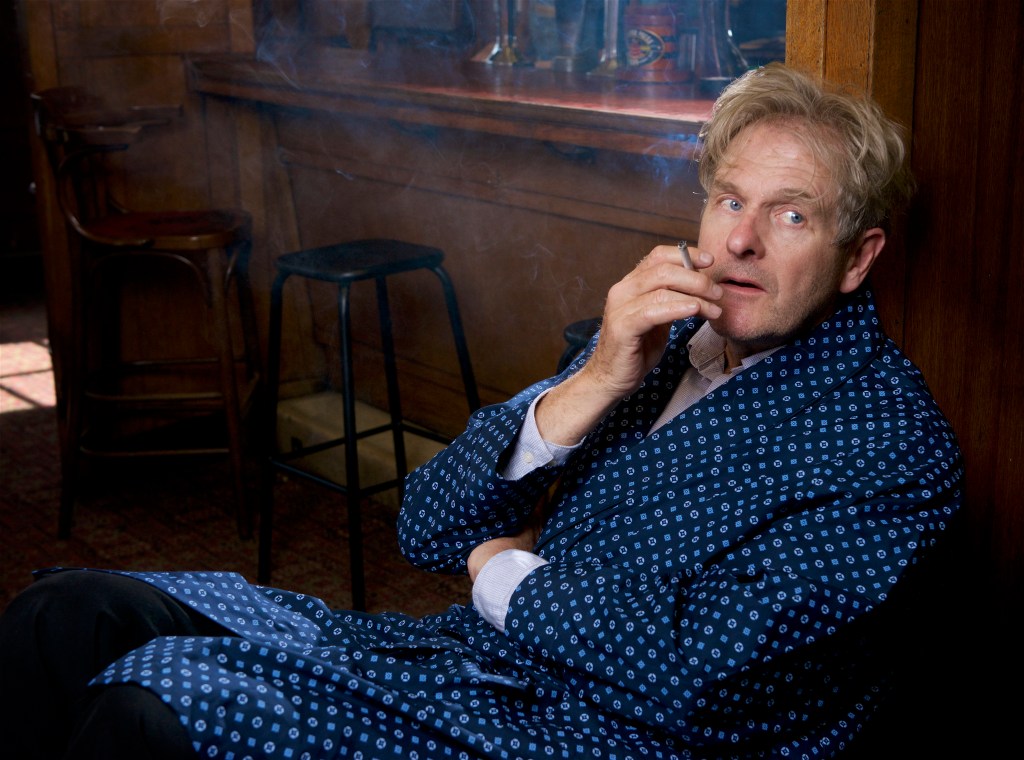
Immersive theatre gets a boozy kick in this adaptation of the 1989 Keith Waterhouse smash hit, celebrating Soho’s favourite dissolute son Jeffrey Bernard, based on his weekly columns chronicling the drinking, gambling, and other nefarious activities of central London’s most notorious quarter. First seen in 2019, James Hillier’s version shaves the original play down to a one hour monologue with bits of audience participation and, in a stroke of genius, is performed in the very pub, the Coach and Horses in Greek Street, where the real Bernard (1932-1997) hung out. That authenticity is key to its success, with the audience standing or sitting all around the unflatteringly lit, slightly rundown saloon bar as Robert Bathurst’s Jeffrey regales us with alcohol-infused philosophies and tales of his sundry misdemeanours.
Even more than Peter O’Toole who famously originated the stage role, Bathurst genuinely resembles Bernard, with his craggy, handsome face, floppy blonde-grey halr and lumbering but never graceless gait. He has perfected the slightly dead-eyed stare of the perennially drunk, and the rapid energy changes from languid to almost manic that can occur in the blink of a bloodshot eye. This Jeffrey Bernard seems to be at the point where joie de vivre has curdled into hopelessness, and, while he’s exasperating, he is, crucially, never malicious. If there are times when his speaking of the lines sounds a little like somebody rattling off a list, a quick Google search will reveal that this is pretty much how the real Jeffrey spoke, as though words are something to get through before the next slug of vodka.
Bathurst superbly captures the (often self-deprecating) wit, although the foggy, imprecise delivery sometimes obscures some of the laughs. Either that, or the concept of somebody drinking themselves to death (John Osborne famously referred to Bernard’s Spectator column as “a suicide note in weekly instalments”) just isn’t that amusing in 2023.
Just as the Coach And Horses pub itself seems stuck in the past, so the play feels like a throwback to a different era. The women in Bernard’s life are reduced here to a series of increasingly infuriated answerphone messages, and his casual indifference to them seems cruel until you realise that he’s indifferent about, well, almost everything. Removing all the other live actors and turning the play into what is essentially now a monologue makes it feel more than ever like a study in loneliness, however un-self pitying the central character. Still, this is a soured, ash-stained love letter to a Soho that’s now mostly lost to coffee shop chains, unaffordable apartments and other signs of urban gentrification.
Hillier’s staging consists mainly of having Bathurst circling the bar so that everybody can see him, and might benefit from more periods of stillness, although that could be difficult in such an idiosyncratic space. It undoubtedly nails the sense of seedy grandeur that attended Bernard and his ilk however, and has the unmistakable feeling of being a unique event. I saw the original production and, despite the magnificence of O’Toole, found it a bit overlong and self-indulgent; I actually preferred this one. It’s a celebration of, and lament for, a Soho that will never return, and one of its most unashamedly notorious denizens.
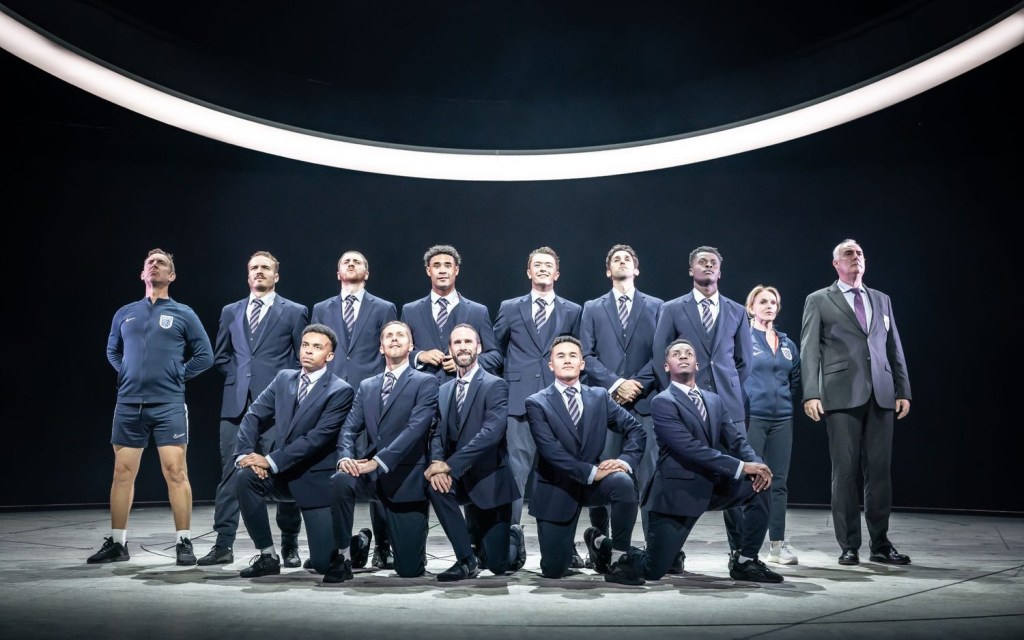
Great theatre and great sport: two things that bring people together. We get both in James Graham’s new masterpiece, which, in Rupert Goold’s staging, is equal parts state-of-the-nation docudrama, national celebration/examination and magnificent populist entertainment. A total sell out after a slew of rave reviews at the National earlier this year, Goold’s stunning production swaggers into the Prince Edward (where, fun fact, it’s the first non-musical to play since the 1977 Christmas season of Peter Pan with Susannah York and Ron Moody, when the theatre was called the London Casino) with justifiable bravado.
Like this author’s other masterpiece to date, the politically charged 2012 This House (and also his more recent Labour Of Love, Ink and Quiz), Dear England is ostensibly about one specific thing (in this case the pressure upon England football manager Gareth Southgate to revivify an ailing team since his accession to the job in 2016) but actually addresses much more urgent, universal topics. It covers national identity, toxic masculinity and its opposite, the fragility and resilience of the human spirit, British exceptionalism, and the place of England in Europe as a whole. To be fair, Wales, Scotland and Northern Ireland don’t get a look-in, but, come on, it’s football Graham is writing about, not rugby. It’s also about the importance of love (“and yes I did just use that word” to quote Denzel Baidoo’s Bukayo Saka at the play’s tearstained conclusion) and emotional support in a frequently tough environment.
It’s interesting that the character instrumental in effecting a transformation in moribund English team spirit (a luminous Dervla Kerwan as psychologist Pippa Grange) has had her Aussie-ness slightly amplified by Graham; the real Grange only moved to Adelaide in 1996. It smacks a bit of contrivance but it brings a satisfying global complexity to the storytelling. Lord knows, Australia has its issues right now (where doesn’t?!) but the schematic neatness of the New World chivvying up the Old is irresistible from a dramatic point-of-view.
Goold’s production has a carnival-esque vigour, breadth and joy. It feels almost more choreographed than directed (I wasn’t this excited about football onstage since contemporary dance’s Meryl Tankard’s soccer ballets for the almost forgotten Andrew Lloyd Webber flop The Beautiful Game), with Ellen Kane and Hannes Langolf’s dynamic work creating unforgettable stage pictures. But then you stop and consider the attention to detail in the characterisations and in Graham’s gritty, lovely, life-affirming dialogue….
Graham’s writing here is mind-blowing; expansive in its command of themes, meticulously researched, warm and compassionate in its depiction of the real life people being portrayed onstage, and frequently killingly funny. Some of the humour is pretty low hanging fruit – there’s a ghastly dancing Theresa May, an impromptu fashion show for England managers, a suitably repellent Boris Johnson – but it becomes irresistible when all swirled up and served with this level of brio and dazzle.
What’s so beautiful is that, even though he is a formidable intellectual and artist, Graham refuses to patronise or look down his nose at regular people who don’t happen to have a brain as big as a planet. Unlike some of the so-called ‘urban elite’, Graham’s innate love for his fellow human and massive generosity of spirit shines through. It’s in so many scenes here, such as striker Harry Kane’s distress when he feels he’s let his team mates down. Kane – played, winningly (!) at the performance I caught by brilliant understudy Ryan Whittle – is famously not a great talker but the writer gives him a gruff honour and sensitivity that quietly engrosses. Similarly, there’s a grave, everyday poetry to the speech Kel Matsena’s Raheem Sterling gets, expressing his doubts about being a Black man expected to pledge allegiance to the same St George’s Cross that is the mascot of many who would happily see him banished back to the land of his ancestors. If you come see it, which you undoubtedly should, expect to be wiping away frequent tears.
You can also expect to be utterly exhilarated and transported, in a way more usually associated with epic ‘feel good’ musicals, such is the sheer breathtaking stagecraft on display. The flashy showmanship recalls the visual aesthetic of some of Goold’s most acclaimed productions (Enron, American Psycho, and especially last year’s The 47th for The Old Vic) but has a cool spareness that allows focus to rest effortlessly on individual figures and moments, before exploding again into yet another orgy of theatrical bravura. The pace is exquisitely managed, and there’s a palpable sense of excitement coursing through the house during the tournament sections that even gives a total footie ignoramus like myself heart palpitations. Cumulatively, Goold and Graham’s work cuts to the heart of the English obsession with football being part of the fabric of the nation, and draws a direct line between each player on the pitch and every one of their predecessors. It’s a mind-blowing achievement.
An almost unrecognisable Joseph Fiennes as Gareth Southgate far transcends mere impersonation in a quietly magnetic portrait of human decency and kindness that never cloys: it’s a remarkable achievement. He leads a huge cast without a single weak link. This is very much a company show and I can’t resist singling out the delightful work of Lloyd Hutchinson, John Hodgkinson and Paul Thornley as senior team staff and Darragh Hands’s finely observed Marcus Rashford, but really everybody is wonderful.
The technical elements represent the National at the top of their game (sorry, had to): Es Devlin’s set sandwiched between two vast discs, dressed only with lockers that double as portals or hiding places, has a clean almost futuristic feel, etched in neon bright light and slick video. The revolve is brilliantly used, and Evie Gurney’s costumes look like real life only more so. Great tsunamis of sound (Dan Balfour and Tom Gibbons) and light (Jon Clark) rise up and crash pleasurably over the audience, so that it’s impossible not to react to it on a physical and emotional level. Ash J Woodward’s elegant monochrome video designs against the expanse of the cyclorama contrast repeatedly with the vividly colourful humanity disporting before it. This is Total Theatre… it’s almost overwhelming but it never quite is.
If somebody had told me that two of the plays I would love most in 2023 were going to be centred on football (the other was the Bush Theatre’s Red Pitch by Tyrell Williams) I would never have believed it, but here we are. Do not miss Dear England though, it’s great art and great entertainment. A thundering triumph.
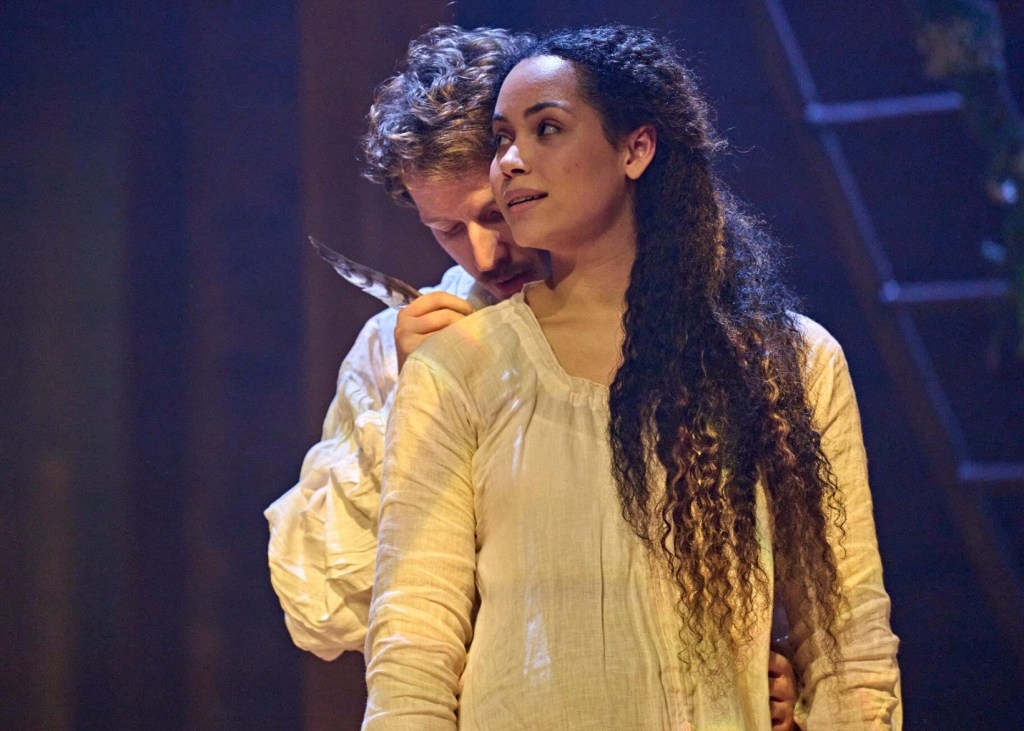
Madeleine Mantock and Tom Varey, photograph by Manuel Harlan
HAMNET
by Maggie O’Farrell
Adapted by Lolita Chakrabarti
Directed by Erica Whyman for Royal Shakespeare Company
Garrick Theatre, London – booking until 17 February 2024
First seen as the reopening production of the newly refurbished Swan Theatre in Stratford-Upon-Avon, Hamnet arrives in London feeling simultaneously like an old and a new play. In truth, nobody does these drama-cum-pageant historical pieces better than the RSC, and Hamnet is vintage work, with its economical but stylish production values, intelligent theatricality, and fine performances from a diverse cast. It’s not going to set the world alight maybe, but it’ll nicely warm up the winter nights for many.
Lolita Chakrabarti’s play is based on the 2020 novel by Maggie O’Farrell which imagined what happened when Hamnet, William Shakespeare and Agnes’s (after reading the will of Hathaway’s father where he refers to her as Agnes, O’Farrell is convinced that she has been misnamed for over 500 years) eleven year old son died, and the effect this would have had on his grieving parents and family.
First seen flying her pet kestrel, watched by a smitten Shakespeare (Tom Varey, excellent), Agnes is a feisty, unconventional, fascinating young woman, unfashionably (for the time) free-thinking, and in connection with otherworldly forces, a seer, a herbalist, a hearer of voices. Madeleine Mantock, in a ferociously good performance, invests her with enormous warmth, emotional directness and a compelling fearlessness. William falls for her unconventionality, and so we. Her grief after the death of her beloved son is authentically difficult to watch, and her regret and bitterness when it looks as though her marriage will be the next casualty after her child, is beautifully, painfully expressed.
One of the virtues of Chakrabarti’s script is that it seldom feels like an adaptation. So many stage versions of novels suffer from a somewhat frantic necessity to cram in beloved sections of the book so that the cumulative effect is less theatrical and more like box-ticking, but not so here. It is, by necessity, episodic as the location switches between Stratford and London, and it’s hardly dynamic. However, it has clarity, a measured theatricality, and the story and characters get full rein to breathe. It also feels relatable in this post-Covid era, as the Shakespeare household is forced to quarantine when the twins Jude and Hamnet succumb to the fever that will eventually carry the latter off.
The detail in Erica Whyman’s production is impressive: minor characters seem vivid and fully drawn, the subtle adjustments in sound and lighting evoke interior or exterior, a simple repositioning of the blocks on Tom Piper’s glorious timbered set transform the space into “this wooden o” of Shakespeare’s Globe where the final scenes take place. Prema Mehta’s lighting design is particularly effective: autumnal, evocative. Simon Baker’s sound is complex and transporting, although I could barely make out what the “voices” that haunt Agnes were saying.
In a large cast, there’s superb work from Peter Wight, doubling as Shakespeare’s abusive father and a fruity Globe actor, and Sarah Belcher and Liza Sadovy as a pair of contrasting female family members with suitably strong opinions on the relationship between William and Agnes. Ajani Cabey and Alex Jarrett are very affecting as the Shakespeare twins, as is Phoebe Campbell as their older sister. Gabriel Akuwudike is magnificently understated as Agnes’s world weary, likeable brother. The use of Midlands accents is a nice, unforced touch.
It isn’t perfect: some of the blocking feels as though it hasn’t quite been adjusted from the (quite differently shaped) Swan, which makes a few moments frustratingly unfocused. There’s not much humour, and the pace is sometimes lacking in energy. It’s a shame also that Chakrabarti’s depiction of the relationship between William and Agnes is presented in a more linear, less quirky manner than in the book, and the connection between Hamnet the boy and Hamlet the play that Shakespeare may or may not have written as a posthumous tribute to him isn’t really explored.
These cavils aside, this is a predominantly spellbinding piece of theatre, classy, intelligent and satisfying. Warmly recommended, whether or not you’ve read the book, and a solid West End hit for the RSC. I also think culturally minded foreign tourists will love it.
For the second time this month the West End has seen the opening of a musical production that will be talked about for decades. But where Cameron Mackintosh’s ravishing tribute revue Stephen Sondheim’s Old Friends feels like a warm hug from a best mate, Jamie Lloyd’s technically breathtaking reinvention of Sunset Boulevard, starring an incandescent Nicole Scherzinger, is the theatrical equivalent of having a bucket of icy water thrown over you.
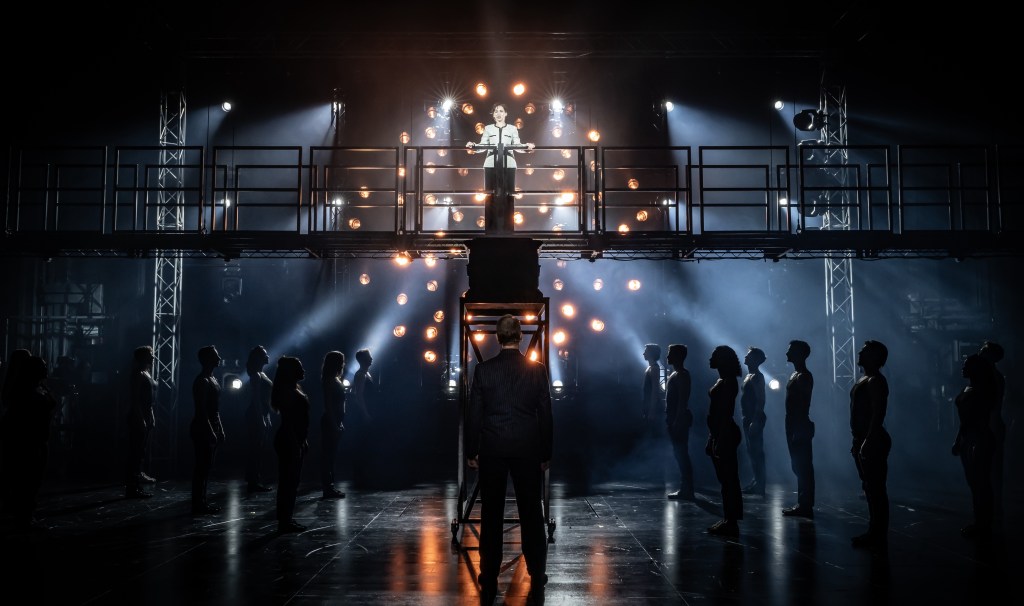
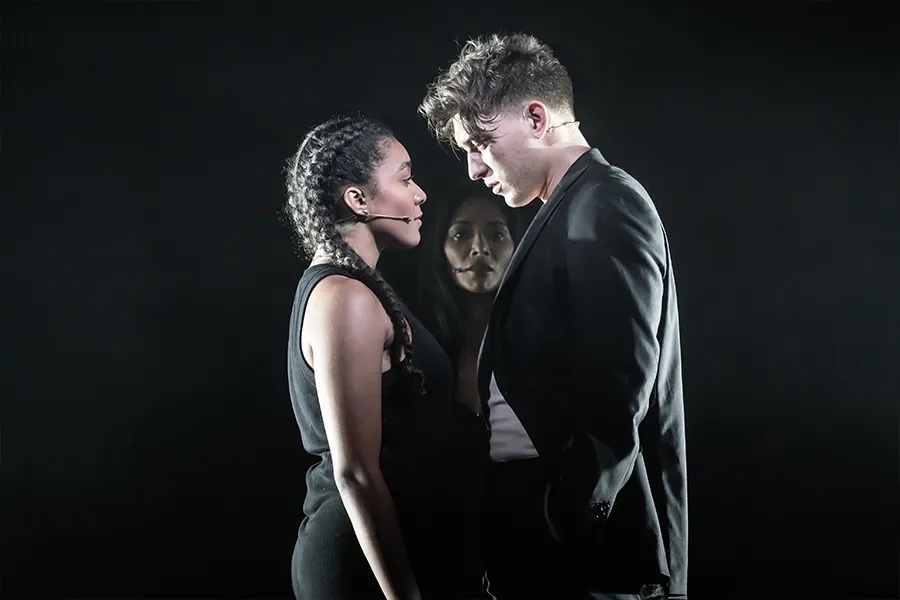
This might be retitled Deconstructed Boulevard as it simultaneously refocuses and comments upon both the 1993 Andrew Lloyd Webber musical and the Billy Wilder film classic, with live filming (brilliant, game changing work by Nathan Amzi and Joe Ransom) an essential part of the experience, and an elegant, brutally spare visual aesthetic in an almost exclusively black and grey colour pallet. The most obvious comparison is to the multimedia work of European auteur Ivo van Hove: the meta staging of the title number is particularly reminiscent of an outdoor filmed section of his National and Broadway smash Network from a few years back, but Lloyd and team go bigger and even more remarkable here.
The overall effect is of watching a beautiful nightmare unfold. The figures move in dreamlike slow motion through blasts of dry ice then suddenly, stunningly break into Fabian Aloise’s dynamic, jagged choreography. It’d be anachronistic if they’d been dressed in the 1950s fashions of the original but here it looks appropriate given that everybody is attired as though they’d ramraided an All Saints store. Meanwhile, a giant, stage-filling screen pivots, tilts, raises….and turns out to be the only set (design by Soutra Gilmour) that we get. Somnambulistic characters only occasionally address each other directly, mostly delivering their lines out front.
This is especially true of Scherzinger’s Norma Desmond – less a faded film star and more a free-floating, sensuous wraith, equal parts attitude and neediness – who often seems the only person onstage aware of the encircling cameras, and plays up to them or to “my people in the dark” (specifically, us in the audience) as though the adoration of fame and fandom is the oxygen upon which her life depends, which it just might. This version feels less about a reclusive actress deludedly trying to reclaim her stardom and more the pressure on women in the public eye to stay relevant and desirable in a world where, increasingly, youth and surface are all. Tellingly, a lot of the references to old time film stars in Christopher Hampton and Don Black’s script and lyrics have been excised.
Instead of inheriting the gowns and jewels of previous Normas, Scherzinger’s is bare footed, raven locks tumbling free, her bone slender dancers body clad only in a sheer black shift. She’s still gorgeous, astoundingly so, even when juxtaposed in unforgiving close-up with Hannah Yun Chamberlain’s ghostly, athletic youthful iteration of the character. Vocally, she’s exhilarating, going seamlessly from gently breathy to full out diva belting, and observe the way she physicalises the big numbers ‘With One Look’ and ‘As If We Never Said Goodbye’, pleading yet imperious, it’s impossible to take your eyes off her.
She’s also irrepressibly camp, but not in the Grande Dame manner of LuPone, Close, Buckley, or Elaine Paige (the only Norma from the original production to bear a resemblance to Gloria Swanson in the movie): this Norma is all finger-snapping, eyebrow-arching, pouting-to-camera “yassss kweeen” camp, and it works brilliantly. Some of her asides and moues to camera are as hilarious as they’re provocative, and she has an irresistible eccentricity tempered with a fragility that tears at the heart. She’s weird and self obsessed, but it’s impossible not to like her. The descent into madness (which includes an unsettling, rollickingly unhinged dance section courtesy of Mr Aloise, featuring multiple Norma’s) is more painful to watch than that of any other actress I’ve seen in the role, and Scherzinger finds an animalistic, elemental rawness that stuns. Her Norma exists at the axis between iconic and vulnerable, and she’s unforgettable. This is a career redefining performance from an artist at the very height of her powers.
Opposite her as struggling writer Joe Gillis, Tom Francis catapults himself into the top bracket of young West End leading men. He’s sexy yet tormented, and detached, with a wariness behind the eyes that suggests a deep-rooted hurt, despite his comparative youthfulness. It’s a tremendously nuanced take, abetted by the (literally) in-yer-face camera work, and his singing has an agreeably gritty edge. He’s magnificent.
David Thaxton’s devoted Max is another performance that completely remints a familiar role, and benefits from the detail afforded by playing straight to camera. He’s a saturnine, powerful presence with a palpable sense of longing and pain, that can suddenly, disturbingly flip into snarling aggression when he perceives a slight upon his beloved star. Thaxton’s voice has never sounded finer, and he pulls out money notes that make you hold onto the arms of your seat and gasp. Grace Hodgett Young as Betty is appealingly direct, with an intriguing steely edge, a palpably ambitious young woman rather than an idealistic neophyte: she’s a wonderful find, and a perfect foil to the streetwise lost boy of Francis’s multi-layered Joe.
The ensemble is outstanding, a glorious cacophony of fine individual voices that collectively thrill the blood when they coalesce. Aloise has them hurling themselves about, tumbling, rolling, posing, like an organic whole from which soloists periodically extract themselves to powerful effect: it’s visceral, striking work, sublimely theatrical in amongst all the cinematic high tech.
There are moments when the cool, stark style of Lloyd’s overall concept works against the lushness of Lloyd Webber’s music (which has never sounded better, by the way, not even in the bigger orchestrated Coliseum version of 2016) but that also creates a tension that gets closer to the dark acidic heart of Wilder’s legendary movie than Trevor Nunn’s lavishly literal original production ever did. This Sunset is expressionistic and demands that we use our imaginations, and Lloyd has a stronger handle on this material than he did on Evita in his bold but occasionally bewildering 2019 Regents Park staging. It’s playful too, sometimes perversely so, as when we are shown a Jamie Lloyd Company mug, Pussycat Dolls photos and a cut out of ALW in the live streamed backstage sections. I’m not sure that really adds anything to our perception of the show, but it’s a lot of fun.
Musically, it remains a sometimes overblown fusion of surging, soaring melodies and operatic dissonances, pitched somewhere between pop opera and Hollywood film score. It still doesn’t quite hang together but, packaged up in Lloyd Webber and David Cullen’s fine orchestrations, with a crystal clear sound design by Adam Fisher that gives the bombast full measure but never sacrifices intelligibility to volume, it registers mightily here. Hampton and Black’s partially revised, generally impressive lyrics are very well served, and Jack Knowles’s sophisticated, thriller noir-ish lighting is undeniably classy.
Inevitably there will be fans who mourn the loss of the grand staircase, the frocks (the turban!) and the dead monkey, but what’s in their place is so exciting and inventive, it’s pretty much impossible to resist rising to your feet and bellowing superlatives. This astonishing onyx-black production and its mesmerising leading lady really have, to quote one of the songs, “found new ways to dream”. Shatteringly good.
Jenna Russell is a bona fide theatrical treasure. She’s incapable of giving a bad performance; furthermore, she never strikes a false note musically or dramatically, a brilliant technician with heart, nuance, warmth and truth, whether it’s Sondheim, Ayckbourn, Hare, Jason Robert Brown or more avant garde fare. She’s once again delivering perfection, this time as Mrs Ada Harris, a post-war widow who works as a cleaning lady in big London houses and whose eyes are opened to the potential richness of life when she discovers a stunning Dior gown in a wealthy employer’s closet. Russell conveys Ada’s essential straightforwardness and kindness without ever patronising or commenting on her, finding in this lovely woman a sharp humour and wistful longing that never cloys, augmented by sensitively powerful vocals.
She’s exquisite. So is the show’s central message about the importance of art and beauty, and it’s gentle but firm insistence on not writing people off just because they’re packaged a little differently from what you’re used to. There’s a kindness and humanity at the core of Paul Gallico’s original novel, it’s subsequent screen adaptations and now this likeable musical (first seen in Sheffield in 2016 then in Chichester, but only just receiving its London debut) that is deeply unfashionable but undeniably tugs at the heartstrings. Bronagh Lagan’s production is very nice to look at and listen to, and, like the material itself, feels like a throwback to a simpler time. What it lacks in dynamism, it makes up for in charm, although theatregoers who look for a little more oomph and drama in their musicals may find themselves perplexed, despite the consummate craft on display.
Certainly, there’s no faulting the cast. As well as the glorious Jenna, there’s Annie Wensak delivering feisty, funny work as Ada’s best friend and Hal Fowler is a winning mixture of humorous common sense and warm steadfastness, with a voice like sweet molasses, as the late Mr Harris. Kelly Price is utter comic perfection as the self-obsessed aristocrat whose posh frock starts Ada on her journey, then finds remarkable colours and layers in the elegant Parisian guardian of Dior who unexpectedly thaws out when faced with our heroine’s innate goodness. Nathanael Campbell makes much of lovelorn accountant André, and quicksilver-voiced Charlotte Kennedy is affecting and brings more complexity than is present in the script, to the flaky but entrancing model he adores. If Kennedy is less convincing as the West End soubrette who employs Ada in London and proves a liability in more ways than one, that’s down to the intractability of the writing.
Rachel Wagstaff’s book does an excellent job of establishing Ada’s relationships with her deceased husband and her very much alive best friend, but skirts with too much haste over significant plot developments and changes in characters attitudes. I found myself less moved than I’d hoped and more bewildered by the whiplash changes in direction. Taylor’s attractive but samey score, constantly easy on the ear but never throwing up anything exciting or truly memorable and saddled with a couple of howl-worthy rhymes in the lyrics, doesn’t help. I like that it breaks the trad musical theatre rules (there are few standalone songs…no number to open the show, just a note of music and we’re straight into the first scene…no big finale) but was frustrated by the lack of anything innovative to replace them.
Mrs ‘Arris Goes To Paris, the 1958 novel that is the source material, is written by an American and there is a sense of working class Brits being romanticised through rosey transatlantic specs that pervades into this stage version. It feels like a fairy tale for middle aged people, and Nik Corrall’s gorgeous multi-doored set and Sara Perks’s costumes further add to that impression. The whole thing is ravishingly lit by Adam King. I can’t help feeling the show would play better in a chocolate box-y intimate theatre than in the rather charmless wide open space of the Riverside Studio’s larger auditorium.
Ultimately, this is a pleasant bit of escapism, elevated to something distinguished by the sheer brilliance of the central performance and by a fine supporting cast. Definitely worth a trip out to Hammersmith.
There’s so much to adore about this scintillating celebration of American musical theatre genius Stephen Sondheim that it’s hard to know where to begin. It’s clearly a labour of love for everyone involved creatively, and an embarrassment of riches for us in the audience. Devised by producer Cameron Mackintosh, whose association with the maestro began in the mid-1970s with the revue Side By Side By Sondheim, staged by Matthew Bourne in tandem with Julia McKenzie (inarguably the greatest interpreter of the great Steve’s work that this country has ever produced) and choreographed by showman extraordinaire Stephen Mear, there’s no attempt to provide biographical context, preferring instead to dazzle us with the work. This is effectively Sondheim’s Greatest Hits, performed by a team of seasoned talents, whose collective Broadway and West End credits could choke a cart horse, and a couple of rising stars, and that is more than enough. Actually, it’s even better than that: this is one of the most pleasurable theatrical evenings within living memory, a soaring but elegant appreciation of a once-in-a-generation talent presented with intelligence and showbiz flair, it delivers laughter, more than a few tears, and the uplift one associates with truly great musical theatre.
First presented as a one-off concert in the wake of Sondheim’s death last year, Old Friends (it’s title is derived from the 1981 flop Merrily We Roll Along, currently previewing again on Broadway in a sold out revival starring Daniel Radcliffe and Jonathan Groff) is handsomely mounted in its return season, and looks built to last, despite being only scheduled to play through to early January. The cast is again led by Sondheim muse, Broadway veteran Bernadette Peters, making her West End debut here, joined by Mackintosh favourite and international star Lea Salonga, and a parade of the London stage’s finest, many of whom feature a lot of Sondheim on their c.v’s.
Janie Dee brings the house down with a breathy, hilarious version of ‘The Boy From…..’ as does Joanna Riding delivering a flawless, manic account of the panic-stricken bride in Company’s ‘Not Getting Married’, a crowdpleaser that quintessentially captures Sondheim’s mixture of ruefulness and Manhattanite neurosis (“I telephoned my analyst about it, and he said to see him Monday / But by Monday I’ll be floating in the Hudson with the other garbage”). Damian Humbley is as vocally gorgeous as he is dramatically accomplished, and Jason Pennycooke has a lot of fun with ‘Buddy’s Blues’ from Follies. If Bonnie Langford seems a little uncomplicated to really nail the devastating ‘I’m Still Here’ from that same show, she remains an effervescent, loveable stage presence.
Clare Burt’s ‘The Ladies Who Lunch’ is a masterclass in acting through song, simultaneously exhilarating and discomfiting, and Gavin Lee’s waspish take on ‘Could I Leave You?’ is similarly multilayered. Amongst the younger performers, Bradley Jaden is terrific as an unusually sexy Wolf doing Into The Woods’s creepy-cute ‘Hello Little Girl’ opposite Peters’s hilariously off-kilter Little Red Riding Hood, and Christine Allado and Beatrice Penny-Touré sound and look divine as Anita and Maria in a West Side Story section.
Ms Peters is luminous, with delicate comedy timing and an extraordinary emotional acuity that remain totally unique. Although her voice, always a compellingly eccentric instrument, isn’t always secure she’s such a formidable technician that she leans into what she is capable of, and makes standards like ‘Losing My Mind’ and A Little Night Music’s ‘Send In The Clowns’ feel breathtakingly new minted and urgent. Salonga is a revelation. I’d naively thought of her as a sweet voiced eternal ingenue, but what a pleasure it is to be proved so utterly wrong. Her take on ‘Everything’s Coming Up Roses’ is raw, dangerous and powerful, a glint of real mania behind the liquid black eyes, and her glorious Mrs Lovett opposite Jeremy Secomb’s fine, intense Sweeney is as funny as it is unsettling. She also triumphantly disproves my theory after seeing Annaleigh Ashford’s bewilderingly accented, overly-vaudevillian turn in the current Broadway production of Sweeney Todd that only British actresses should play this role.
Comparative newcomers to the blessed cult of Sondheim will appreciate the breadth and scope of the work on display here but older theatregoers may notice the magnificent ghosts that hang benignly over the whole enterprise. Not just of the man himself, but also the phantoms of earlier performances, of Peters’s own creations of the Witch in Into The Woods and Sunday in the Park With George’s Dot (both of which we get tantalising, heart catching glimpses of), of Julia McKenzie’s triumphs in everything from Company and Follies to Into The Woods and Sweeney. It’s hard not to be reminded of Sheila Gish’s Olivier-winning turn in Company when Burt cantankerously shakes her golden mane during ‘The Ladies Who Lunch’ (Burt played Susan in that 1996 Donmar production) or of David Kernan, who first reframed Phyllis’s venomous ‘Could I Leave You?’ from Follies as an acidic attack from an exasperated male lover, in Side By Side By Sondheim, and is matched in sibilant bite here by Gavin Lee. Many of the current performances are every bit as fine as their predecessors but they collectively form an inspirational, intriguing homage.
Cameron’s detractors could argue that this is Sondheim filtered through a Mackintosh prism (the impresario features in a surprisingly large amount of the projected imagery that dominates Matt Kinley’s gleaming set), but with production values this elevated and the sense of affection towards both the material and the artist himself so pronounced, only a churl would complain. The music is so good -literally a selection of the very finest showtunes of the last half-century, breathtaking in scope and ingenuity- and the lyrics, by turns piercingly witty, heartrendingly moving and fiendishly difficult (for the performers that is, not for us), so brilliant, it’s almost too much: an opulent champagne shower of excitement and ingenuity where the enjoyment never lets up, even as it’s tempered at times with the most exquisite pain.
Alfonso Casado Trigo’s orchestra sounds lush, full and way larger than it is. It’s also wonderfully versatile as it negotiates Jonathan Tunick’s unsurpassable orchestrations, whether it’s the whipped cream waltz lightness of Night Music or the terrifying bombast of Sweeney. All the creatives are at the top of their game, from Warren Letton’s golden lighting and Mick Potter’s crystal clear sound to Jill Parker’s stylish costumes. The way choreographer Stephen Mear builds numbers is exemplary, finding a dynamism in the material and the performers that simultaneously showcases and illuminates: really marvellous work.
The intelligence of the way that the show is put together means that the individual numbers, although out of context, preserve their power and impact, be it comic, tragic, or usually a combination of both. Interestingly there’s nothing from the fascinating Pacific Overtures, perhaps one of the trickiest from which to extrapolate individual songs, which is all the more reason to get to the Menier Chocolate Factory for the rare revival happening there this winter. In the meantime, this is a ravishing collage of Sondheim, and an enthralling smorgasbord of musical theatre magnificence that will be talked about for years to come. Please don’t miss it.
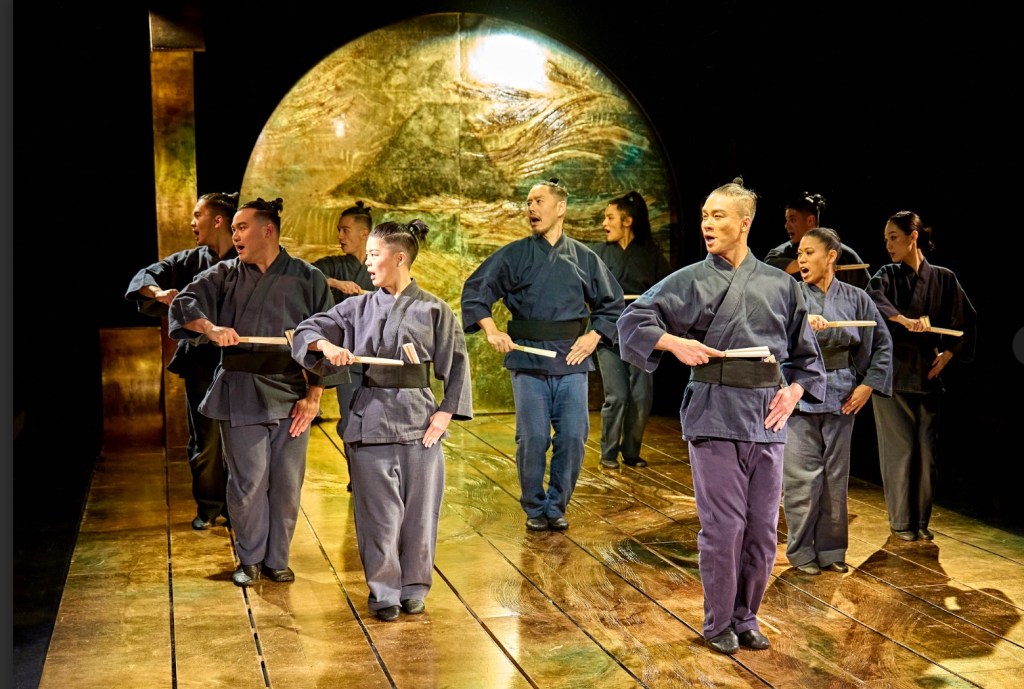
Any London theatre season that features two UK premieres by double Pulitzer winner Lynn Nottage, arguably the finest African American female playwright at work today, is cause for celebration. Nottage is a wonderful writer, an impassioned, socially aware, astonishingly versatile artist with fire in her belly and on her keyboard, a bold sense of the theatrical, and a command of language that can turn from elegant to raw as required. The Donmar will present her 2022 Tony nominated Clyde’s later in the autumn, but first up is Mlima’s Tale, first seen at New York’s Public Theater in 2018 and now here at the Kiln in a starkly effective staging by Miranda Cromwell.
In a number of ways, Mlima’s Tale forces us to evaluate what a “play” actually is. Part ritual, part docudrama, part lecture, it’s an angry, intermittently poetic examination of the black market trading in elephant ivory, that serves as a critique of human greed and selfishness and a wake-up call with regards to the dwindling elephant population. The text also revels in the spiritual afterlife of those magnificent pachyderms, and eschews linear storytelling in favour of a series of scenes, sketches almost, and dance-heavy moments that coalesce into a bigger picture longer on symbolism than on dramatic tension.
There’s little humour, but then again there’s nothing funny about humankind exploiting the natural world to the point of permanent damage, and most of the characters are little more than sketches rather than fully rounded creations. This may well be Nottage’s point -that humans are only a small part of the overall picture- but it doesn’t help that Cromwell’s production hasn’t, as yet, found the right tone for some of the sections. Despite the pithiness of the writing, it isn’t always clear just how grotesque or how sincere the trio of ensemble actors (Gabrielle Brooks, Pui Fan Lee and Brandon Grace) are supposed to be as they glide between gender and racial boundaries as a succession of people, some corrupt, some wracked with guilty, others simply indifferent, all embroiled in some way in the clandestine global ivory trade.
Natey Jones is very effective as the nearest thing the play has to a human protagonist and finds convincing layers to Geedi’s anguish and uncertainty. The production’s biggest asset is the astonishing central performance of Ira Mandela Siobhan as the titular Mlima, a fifty year old elephant prized, sought after and then murdered for his tusks, before becoming an omnipresent figure for the play’s duration (although he lingers in your mind long after that), watching, judging, bearing witness. As choreographed with sublime sensitivity and imagination by Shelley Maxwell, his supple, finely honed black body larded with more and more swathes of white emulsion like so much contamination as the performance progresses, this Mlima is a riveting, magnetic combination of grace and power. Transforming from a physically beautiful example of humanity to the dignity and gravitas of the elephant by bending his torso forward and crooking his arms just so, he is miraculous to behold, moving with a liquidity that simultaneously suggests the sheer size of the creature and an ethereal otherness. Vocally, he is commanding, whether howling in pain or bellowing in righteous indignation. This is a unique, unforgettable interpretation, and should to be a major boost to this fine actor’s rapidly ascending star.
Femi Temowo’s evocative musical score runs throughout, above and alongside Nottage’s words, and the physical production (Amelia Jane Hankin – design, Amy Mae – lighting, and Emma Laxton – sound) has a simplicity that amplifies the urgent messages of the text. This may not be a great piece of drama, but it’s heart is emphatically in the right place, and Cromwell’s production has numerous takeaway moments that stay with you long after the ninety minute duration.
Police Cops is the name of the company behind this zany belter of a musical as well as the title of the show, which was seen in a drastically different earlier version at the New Diorama in late 2021. Zachary Hunt, Tom Roe, and Nathan Parkinson have become award-winning darlings of the comedy and fringe theatre circuit with their signature brand of athletic improvisation, keen-eyed parody and breathtaking invention, and on the basis of this piece of inspired lunacy, it’s not hard to see why.
Police Cops The Musical arrives at Southwark by way of Edinburgh, with new music courtesy of Ben (A1, Eugenius!) Adams, and is a leaner, more coherent beast than that earlier iteration, and the new songs and choreography (Olivier winner Matt Cole, judging exactly the correct amount of tongue to be left in cheek) are genuine upgrades. Crucially though, the anarchic spirit, ruthless observation and sense of often eye-wateringly bad taste fun, remains utterly irresistible.
“Is it shit theatre-making or is it inspired? You decide!” bellows Heath Ledger lookalike Tom Roe, traversing the stage wearing a hollowed-out TV set on his head having just been playing a news reporter, and it’s probably as good a summation of this utterly bonkers, hilarious musical as anything one can write about it. It definitely errs on the side of inspiration though, as it affectionately sends up the American TV cop shows and bombastic pop-rock of the 1970s and 1980s (“I’m an AmeriCAN! Not an AmeriCAN’T!”).
Back in the unreconstructed later decades of the twentieth century, men were men, women lacked agency and nobody batted an eyelid at some fairly horrible attitudes to anyone who wasn’t white (but especially Hispanic people), and the macho posturing and strong jawlines of the fictional police heroes belied the fact that most of them were seedy as hell. Probably the only way to contemplate such reactionary fare these days is through a veil of satire, and the musical treatment (cue much beatific staring into the middle distance while belting out the money notes) further ups the hysteria ante.
Ben Adams’s tunes are catchy as hell, and are partnered with some brilliantly pithy lyrics. I reckon Sondheim would have approved of the act two opener, a cri de cœur soft rock ballad where a woman working in a Mexican orphanage (Melinda Orengo, brilliant) laments full throatedly that there must be something more fulfilling than helping underprivileged children. Much of the humour is similarly sick (in both senses of the word). It’s the sight gags (of which there are many, and some of them are astonishing in their lo-tech ingenuity), the multiple running jokes, and the bravura performances that linger longest in the memory.
Zachary Hunt is rookie cop Jimmy Johnson, destined for a life in the Force after making a death bed (well, death pavement actually) promise to his sister (Natassia Bustamante, stunningly versatile) after she was mown down in a drive-by shooting. Hunt brilliantly maintains an air of baffled seriousness even when the plot, such as it is, goes into ever more outlandish territory, that makes it far funnier than playing it for laughs. That’s also true of Roe, gruffly delightful as his gravel-voiced sidekick, a disgraced police officer with a guilty secret. Nathan Parkinson is hilarious in a variety of roles, most notably as a Mexican arch villain with a penchant for dressing up like a cat.
Andrew Exeter’s lighting and neon-augmented grubby Stars’n’Stripes set are spot on and choreographer Matt Cole has a field day, creating work for this sublimely talented quintet who are as good as movers as they are comics. His work reaches a joyful apotheosis in a competitive hoe down number (you have to see it for yourself) and again in an audience participation section where the power of dance conquers racism (yes it does).
If this all sounds a bit scattershot, well, it is, and the overriding silliness may prove too much for some, but Police Cops The Musical frequently reaches that marvellous point where it is impossible to stop laughing. The universally lauded Operation Mincemeat, which it sometimes resembles and which also made the journey from the New Diorama to Southwark, has ended up in the West End. For Police Cops The Musical to follow that trajectory, it could do with a little tightening up in the second half, but it’s a rollicking two hours. The cast are as adorable as they are energetic, and work their socks off.
Seldom has a show compounded it’s clichés so effectively: from the dated tropes of last century television to the cheesily emotional excesses of musical theatre, it’s all observed with devastating accuracy, and served back up with sparkle, invention, energy and some serious belly laughs. A recently deceased corpse breaks into backing vocals, Mexican orphans wrestle, babies ping across the stage, sheets of perspex are waved around to create a rock video ‘wind’ effect, the hero repeatedly bursts out of his shirt for no good reason and a chorus of backing singers get stroppy and tell the lead vocalist to eff off… as I said, this is a bonkers evening. I loved it.
“I’m not nearly as nice as people think I am” states Broadway icon Chita Rivera at the beginning of this delightful autobiography. It’s probably the only thing that readers won’t agree with when they complete this memoir, co-authored with Emmy-winning arts journalist and commentator Patrick Pacheco and suffused with love, humour, humanity and fascinating backstage stories. What emerges most strongly is the picture of Chita, or Dolores Conchita Figueroa del Rivero Montestuco Florentina Carnemacaral del Fuente to give her her full name, as a thoroughly decent, well-rounded human being, albeit no pushover and certainly prone to some beguiling eccentricities, as well as a consummate professional and an authentic showbiz legend. But yeah, she’s not so much “nice” as utterly irresistible.
As anybody with an interest in musicals will know, Chita Rivera was the original Anita in the Bernstein-Sondheim-Laurents-Robbins masterpiece West Side Story, so was the first person ever to perform such classics as “America” and “A Boy Like That” on any stage anywhere. She subsequently reprised her Broadway role in the West End premiere, a feat she repeated with Rosie Grant, the lead in Bye Bye Birdie. She lost out on both roles in the film versions of those shows, to Rita Moreno and Janet Leigh respectively, something she writes about sanguinely here, but was unforgettable as one of Shirley MacLaine’s hard-boiled, big-hearted sidekicks in the movie of Sweet Charity.
With remarkable equilibrium, Rivera acknowledges that her friend and colleague Gwen Verdon (who created Charity Hope Valentine onstage for Bob Fosse, and who was Roxie to Chita’s Velma in the maestro’s original 1975 Chicago…and the whole section on that is unputdownable) had similar experiences to herself when it came to transferring, or rather not transferring, a Broadway role to the silver screen. It’s commendable but also deeply lovely how Chita remains loyal to her magical stage colleague while never trashing MacLaine’s performance on celluloid. Referring to her own experience, she writes “people often ask me if I feel ownership of the roles I have created on stage….Hell, ya!” but then, in imitable Rivera style, concludes “To the actors inheriting these parts, I say ‘Blessings. More power to you!’”
Learning first hand about the creative processes and tribulations behind shows that are part of the fabric of Broadway lore from somebody who was actually there, and who recounts her memories with a beguiling combination of humility, wonder and honesty, is a rare treat for theatre enthusiasts. The book is gossipy too, but never salacious – Chita is way too classy for that – but she touches upon some of the demons that haunted Sammy Davis Jr, with whom she had a personal relationship and shared a stage in the Broadway tuner Mr Wonderful, and Liza Minnelli, her co-star in Kander and Ebb’s The Rink, the show for which Rivera won her first Tony award (she actually has three); she recounts these issues with compassion but zero sensationalism, judgement or sentimentality, and there is a sense of a certain naivety in her outlook that, alongside once-in-a-generation talent, formidable work ethic and being a human that is generally a joy to be around, may help to account for her long term survival in a brutal industry.
Strong women are a recurring theme here: there’s her beloved mother Katherine, simultaneously a cheerleader and an anchor for the budding star, then her daughter Lisa Mordente, a terrific performer in her own right and, as depicted here, a total force of nature, also her first dance teachers Miss Jones and Miss Haywood, disciplinarians who envisioned a multiracial world of ballet beyond its (at the time) entirely Caucasian constraints. Then there’s Dolores….
Dolores is, to all intents and purposes, the alter ego of Chita. Dolores is who comes out when things are not going well, productions are failing due to incompetence or carelessness, when Ms Rivera suffers a professional slight or, as Lisa Mordente so memorably puts it, “when Mom goes Puerto Rican”. In a sense, she’s a ‘get out of jail free’ card for when Chita needs to behave like a diva. It’s an intriguing prospect and Dolores is a frequent, and highly entertaining, presence throughout the narrative.
Not as entertaining as Chita herself though; her turn of phrase is idiosyncratic and frequently hilarious. Reading the text, it’s impossible to get her witty, smoke-infused purr of a voice out of your head. Anybody who can come out with lines like “Boris Karloff, the sexiest man alive. Always. When he was alive, that is” or “in Bernarda Alba, my costume was a black mourning dress and I wore clunky shoes that made me look like a truck driver” is someone I want to spend time with. There’s a keen, quirky wit but also a wild imagination at play here: for instance, when taking about Antonio Banderas, with whom she co-starred in the 2003 Roundabout revival of Nine, she writes “I imagined Antonio as a golden bird climbing into the sky with all this power coming from his tail feathers. I saw myself hopping on his back for the ride. Okay. I’m not sure what a psychiatrist would say about that. Probably plenty. I’m not one to analyze myself.” Glorious.
She’s sensitive too, as she talks about AIDS decimating the world of theatre during the 1980s (she was a true ally to the gay community long before it became fashionable, or widely accepted), and very moving when she pays to tribute to her beloved co-star, English classical actor Roger Rees, who died midway through the run of her most recent Broadway show, Kander and Ebb’s powerful, unsettling, death-fixated The Visit. As lifelong friends, as well as creators of some of Chita’s most acclaimed roles as well as her near-legendary night club act, John and Fred loom large in the book. They, along with Harold Prince, were also responsible for her memorable return to the West End stage after an absence of several decades, in Kiss of the Spider Woman, another tuner obsessed with mortality as Rivera freely admits she herself is too, in the dual role of Aurora/Spiderwoman for which she would end up winning another Tony when the show went to Broadway. The chapter on that show is particularly interesting.
All in all, this is a great read for anybody interested in theatre, but specifically Broadway musicals and their sometimes rocky road to the stage. Showbiz enthusiasts will love spotting the famous names Chita worked with and befriended (or not) and anybody starting out in the industry will get a sharp, but kindly, lesson in just how hard it can be, even when you’ve got a cv like Ms Rivera’s, and the importance of acknowledging and appreciating the people who help you. Another major takeaway I had from Chita – A Memoir is that she is living proof that it is possible to be a roaring, unassailable talent and enjoy the acclaim and rewards that brings, and a true survivor, while still being a damn good person. That’s pretty special, like Chita Rivera.
A major hit in the West End and even more so on Broadway over a decade ago, partly due to starry casting as the quartet of urban sophisticates whose glossy veneer of civilisation devolves into savagery when challenged, Yasmina Reza’s boulevard comedy-meets-angsty melodrama has not aged well. In Christopher Hampton’s potty-mouthed but only intermittently witty English version, these wealthy, successful couples, forced together because one of their sons has attacked the other, come across as precious, out-of-touch and pretty much insufferable as they bang on about everything from Africa to fine art to whether or not a clafoutis is a tart or a cake.
For this gossamer thin material to work, it needs to be played at a lightning quick pace, with a side order of acid and a lightness of touch that can shade into the seriously macabre when the text demands it. This unfortunately doesn’t happen in Nicholai La Barrie’s leaden production which is neither funny nor stylish enough, and suffers from the bizarre decision to have Lily Arnold’s elegantly minimalist set revolve for the entire interval-less show at a snails pace, which means that there is, at least if you’re sitting in the stalls, always a lamp or a sofa or an actors back blocking your line of vision. This would matter less if the selfish characters were more sympathetic and their eclectic views were worth listening to. They need as much help as they can get to feel remotely relatable or entertaining, but instead this production alienates us from them with every turn of the revolve.
The performances are no less frustrating. Each of the actors has fine individual moments but it feels as though they are striking individual attitudes and poses but with zero connecting dramatic tissue from one sequence to the next. Accordingly the characters feel less like real people and more like a series of shouty, sweary mouthpieces. Considering that they’re supposed to be married couples, none of their relationships feel credible, so busy are the actors bowling their individual bits of shtick at the audience.
La Barrie’s staging has a multi-racial cast but, unlike in Jamie Lloyd’s brilliant new take on Lucy Prebble’s The Effect, currently at the National, the text hasn’t been adapted to reflect that. That doesn’t necessarily have to happen, but it feels a bit strange to have a particularly nasty racial slur bandied about when there are two Black actors onstage, and it goes pretty much uninterrogated. It also doesn’t help that half of the cast seem to have almost no comedy chops whatsoever, either playing the material with deadening over emphasis or throwing it away.
Dinita Gohil excels as the bilious (literally) wealth manager appalled at the social shit-show she is unwillingly cast into the middle of, and makes lovely work out of her drunken last speech evaluating what a “real man” is. Martin Hutson pushes a bit hard initially as over eager host Michael but finds some real comic gold amongst all the bellowing. Freema Agyeman brings a lot of energy to his stroppy partner, and Ariyon Bakare works hard as a lawyer who’s in constant thrall to his mobile phone. None of these characters seem particularly plausible though, and personally I was longing for them all to shut up way before the ninety minutes running time was over.
Ultimately, the biggest problem here is Reza’s text, which is irredeemably shallow, and never as funny or clever as it thinks it is. Without the magnetic brilliance of, say, Ralph Fiennes, Tamsin Greig, Janet McTeer and Ken Stott, who did some major heavy lifting in Matthew Warchus’s original production, God Of Carnage comes across as pretentious, self-congratulatory and, frankly, tedious. The concept of civilised behaviour being a thin veneer over roiling baseness isn’t an original one, and the descent from brittle comedy to vicious farce is handled here with an uninspired abruptness.
The Lyric Hammersmith has, with Accidental Death of an Anarchist (just about to close at the Haymarket after a triumphant transfer), The Good Person of Szechuan and the gorgeous School Girls, or the African Mean Girls Play, given me some of my best theatrical nights out in 2023. I guess nowhere can have a 100% strike rate, but this one is a real dud.