“To die will be an awfully big adventure” so said J M Barrie in his perennially popular fantasy Peter Pan. There’s something of the boy who refused to grow up about Adam Scott-Rowley’s unique, shape-shifting creation in this bracingly original piece of theatre, that embraces, explores, reveres and often blows a raspberry in the face of human mortality.
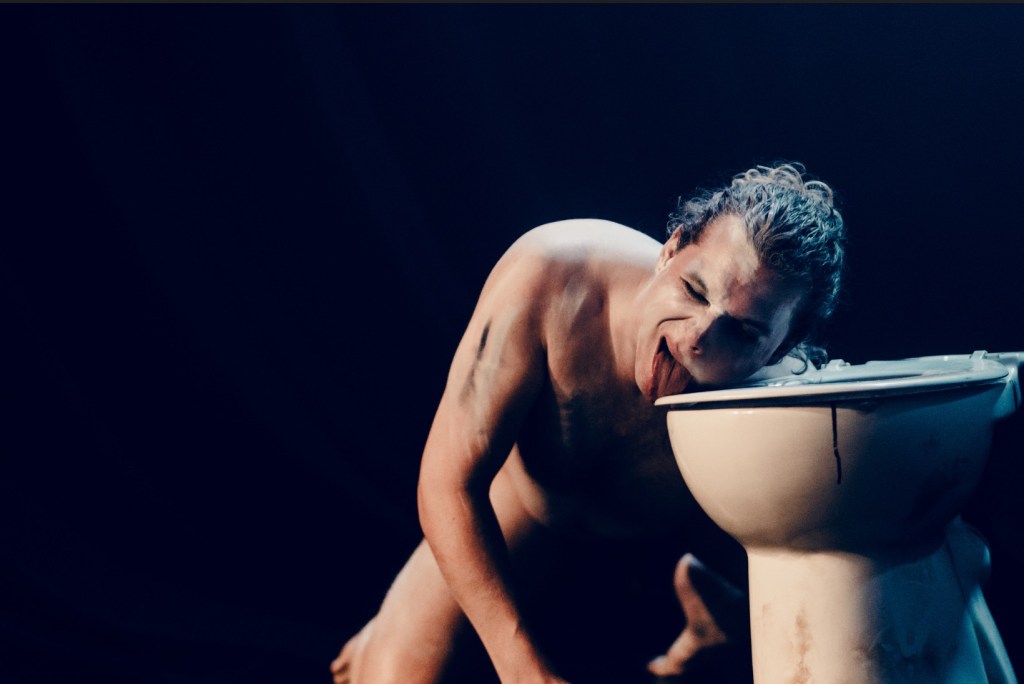
Naked, unkempt and crudely painted, there’s also something of the clown, the shaman, the tragedian, and the unreconstructed Northern club circuit comedian about Scott-Rowley. He’s by turns inviting, threatening, charming and utterly magnetic. The nakedness isn’t for titillation but to give a sense of the primal about this sort-of apocalyptic solo vaudeville that is sometimes too esoteric to be fully comprehensible but is more often hypnotic and surprisingly hilarious. The lone toilet on stage, and which is the only set we get, feels indicative of the show’s attitude to existence….as though this is where humanity is heading. It’s a funny conceit, but also a nihilistic one.
Although male genitalia are clearly on display, Scott-Rowley is a curiously androgynous figure for much of the performance, a sort of conduit and representative of humanity in all its squally, plaintive, anxious imperfection. You Are Going To Die seems calculated to unsettle, amuse and baffle in equal measure, and it succeeds.
This was a sell out sensation at Edinburgh and the Vaults festival, and it’s not hard to see why. Scott-Rowley’s astonishing performance is augmented only by the aforementioned toilet, Matt Cater’s evocative, majestic lighting design and a doom-laden sound score. It’s simultaneously simple and hugely challenging. Prepare to laugh a lot, gasp in sheer astonishment…and take part in the most ribald audience singalong you’ve ever heard.
About an hour of this level of intensity and insanity is probably about as much as anybody can cope with, but it really is a hugely rewarding piece of theatre. And even its detractors can’t cry emperors new clothes…as he’s all too aware that he isn’t wearing any. Strangely life-enhancing stuff, for all its desolation and shock value.
There’s a lot of theatrical snobbery around the jukebox musical genre – for every & Juliet or Our House, there’s a Daddy Cool or a Tonight’s The Night – but when a show is as fresh, well-crafted and just flat-out delightful as this new Broadway tuner built around Huey Lewis’s apparently inexhaustible song stack, resistance is futile. That’s particularly true when Jonathan A Abram’s genuinely funny and touching script and Gordon Greenberg’s effervescent production are good enough to stand up to pretty robust critical analysis while at the same time giving audiences a really wonderful time.
This might be the best integrated jukebox musical since the Madness-Tim Firth-Matthew Warchus Our House in that, if you walked in not realising that Huey Lewis and The News are a platinum selling band, you’d probably assume this was a custom built 1980s-set rom com studded with catchy soft rock numbers created for this specific story. That’s no mean feat, but The Heart of Rock and Roll wears its artfulness lightly.
The plot’s not exactly challenging: nice guy Bobby who gave up on his rock band stardom dreams for a steady pay check in a cardboard box factory (try to contain your excitement) gets fired for a costly mistake, is reinstated when he redeems himself, gets involved with the boss’s daughter and finds his music career possibilities reignited at the most inconvenient moment. So far, so anodyne…but Abrams populates his story with such a sweetly eccentric rogues gallery of characters and writes with such wit and feeling, that what could have felt tediously predictable comes off as warm, quirky and surprisingly satisfying. It also finds an interesting tension in Bobby’s dilemma, and the ending is slightly unexpected.
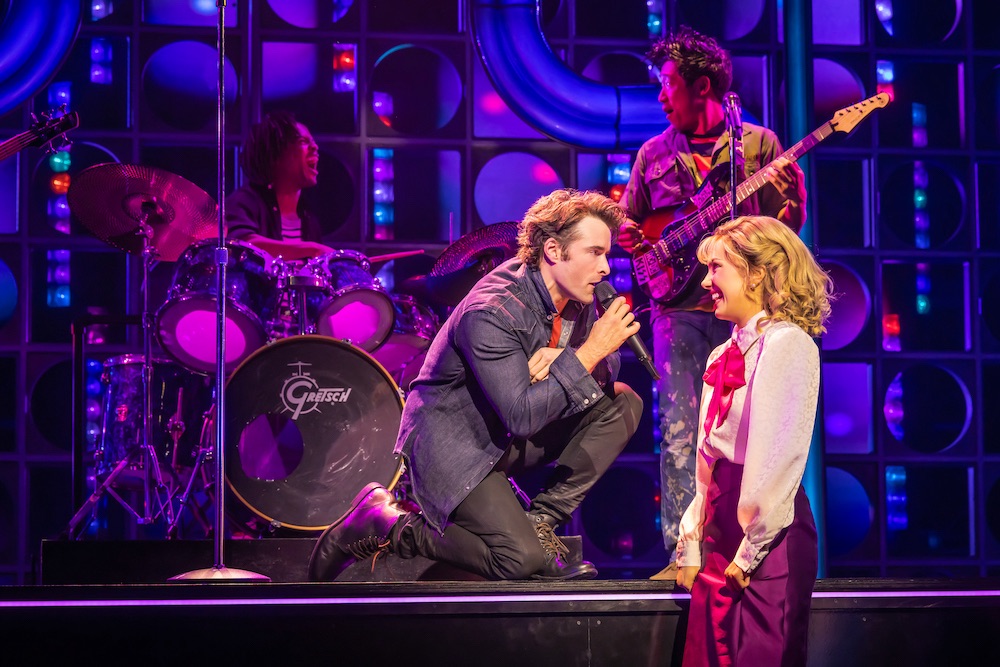
It also helps that in leading man Corey Cott the show has a bona fide heartthrob, one who sings and swaggers like a true rocker, has charm and vulnerability, can point a funny line, and looks, frankly, gorgeous. He’s reminiscent of a young Hugh Jackman, even down to the musculature, and is so adorable it’s impossible not to root for him. That proves especially valuable later in the second half when he breaks down in a cri de cœur solo lamenting his fractured relationship with his now departed father. It provides a surprisingly powerful emotional centre to what is elsewhere mostly a fun, light-hearted show. Opposite him, McKenzie Kurtz is every bit as fine, investing superficially uptight Cassandra with a kookie manic edge and real heart, in a performance that sometimes recalls Jane Krakowski at her most sparkling.
Other stand-outs include Orville Mendoza as a marvellously bizarre Swedish tycoon, Billy Harrigan Tighe as an oleaginous, ruthless corporate player with designs on Cassandra (look out for the hilarious nightmare -as opposed to dream- ballet where she envisions the matrimonial horrors ahead as his bride) and F Michael Haynie, Raymond J Lee and John-Michael Lyles as Bobby’s bandmates, a trio of man-children whose weirdness is matched only by their heartwarming steadfastness. Broadway veteran John Dossett brings a nice dose of sincerity as Cassandra’s Dad. The superbly drilled ensemble execute Lorin Latarro’s high energy, often highly inventive choreography with skill and gusto (there’s a particularly fun dance on bubble wrap that’s as invigorating as it’s silly, and a bonkers aerobics number).
Best of all there’s Tamika Lawrence as Bobby’s best mate, who is also the not-always PC HR manager in the factory. Lawrence has the god given ability to make any line funny, and when she lets rip vocally….consider yourself blessed. Roz, Lawrence’s character, is gay but it’s only lightly touched upon and in a way that is neither sensationalist nor patronising, another instance of this good-hearted charmer of a show getting it absolutely right.
Derek McLane’s sets, Jen Caprio’s costumes and Nikya Mathis’s wig and hair creations all embrace the 1980s aesthetic with eye-popping, colourful flamboyance that never tips over into the grotesquerie that can sometimes happen when revisiting the decade of big hair, shoulder pads, leg warmers etc. The band and voices are all superb and, if the wrapping up of the plot feels a tad contrived, that’s a minor misstep in a massively likeable show.
The Heart of Rock and Roll isn’t trying to reinvent the genre, but as a crowd-pleasing piece of nostalgic entertainment, appealing equally to the eyes, ears and heart, it succeeds triumphantly. It’s sometimes reminiscent of other shows – The Wedding Singer and Back to the Future, both set in a similar time period and the latter of which it shares ‘The Power of Love’ with as a finale, spring immediately to mind – but this is arguably better put together than either of these despite not being an original score, and ultimately it works on its own terms. “Do you believe in love?” goes one of Huey Lewis’s biggest earworms, used repeatedly here. The answer is a resounding yes.
The struggles and setbacks encountered by the women’s suffrage movement is an incontrovertibly important matter and one of many admirable things about Shaina Taub’s worthy tuner, now on Broadway after considerable reworking from its original Public Theater run, is that it presents these grim challenges with equal parts gravitas and lightness of touch. A common accusation levelled at musicals trying to tackle “big” themes is that the song and dance treatment risks trivialising the serious points being made (much of Sondheim, Jason Robert Brown and of course Hamilton and Cabaret are notable exceptions), but nobody is likely to accuse Suffs of that either. Whatever its flaws, this bold new musical takes a clear-eyed, unsentimental look at not-too-distant American history, and appraises it with a cool head, a fire in its belly, and considerable wit.
On paper, Suffs sounds like the American answer to the Old Vic’s Sylvia, which filtered the English suffragists stories through a modern lens, including hip hop and rap, and came off a bit like a Brit Hamilton wannabe. However, in chronicling the history of American suffrage and the battle for women in the United States to get the vote, Taub’s compositions are more timeless, taking in influences from vaudeville, traditional Broadway, and the sort of anthemic chorales that characterised the pop operas of the 1980s and 1990s. There are some ballads too, usually performed by Taub herself as chief agitator Alice Paul, but they tend to be reflective and gentle rather than bombastic. It’s a pleasant score, and intermittently very rousing, but not an especially memorable one.
The all female company, fine voices all, sing it as though their lives depend upon it (which, in a way, they do) and Jason Crystal’s sound design and Michael Starobin’s subtly effective orchestrations ensure that the songs are showcased as compellingly as possible. The storytelling in Taub’s script is less successful however. It’s more of an episodic pageant than a conventional musical book, which works insofar as the cause is more important than any individual characters, but it does mean that most of the emotional engagement is achieved through broad, generalised brushstrokes, such as in the raging act one closer (“How Long?”) in which the collective of women attempt to reconcile the loss of one of their leading lights, Inez Milholland (Hannah Cruz in a luminescent Broadway debut), or the gorgeous, galvanising finale, “Keep Marching”, rather than connection to individual characters.
That is partly the point of course, that the sweeping subject is of far more relevance than the plight of individuals, but it can make for theatre that is sometimes repetitious and only intermittently involving. In the second half, the show includes the hunger strikes and force feeding while incarcerated that was endured by these early feminists, and the simultaneous gaslighting of the general public from the offices of President Woodrow Wilson (a chilling but sparkling Grace McLean), but none of this hits with the shocking impact it should, partly because the characters feel more like sketches than fully rounded people and Leigh Silverman’s stylish but sanitised staging seems intent at keeping us at arms length.
A face-off duet between Paul and society suffragist Carrie Chapman Catt (Jenn Colella, incisive, magnetic and customarily stellar) sees the latter change her mind about the former within the space of about a verse, which just feels like sloppy writing. Also, the tensions both within the Black contingent of suffragists and in relation to the rest of the movement are only addressed perfunctorily. All of this is essential, fascinating information but it often doesn’t feel fully fleshed out, as though through a need to keep the show down to a manageable running time.
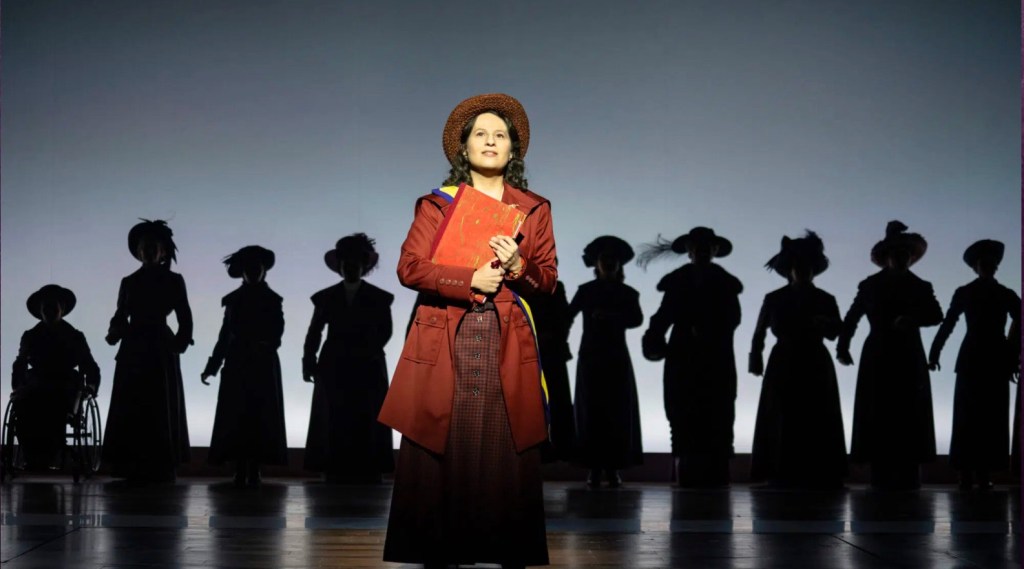
Taub’s achievement here, as book writer, lyricist, composer and star, is extraordinary but one wonders if the piece would be structurally stronger if she had more collaborators. Her singing has an attractively plaintive quality that gives way to a sweet and surprising power in the upper register. She’s a solid actress yet Alice feels strangely unknowable as the centrepiece of the musical.
Ally Bonino and Nadia Dandashi have less stage time but register more vividly as two of her colleagues, and I loved Kim Blanck’s fiery, funny, staunch Ruza Wenclawska, whose self-dramatising histrionics would eventually secure her a career on the stage. Nikki M James finds complex layers in the brilliantly outspoken Ida B Wells and is a potent stage presence. Glorious Emily Skinner injects a welcome jolt of camp as society benefactress Alva Belmont.
Visually, the production is elegant (especially Paul Tazewell’s beautiful period costumes) but sometimes a bit too crisp and clean. There are a couple of ponderous choices, such as the bizarre half-horse creation with which designer Riccardo Hernandez recreates the famous image of Inez Milholland, clad as a symbolic herald, on horseback leading the 1913 Women Suffrage Procession: it’s a striking image for sure, especially when juxtaposed with the giant photo of the actual woman (and horse) that flies in at the end of act one, but the actual structure Cruz’s Milholland is perched upon is distractingly strange to look at, with it’s golden head, white body and neck and legs that appear to be constructed out of coathangers. It’s the sort of prop that looks as though it was cobbled together for rehearsals but should have been replaced for the stage. Elsewhere, Hernandez’s work is spare and unobtrusive, but never, to be fair, cheap-looking.
Ultimately, Suffs succeeds because of its ambition and originality, but most importantly because it talks about a fight that is still going on. It honours the work and sacrifices of the women who looked ahead for the generations of women who would come after them. It’s not a great musical, but it’s a richly significant one, and it doesn’t look or sound like anything else, not even the questionable Roundabout revival of 1776 from two seasons ago and which cast the (almost) entirely male dramatis personae with female and non-binary performers. That felt like a gimmick, but having an all-female cast here is a logical decision borne out by the themes and material.
The ovation at the end of the performance I saw felt as though it stemmed as much from a desire by audience members to stand up and be counted as much it did to acknowledge the undeniable excellence of this cast and (also all female) orchestra, and that’s pretty powerful. I suspect these suffragists will “Keep Marching” on Broadway for quite some time.
Talk about having your cake and eating it. Hell’s Kitchen, the breathtaking, heart-pounding Alicia Keys musical now on Broadway hopefully until hell itself (if such a place exists) freezes over, is both a love letter to the “concrete jungle where dreams are made of” which New Yorkers will watch with pride-filled hearts and damp eyes, and also the quintessential NYC theatrical experience for tourists. Not since Rent, with which it shares director Michael Greif, has a musical so compellingly captured the relentless energy, sharp edges and bruised magnificence of the city that never sleeps. Not even In The Heights, which it also superficially resembles in its depiction of a teeming Manhattan community on stage, achieved this sense of caffeinated urgency tinged with wonder and danger.
Over a decade in the making, Keys’s semi-autobiographical musical, now on Broadway after a sold out premiere at the Public, tells the story of 17 year old Ali (the abbreviated name isn’t by accident) growing up in the 1990s at Manhattan Plaza, the mighty tower block right in the heart of Hell’s Kitchen that provides low cost housing for artists and other creative people. It’s a real building and Alicia Keys really did grow up there. Kristoffer Diaz’s feisty, engaging book charts Ali’s joyous discovery of music, also boys, and her sometimes fractious relationship with her solo parent, mother Jersey (a beautiful, selfless performance by Shoshana Bean, that only becomes showy when she turns up the vocal heat to exhilarating effect).
Diaz’s script namechecks historical Black female musicians via the authoritative, slightly elusive figure of Miss Liza Jane (a sublime, incandescent Kecia Lewis) who spots Ali’s musical potential and nurtures it with tough love and uncompromising excellence. If the unreliable dead-beat Dad, forever promising to show up then failing to do so, is a bit of a cliché, although one superbly played by Brandon Victor Dixon, the character of Knuck (Chris Lee, heartcatching), the tough-looking but honourable street drummer Ali falls for, really is not. Similarly, there’s nothing particularly original about the way the pull-and-push of the mother-daughter relationship is depicted, but it’s so well acted and the dialogue is vital and authentic, so it’s impossible not to get involved.
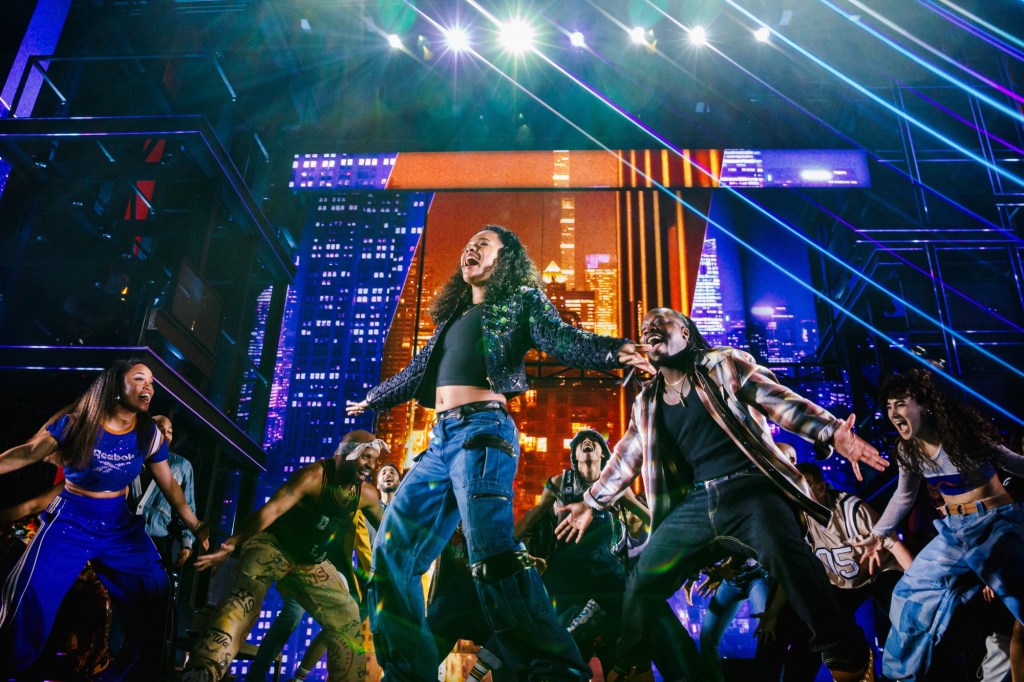
Then when you then throw in Keys’s beloved songbook, a host of thunderously successful technical elements, Camille A Brown’s wild, raw, gorgeous choreography (surely this is the most exciting dancing currently on Broadway) and a truly phenomenal cast, you may find yourself not just involved but catapulted joyously into the stratosphere. Hell’s Kitchen might be the greatest legal high available in New York City right now, even allowing for the fact that cannabis has been decriminalised here.
Yes, it’s really that good: a kaleidoscopic, emotional, visual and aural rollercoaster that captivates non-stop. From the first glimpse of Robert Brill’s complex, gleaming urban jungle set, dazzlingly lit by Natasha Katz, through to the soul-stirring ‘Empire State of Mind’ finale, so thrilling it’s almost an out-of-body experience, Hell’s Kitchen is a full-on New York assault on the senses as much as it’s a traditional musical.
The frenetic chaos of the multicultural Manhattan streets gives way to the oasis of calm that are Miss Liza Jane’s piano lessons for Ali, and number after number threatens to rip the roof off the Shubert (Gareth Owen’s sound design is sensational, as are Tom Kitt and Adam Blackstone’s orchestrations which succeed in preserving the essence of Keys’s original recordings while making the songs sound dynamically theatrical.) Each ensemble member reads as an individual, even when executing Brown’s jagged but graceful dances in unison, and they are all utterly fabulous.
Kecia Lewis closes the first half with a transfixingly powerful version of ‘Perfect Way To Die’, Keys’s mediation on police brutality and racism (“Another dream lost /Another king and queen lost /Another broken promise they refuse to make right”) which is one of the most extraordinary examples of acting through song I’ve ever witnessed. Lewis’s voice is ringingly sweet in its upper register and like a growl of deep-rooted pain in the lower. She’s stunning. The unbridled joy of ‘Girl on Fire’ and a glorious new song written especially for the show, ‘Kaleidoscope’ (staged with a kinetic vitality that stirs the soul) is equally moving, but for very different reasons.
At the centre of it all is newcomer Maleah Joi Moon as Ali, delivering one of the most blazingly impressive debuts within living memory. Tiny in stature but mighty in everything else, she captures the rangy freshness of Keys’s vocals but without resorting to impersonation. Her acting is wonderfully alive and in-the-moment, she has the comic instincts and the emotional depth of a seasoned pro decades older, and makes Ali a tough but infinitely lovable go-getter. She’s lost yet cocky, ambitious but never obnoxious, even when warring with Bean’s memorable Jersey. She gets a little croak in her voice at moments of high emotion that tears at your heart, and has an irresistible energy and edge. It’s a platitude, but a star really is being born here.
Greif’s direction and Brown’s often witty choreography, with influences from Alvin Ailey to street dance and much in between, marry whirring restless energy with complete clarity. Batteries of lights spin and whirl, great walls of sound surge through the theatre and the multilevel set, with musicians arranged in towers on either side of the stage, is in constant motion, augmented most pleasingly by Peter Nigrini’s colourfully inventive projections…technically the show is an absolute marvel, yet never at the expense of the humanity at the core of this compelling story.
Vibrant, transformative and just damn beautiful, Hell’s Kitchen is the sort of show that makes you fall in love all over again both with the theatre and with New York City. To misquote one of Keys’s lyrics, “this show is on fire”….and it’s on fire ‘cos it’s dynamite.
There is a common perception that while Americans are peerless at producing high energy musical theatre, we Brits have the monopoly on straight drama in the English speaking world. Obviously, there are exceptions, such as Williams, Miller, Wilson and O’Neill to name a few, but traditionally the received wisdom is that Broadway excels at musicals, while we are superior at the non-singing and dancing stuff. A play like David Adjmi’s engrossing Stereophonic, newly transferred to Broadway after a sold out premiere run at Playwright’s Horizons, poses a mighty challenge to those archaic preconceptions though.
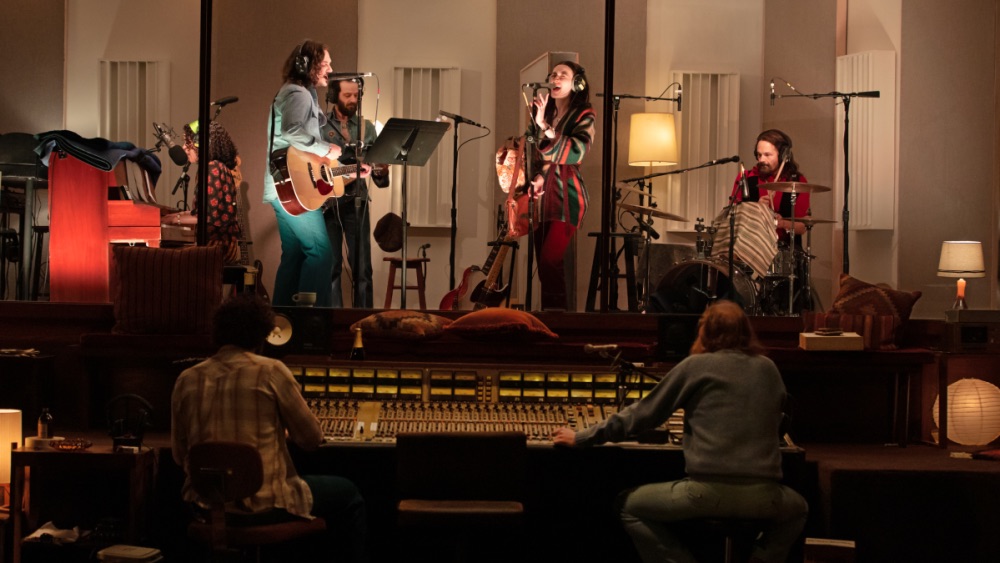
Like the works of Annie Baker and Stephen Karam’s 2016 Tony winner The Humans, this is one of those great American plays where seemingly nothing much happens…and yet everything happens. This rewarding slow-burner charts, with forensic precision, piercing wit and a clarity of vision that the characters themselves seldom possess, the progress of a rock band creating a career-defining album. It’s like a fly-on-the-wall documentary but performed live, and Adjmi carefully, lovingly builds up a picture of these people -their flaws, their insecurities, their loves, their eccentricities- so that they glow before our very eyes, with a rare richness of colour and detail. The first couple of minutes are bewildering, as the characters talk over each other, speak at levels and speeds that are naturalistic but not immediately accessible, but stick with it….
So sublime and real is the direction of Daniel Aukin and the flawless cast of seven (all but one of whom are Broadway debutants) that it’s hard to know where Adjmi’s script ends and the brilliance of the production takes over. It hardly matters. The play deals with the sometimes fraught, often random nature of the creative process, and of how success and validation can wreak havoc on personal relationships. Across three hours duration and a two year timespan (1976-77), the group’s journey from amazement at their new found success to ragingly huge egos, is beautifully managed.
Will Brill’s mercurial, meticulously well observed bass player Reg transforms from alcoholic, drug-infused mess to holier-than-thou but deluded health freak (watch for his reaction when Eli Gelb’s guileless recording engineer Grover points out to him that he does in fact still drink). Two romantic relationships break down irretrievably. There’s a particularly amusing second act scene where a couple are bickering vitriolically to the evident discomfort of the singer standing between them, but are able to instantaneously snap out of it to produce the most exquisite harmony.
A mesmerising Sarah Pidgeon brings Meryl Streep levels of truth and emotional engagement to Diana, the lead singer whose relationship with diva-esque, almost cruelly disengaged band leader Peter (Tom Pecinka) is imploding even as they try to make music together, and whose career may be on the verge of going stratospheric independently of the group. She nails the vulnerability of a young woman whose personal life is being torn apart while simultaneously suggesting the dual veins of insecurity and self belief that run through the core of true artists. Pidgeon is thoroughly convincing, even musically, with a rangy, haunting plaintiveness to her vocal timbre that recalls Stevie Nicks.
Pecinka and Brill are magnificent, capturing every aspect of their complex, often infuriating characters. Gelb and Andrew R Butler are cryingly funny yet oddly touching as the engineers trying to preserve some level of self respect while managing the band’s often outlandish behaviours. Despite wavering accents, Juliana Canfield and Chris Stack contribute invaluably as two English members of the group, she reassuringly stable until she absolutely isn’t, and he covering personal emotional pain with a veneer of scabrous sarcasm. The camaraderie between the two women in a predominantly male environment strikes a real chord. There’s not a single moment that doesn’t ring true (accents aside) and the tiniest of details becomes absolutely riveting.
Behaviourally, these people are often nightmares but, and here’s where Stereophonic becomes truly magical, when they find the sweet spot in their music, all is temporarily forgiven. Will Butler has crafted a selection of rock songs – galvanising, affecting, rousing, most of which we only hear fragments of – that aren’t just authentic, they’re completely wonderful. Like, this is an album one would go out and buy. The music is fully live, and the whole play becomes testament to its power to express, heal and uplift.
Presenting artists on stage agonising about their art can be tricky: if you don’t show any of the ‘work’ then audiences can feel cheated, but if you do present a taste of it and it isn’t very good (Steven Pimlott’s original NT production of Sunday in the Park with George is a case in point, where the act two Chromolume was eye-rollingly pretentious) it potentially invalidates everything you’ve been trying to point out about creative struggles. From this point of view however, Stereophonic is an utter triumph, these songs sear and soar.
That triumph extends further to David Zinn’s richly textured, intricate set, a hermetically sealed band box atop a scruffy but homey communal area, so evocative you can almost smell it, centred around a gigantic mixing desk. Ryan Rumery’s sound design is a masterpiece, balancing the two environments, and finding both the human and the monumental. It’s fascinating, even moving, such as in the final moments where Gelb’s lovable, shell-shocked Grover, alone in the recording studio, plays around with tracks, isolating then adding, making the full sound we’ve been listening to, then dismantling it, until we’re left with just the human voices, breathy, harmonious and timeless.
In all honesty, it is a bit long: Canfield’s Holly gets to deliver a lengthy pontification on the movie thriller Don’t Look Now that, although beautifully performed, distends an already punishingly lengthy second act, and doesn’t really add anything. Also, it takes a few minutes to tune in at the top of each act. For a piece that so steadfastly refuses to ingratiate itself (although the irresistible humour is an undeniable palliative), it’s still astonishing to see and hear the effect this show has an audience; the night I attended you could’ve heard a pin drop at key moments, and the ovation at the end was like being at an actual rock concert. I would imagine this’ll be a front runner for every Best Play award going, and will be seen in countless international productions. Sonia Friedman is one of the producers so it could well end up in the West End, although it wouldn’t look out of place at the National or the Almeida. If there’s any justice, wherever it ends up, it’ll be with this glorious original cast.
Featuring a reworked book by TV writer and comedian Amber Ruffin and dances by Beyoncé’s choreographer of choice JaQuel Knight, that owe more to Hip-hop, Dancehall and Urban Ballroom than traditional Broadway, this is less a revival than an all-out revisal of the beloved Charlie Smalls-William F Brown property. The Wiz was always a triumph of exuberance and bravura belting over craft anyway, albeit one that ran for more than 1600 performances in its original Main Stem iteration, so an attempt to drag it kicking and screaming into the 21st century is unlikely to have purists bellowing from the rooftops with outrage.
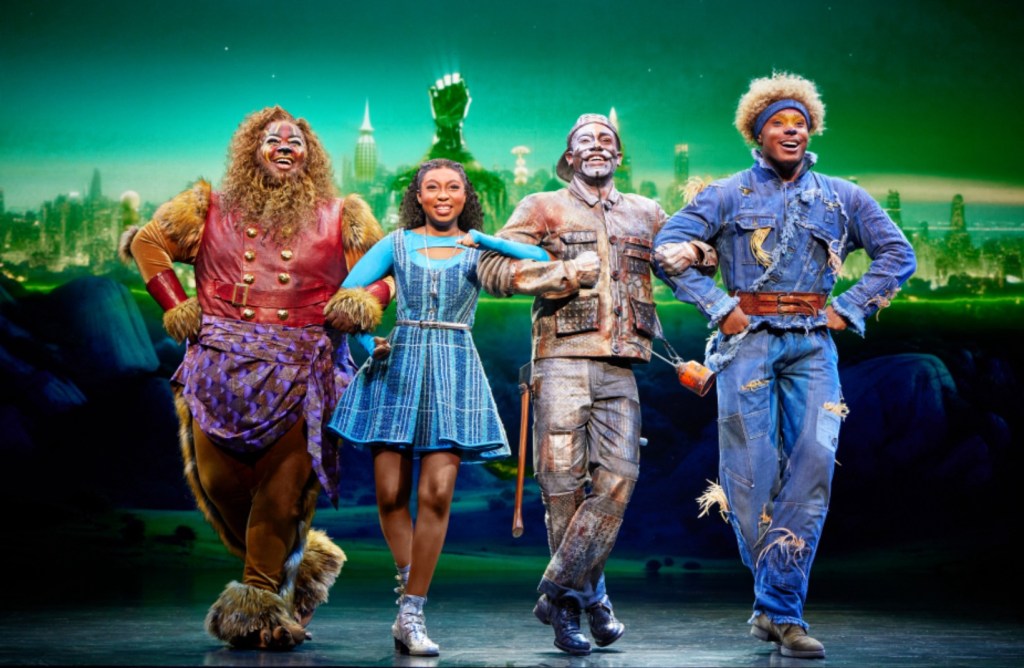
They may be disappointed at the excision of Toto (losing a dog in real life is always a terrible idea but, as the recent London Palladium Wizard of Oz proved, having a puppeteer onstage throughout to evoke one à la War Horse can be an unwelcome distraction) and surprised at heroine Dorothy’s new back story: she’s now an urban youngster adrift in a rural landscape following her mother’s death, bullied by local kids and trying to make a new life with her Aunt Em. Her grief and isolation isn’t belaboured but it lends a raw, streetwise edge to newcomer Nichelle Lewis’s interpretation of the role that genuinely ups the emotional ante in a show that otherwise comes at you like a garishly coloured, hi-energy juggernaut of camp and go-for-broke enthusiasm.
Lewis is a real find; this Dorothy is clear-eyed, sincere but no pushover, and she makes something passionate and affecting out of the much covered soul ballad ‘Home’ that brings the show to a stirring, if somewhat abrupt, ending. Director Schele Williams has surrounded her with quality. It’s hard to imagine a more engaging central quartet than Lewis, Avery Wilson (as an athletic, über-camp scarecrow barely a z-snap away from RuPaul’s Drag Race), Phillip Johnson Richardson (an adorable Tinman with a sweet soul voice and a surprising amount of emotional depth) and Kyle Ramar Freeman’s hilarious, scenery-chewing sweetie of a Lion (“y’all are obsessed with me!” he squeals at his new friends, and frankly who could blame them for being). High octane and far-fetched it may all be, but these young performers, short on Broadway credits as yet but big on authentic star quality, make rooting for them entirely essential.
Then there’s clarion-voiced Melody A Betts in a fiery, funny double role of Aunt Em and a vicious yet strangely endearing Evillene. Allyson Kaye Daniel is fabulous but criminally underused as one of the good witches, while recording star Deborah Cox, all blonde curls and elaborate riffing, is fine but a trifle underpowered as Glinda. The other lead with marquee name recognition is Wayne Brady in the title role and he brings buckets of slippery charm and magnetism, and gets to bust out some pretty impressive moves. The ensemble work is terrific, even when given some less-than-inspired things to do, such as the interpretative dance of the hurricane that whisks Dorothy off to Oz (it may be an homage to the original but it’s still naff) or the slightly toe-curling business for the yellow brick road made flesh, clad in what look like saffron coloured beefeater outfits.
Those aberrations aside, Knight’s choreography is exciting, bringing a new dance language to Broadway. The voguing-heavy Emerald City ballet that opens the second half is pure exhilaration, full of attitude and limb-popping joie de vivre, whipping an already up-for-it audience into total frenzy. Williams’s direction is more serviceable than distinctive with a couple of disappointing key moments, such as the melting of Evillene which is staged with minimum panache but maximum volume. Still, she finds the comedy (although it’s not hard to locate thanks to Ruffin’s zinger-soaked new script) and, crucially, the heart in this crowd pleaser.
The production’s touring routes are evident in the super-busy video-generated backdrops and slightly wobbly set pieces (courtesy of Daniel Brodie and Hannah Beachler respectively) but that matters surprisingly little thanks to the raw talent out front, and the show is never unappealing to look at. Jon Weston’s sound design isn’t always as clear as it could be.
Joseph Joubert’s band is large by current Broadway standards and sounds brassy, funky and fine. ‘Ease On Down The Road’ ‘No Bad News’ and others pop and sparkle, even if there’s sometimes a feeling that the performances are more remarkable than the actual material. That’s not true though of the anthemic, celebratory ‘Brand New Day’ that follows the demise of the wicked witch…good luck with getting that unique syncopation and soaring melody out of your head for days after watching the show.
In a Broadway season that includes the triumphant resurrection of Merrily We Roll Along, the import of the London Cabaret at the Kit Kat Club and the critically hallowed new version of The Who’s Tommy, this imperfect but uplifting revival of an imperfect but uplifting musical is unlikely to get much love from the Tony awards (although I’d be thrilled to see some of the performances honoured). I’m not sure that even matters: it’s got title recognition, it’s family friendly and this is the first time The Wiz has been on Broadway in forty years, so it feels like an inevitable hit. There are many valid, impressive and searing instances of Black misery and trauma in the theatrical canon, and it’s just lovely to experience a show that simply espouses Black joy. This “brand new day” may not really be all that new, but it surely is a blast.
Inspired by the low budget 2007 comedy horror flick of the same name, Teeth is a wild, vivid and altogether marvellous new off-Broadway musical with a cracking score, terrific performances and, if you’ll pardon the pun, some genuine bite. Set in a creepily devout New Testament Village in small town America, the story turns on teenager Dawn (Alyse Alan Louis), step daughter of fire and brimstone preacher (Steven Pasquale) and suffering from a nasty case of Christian fundamentalist guilt….oh yes, and vagina dentata. That’s right, she’s got teeth ‘down there’ and ultimately she’s not afraid to use them.
Oklahoma! this ain’t. Hell, it’s not even Little Shop of Horrors, which is probably the closest the American musical has hitherto ever got to marrying together the unlikely bed fellows of comic glee and all-out horror, unless you count Carrie which was funny for all the wrong reasons in its original iteration. Teeth is a darker, nastier, more outrageous work than Little Shop, although it reaches similar heights of inspired comic lunacy. Where the latter show has an underlying sappy sweetness, this one is savage. It’s also pretty irresistible.
One of the many wonderful things about Sarah Benson’s staging is that, with the exception of Pasquale’s thrilling, scenery-chomping turns as a gung-ho pastor pitched somewhere betwixt a better looking Billy Graham and Rambo, and a dishonourable gynaecologist who makes Little Shop’s Orin Scrivello DDS look like Mary Poppins, the show is played straight. Accordingly, the ludicrous but infinitely catchy ‘Modest Is Hottest’ duet for tormented Dawn and her milquetoast boyfriend (Jason Gotay) has a worldly New York audience screaming with laughter but is performed with such sincerity that the comic stakes are upped only higher.
Sensational Alyse Alan Louis fleshes out Dawn’s self-abasement, uncertainty and anguish with such conviction that it’s almost hard to watch, and if she’s funny (which she unquestionably is) it’s because co-creators Anna K Jacobs and Michael R (A Strange Loop) Jackson have given her lyrics such as “my panties are wet, and it’s not blood or sweat” which she delivers with nary a nod to the absurdity. This pays off richly when the production and show snap their own tether and Dawn becomes the embodiment of a mythical feminist goddess, righting gender-based wrongs by indiscriminately ripping off male genitals with her voracious, razor sharp downstairs department. It’s completely nuts (again, no pun intended) of course, but done with such craft and ferocious go-for-broke commitment that it’s pretty hard to resist.
That said, the gear change between angsty hilarity and full-out batshit crazy is handled quite clumsily at the moment. Although Teeth has, and should have, jagged edges as a musical, the alteration in emphasis and tone feels fudged and rushed. That’s frustrating as there are specific moments – such as an authentically chilling number where Pasquale’s preacher whips his rebellious biological son (Will Connolly) to agony after catching him masturbating – where the lightning fast switches in tone really work for the show. This is equally true of the contrast between the sunny, glazed-eye evangelism of the perennially pure Promise Keeper Girls in the congregation and the murky, cowed group of threatened, lonely young men, the self-appointed Truthseekers, who meet online to bemoan their beleaguered masculinity. It’s witty and disturbing.
I also feel it would benefit from an interval. Although it runs just under two hours, which fly by incidentally, there is a lot to process here, from the shock value to the sheer rollicking bonkers-ness of it all, and there is a point just after Dawn performs her first, er, mutilation, where a break naturally occurs. It would give audiences a breather and, most probably, the chance to chat about how much they’re loving it and will be recommending it to their more broad-minded friends. Leaving the theatre after yesterdays matinee, on a considerable high, I was hearing comments from various people along the lines of “that’s the best thing I’ve seen in ages” and “I can’t wait to come back”.
So, this has the potential to be massive. It’s too rude for family audiences and possibly too graphic for the squeamish (the prop department has provided some very convincing male members that are hurled around with gusto at key dramatic moments, along with lashings of fake blood) but it feels of the zeitgeist with its twin themes of the life-strangling hypocrisy behind religious fervour, and feminism taken to a murderously extreme conclusion. Most crucially, the songs are well-crafted, eclectic bops, reminiscent at times of a more twisted Spring Awakening. The sense of the wells of pop, folk and gospel being subtly poisoned feels absolutely, consistently right; some of the writing is white-hot, and the whole thing is a heck of a lot of unsettling fun.
There’s not a weak link in the cast. Gotay never overplays the apparently wholesome jock whose true colours land him in blood-curdled waters, and Connolly finds troubled, troubling layers in the disaffected preacher’s son. Jared Loftin is hilarious as the unhinged ally whose motivation for befriending the unhappy Dawn is more to do with seeking absolution for his rampant gay-ness than actual altruism. The six-strong ensemble of smug schoolgirls who transform into vengeful, sexually voracious harpies is just fabulous. The singing throughout is roof-raisingly fine.
Moving forward, the show will need sensitive but fearless producing to fine tune and aim it at a wider audience that will cherish it. Teeth is simultaneously puerile and sophisticated, snarky and sincere, and many of its elements require some polishing but not to gleaming blandness: a huge part of the shows appeal is down to how “out there” it feels. It’s more subversive than Heathers and kinkier than Rocky Horror.
Not all of Raja Feather Kelly’s bump-and-grind choreography feels necessary and Adam Rigg’s aggressively ugly set, all nondescript beige walls, neon cross and hideous cheap scarlet carpet, could do with an upgrade when the show gets its inevitable longer life, although its apocalyptic transformation is quite something to behold. Jane Cox and Stacey Derosier’s lighting and Jeremy Chernock’s SFX designs are very effective.
Previous musicals that Playwright’s Horizons have nurtured prior to Broadway include Sunday in the Park with George, Once on this Island and the aforementioned first post-pandemic Tony winner A Strange Loop. This one equally deserves longevity, although whether its natural place is on the frequently homogenised, financially treacherous main stem is a question. Either way, this is a rambunctious good time in the theatre, and one I would happily, if uncomfortably, sit through again in a heartbeat. Culty, gory and unforgettable.
This is a fascinating and important addition to the canon of modern gay plays. Foam feels highly unusual, exploring in a quintet of tense, compulsive scenes, with salty, raw dialogue, the comparatively uncharted (at least in theatrical terms) intersection between far right, neo-Nazi politics and the gay community. It’s inspired by the true story of notorious far Right skinhead Nicky Crane, recruited from a deprived upbringing into the British fascist movement while just a boy, whose terrifying reputation for violence and viciousness belied the fact that he was actually gay. He died of AIDS-related complications in 1993.
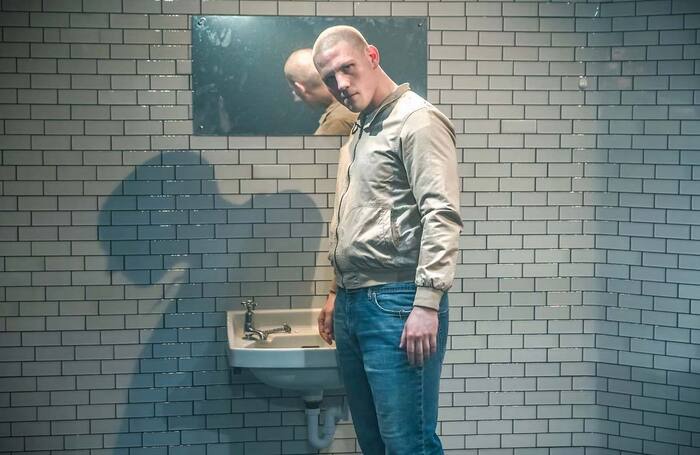
There are shadows of Schnitzler’s La Ronde in the way the sequences dovetail together, as Nicky (played with a wild intensity by Jake Richards) goes on his personal odyssey, taking in jail spells, fledgling careers in music and porn, covert sexual activity, and finally as a barely functioning husk in an AIDS hospice. The writing is brutal, muscular, rude, but more honest than it is sensationalist. Harry McDonald has created a refreshingly original work, as vital as it is disturbing.
In a delicious piece of historical-literary trolling, McDonald’s opening scene features a mythologised version of Oswald Mosley, played with an appropriate mixture of precious superciliousness and ruthlessness by Matthew Baldwin. One can only hope that evil Oswald, founder of British fascism and leader of the infamous Blackshirts, would be suitably appalled to to be portrayed as a kinky old aristocrat who requisitions under-age working class boys in public lavatories (each scene happens in a different washroom, on Nitin Parmar’s dingy but gleaming unit set), luring them with gifts, cigarettes and amyl nitrate.
Although there’s nothing to admire in the character, McDonald doesn’t invest Nicky with any self-pity. His companion (Baldwin again, impressively contrasting his earlier role with a beautiful study in tough but tender) chides him for thinking of AIDS as a punishment for his past misdemeanours. That in itself throws up an interesting moral conflict, in that the horrors of AIDS shouldn’t be visited upon anybody, yet it’s hard to feel pity for somebody who so single-mindedly terrorised anybody who didn’t fit into his pitifully narrow world view. Richards is truly remarkable, giving Nicky a brutish charisma and an inner life that the character could never begin to articulate. The constant thrum of violence is deeply troubling but so are the occasional glimpses of the dispossessed child recruited and manipulated by more sophisticated power players such as Mosley.
Matthew Iliffe directs with scalpel-like precision. Every look, covert or open, every gesture, every movement matters. There’s also a sense, dream-like, enhanced by Jonathan Chan’s lighting and David Segun Olowu’s sound design, that the whole thing is taking place outside chronological time, so that Nicky’s grim tale resonates strongly and lamentably in the present day.
There’s terrific support from Kishore Walker doubling as a young photographer and a porn actor, both realising to their cost that the controversial tattoos and snarling attitude carried by Nicky are not mere style choices. Keanu Adolphus Johnson is bracingly effective as a young Black gay clubber who takes robust steps to fight back.
Foam as a substance is malleable and prone to increasing in volume with manipulation, which is a suitable metaphor for the insidious creeping evil of neo-Nazism and the way Nicky’s strings are pulled from afar by individuals with infinitely more intelligence, influence and power. Foam the play is a deeply moral work; a warning, an acknowledgment and a howl of pain. It’s also cracking but challenging entertainment. I suspect it will have a much longer life following this Finborough premiere run.
It took me a couple of minutes to warm to this HOLE but I’m very glad I stuck with it. That might seem a bizarre way to start a review but then this is a bizarre show, albeit an unexpected, sometimes deeply uncomfortable, treat.
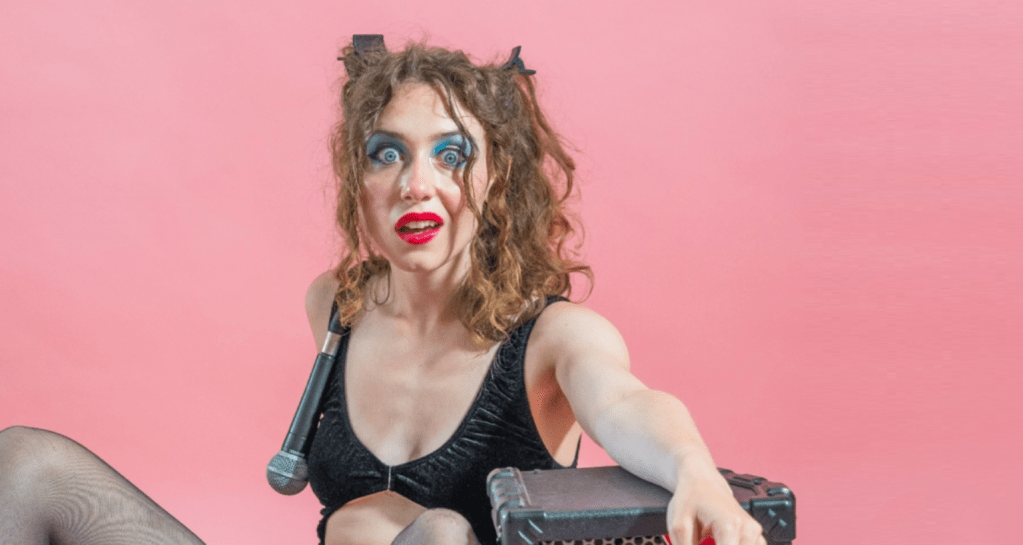
Holly Spillar, wafting in looking like a cross between the door hostess at an eccentric but trendy bistro and Sarah Brightman in her Hot Gossip days, has created a frequently witty, often outrageous and occasional very poignant hour long cabaret, pitched somewhere between stand-up and performance art, inspired by her own vaginismus. For those unaware, vaginismus is a condition whereby the vaginal muscles tighten uncontrollably whenever penetration is imminent, and can be a source of pain and embarrassment to the women suffering from it.
If Spillar wasn’t so likeable and talented, one would still have to applaud her bravery and chutzpah for addressing the condition in this format, and exploding some of the myths surrounding it. By empowering herself, she’s also empowering others, and that’s pretty special.
You wouldn’t necessarily assume that vaginismus could be the basis for a piece of musical entertainment, let alone a rambunctious crowd pleaser. But then you won’t have seen the chaotic but magnetic Spillar, who’s at once ethereal and goofy, with a raw soprano voice that isn’t always easy on the ear but astonishes with its range. She also makes ingenious use of a loop pedal which effectively means that she is her own backing singer(s) and accompanist, except when she’s getting the audience to join in with a jolly singalong about the NHS.
Her comedy instincts are unerring, as she plays everything from a therapist with more than a whiff of Björk about her, some insensitive male doctors and numerous friends and advisors ranging from the hopeless to the offensive. Her ability to morph into different people with just a dip in her voice, change of facial expression and alteration in stance is impressive.
Spillar commands her audience by stealth, the scattershot strangeness of her initial moments giving way to authentic hilarity and moments of genuine shock. You’ll laugh a lot but you’ll also probably wince quite a bit. Life-enhancingly weird and unique: well worth catching next time she’s on.
When it’s done well, O’Neill’s lengthy family drama is a soaring, searing indictment of human frailty and the ties of guilt, blood and co-dependence that bind people together, and when it isn’t, Long Day’s Journey Into Night can seem like an endurance test for audience and actors alike, the title less a description and more a warning. At the moment, Jeremy Herrin’s intermittently riveting but somewhat hesitant revival falls between these two stools.
I say “at the moment” because in a couple of weeks I suspect this script and this cast will be up to full strength, but on press night there were too many moments when the staging and some performances felt curiously undercooked, as though they would have benefited from another week of previews to really get to grips with the epic, unforgiving poetic nature of this classic American text. There are already magnificent individual elements but they don’t, as yet, coalesce into greatness.
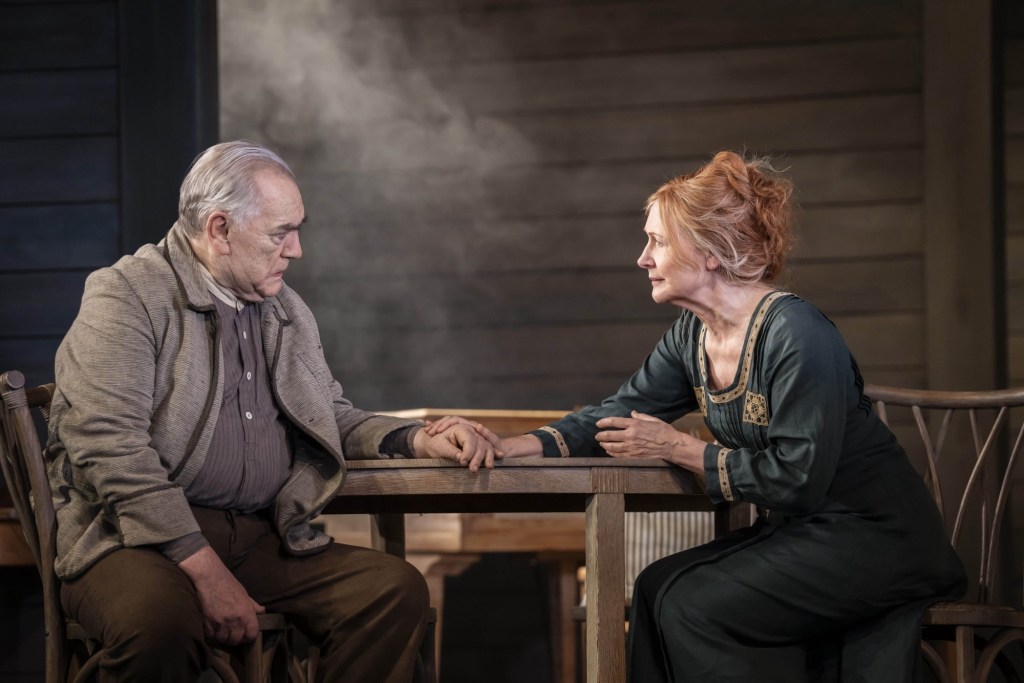
The Tyrone family of the play so closely mirrored O’Neill’s own family story (retired actor father, morphine-addicted mother, one son a drunkard, the other consumptive), that the writer stipulated that it should not be published until 25 years after his own death. Certainly there is a mastery of detail, and a juxtaposition of raw tragedy with often dark humour that has the unmistakable ring of authenticity. The portrayal of Mary Cavan Tyrone, the mother, played here as a wistful wraith with a tang of bracing narcissism by the tremendous Patricia Clarkson, is particularly multilayered, full of compassion but with an unflinching honesty about the fallout from this woman’s addiction and the devastating effect it has on her husband and sons.
Brian Cox’s patriarch, the roaring, hard-drinking actor James Tyrone, has flashes of brilliance. He’s irascible, comically self-dramatising and convincingly wracked with guilt. The extended second half scene with Laurie Kynaston’s magnetically suffering younger son is a masterpiece of boozy anecdotage and fudged filial emotion. He’s less secure though when delivering back-and-forth dialogue, and it’s not clear whether some of the line fluffs are character choices or genuine stumbles. His stage presence is formidable however and this is a performance that will hopefully develop into something richer and more memorable for the right reasons given time.
Opposite him, Clarkson suffers from a similar uncertainty at the beginning but grows in stature as Mary withers, disheveled, before our eyes. The ghost of the conceited but devout young beauty is present in this Mary’s haunted gaze, and in the chilling, lightning fast switches from bathos to imperiousness. Clarkson shows us simultaneously the helpless selfishness of the addict and the equally helpless love of a mother for her children. Clarkson is American acting royalty and there are multiple moments in this performance that demonstrate precisely why.
There’s fine work from Kynaston, and Daryl McCormack invests his dissolute older brother with an authentic rage and sense of lost control. Perhaps the most satisfying performance, and certainly the one that ignites the whole production with a welcome jolt of energy in her all-too-brief scenes, comes from Louisa Harland as the spiky, sassy Irish maid emboldened by the whisky an increasingly strung out Mary plies her with in an attempt to beat back the engulfing loneliness.
Everything about the production, from Lizzie Clachan’s design to Jack Knowles’s dim lighting and Tom Gibbons’s doomy sound design and music, is classy and muted, so as not to detract from the central protagonists and drama. The problem is that, currently, the core of the show isn’t potent or focused enough to sustain the punishing length…the second half alone runs at over 100 minutes. The uninitiated will likely still realise they’re in the presence of greatness, but for swathes of the evening the raw power of O’Neill’s mighty drama is as elusive as the fog metaphor that permeates the text. It’s worth seeing but, as yet, it’s not essential.
 ajhlovestheatre